



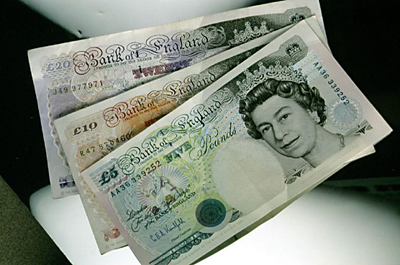
 LONDON: Sterling was steady against the dollar and the euro on Thursday but could cede ground if the Bank of England opts for a larger-than-expected stimulus to support the struggling UK economy.
Investors have already priced in a 50 billion pound cash boost, or quantitative easing from the central bank when it announces its decision at 1100 GMT on Thursday.
But there are a few in the market who are expecting it opt for a 75 billion pound injection and possibly a cut in the bank rate which would be very bearish for the pound, traders said.
Sterling was flat against the dollar at $1.5590, well below this week's high of $1.5723 with offers cited above $1.5650/60. If the BOE surprises, the pound could ease to its June 28 low of $1.5485 in a knee-jerk reaction, traders said.
The pound showed little reaction to data which showed British house prices rose unexpectedly in June.
The pound was also flat against the euro, with the single currency at 80.30 pence, not far from a recent low of 79.85 struck late last week.
"The best way to play the BOE decision is to position for more downside in sterling/dollar," said Geoffrey Yu, currency strategist at UBS. "People will be a bit cautious against the euro given the ECB rate decision is just a few minutes later."
The European Central Bank is also widely expected to cut rates by 0.25 percent on Thursday, and that will weigh on the euro. ECB President Mario Draghi holds a press conference later in the day and there are expectations he may lay the ground for more easing in coming months.
And while more quantitative easing is usually be seen by the market as negative for sterling, many analysts expect the pound to gain against the euro as worries about the euro zone debt crisis offset looser UK monetary policy.
Many also view the BOE's move to ease monetary policy as a pre-emptive one which is contrast to the ECB where pressure is building on it to announce more stimulus and support the euro zone economy that is on the brink of a recession.
Still, sterling is likely to struggle against the dollar and higher-yielding currencies like the Australian dollar in the near term as UK data provides more evidence that the economy is in the midst of a protracted recession.
Data earlier this week showed the purchasing managers' index for services, which accounts for around three quarters of output, fell to an eight-month low of 51.3 in June.
That followed weak PMI surveys on manufacturing and construction earlier this week and suggested the UK economy may have contracted for a third consecutive quarter in the June quarter.




















Comments
Comments are closed for this article.