



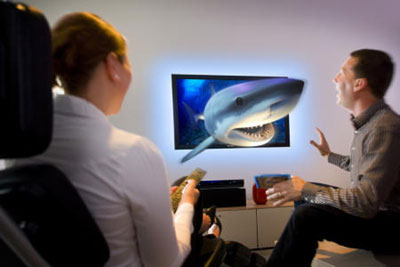
 SEOUL: South Korea's electronics giants are engaged in rare public mudslinging about whose 3-D television technology is better, as they battle for a greater share of a potentially huge global market. Samsung Electronics and LG Electronics, respectively the world's largest and second largest flat-screen TV makers, each claim their technology offers more vivid images and wider viewing angles. The two firms, both driven by newly-appointed leaders, are striving to set the 3-D industry standard. Market researcher DisplaySearch forecasts that 3-D will account for 41 percent of all flat-screen shipments worldwide by 2014, compared to two percent last year. LG champions a technology called film-patterned retarder (FPR), while Samsung uses so-called active shutter glass technology. The two conglomerates rarely attack each other's products but a war of words began in January at the Las Vegas Consumer Electronics Show. Exchanges heated up last month when LG reportedly described Samsung's 3-D technology as a generation behind. The following day, a Samsung Electronics press release said the difference between its product and that of its competitor was "one of night and day". On Tuesday Samsung again attempted to rubbish its rival. Kim Hyeon-Seok, executive vice president of Samsung's visual display unit, described LG's claim that its 3-D TVs offer wider angles than Samsung's as "an attempt to deceive consumers" and criticised the company as "having no conscience".
"It is unacceptable that LG claims that FPR is better than active shutter glasses when the whole world says otherwise," Kim said. Samsung has even published a print ad featuring a popular actor next to a small monkey, both wearing special glasses for 3-D viewing. The monkey's caption reads "Why is my 3-D TV not fully high-definition?" Samsung denies the monkey symbolises LG. LG was scheduled to hold a press event on Thursday to publicly compare the two companies' products to "clear up confusion among consumers". After the success of blockbusters such as Avatar, major TV manufacturers have scurried to produce better and more affordable 3-D home technology. Samsung Electronics was the world's top maker of 3-D TVs by shipments in the fourth quarter last year with a 37.2 percent stake, according to DisplaySearch. Japan's Sony and Panasonic respectively came next, followed by LG Electronics with 5.6 percent. Both the South Korean giants are battling for market share under new leaders. LG Electronics in September elevated founding family member Koo Bon-Joon to CEO after his predecessor quit over flagging earnings. Jay Y. Lee, the only son of Samsung chairman Lee Kun-Hee, was promoted to president of Samsung Electronics last December. Greg Oh, an analyst at HMC Investment and Securities, called the feud "psychological warfare" partly aimed at boosting each company's reputation among consumers less willing this year to buy new TVs.
"Demand for new TVs this year is deemed low as many consumers already own new LCD and PDP TVs so the firms may need something to boost their standing among consumers even slightly," he told AFP.
"But this whole marketing fuss attacking each other looks very childish, unproductive and incomprehensible."























Comments
Comments are closed for this article.