



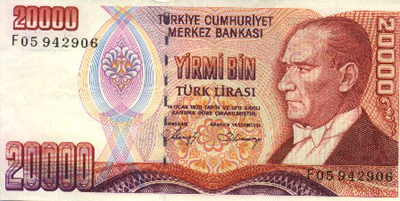
 ISTANBUL: The Turkish lira fell against a strong dollar on Friday, holding above recent lows after the central bank cut the size of its repo auctions and signalled it might narrow its interest rate corridor, which boosted bonds.
A confidence survey indicating that consumers remained pessimistic in their expectations added to indications that the Turkish economy is slowing.
By 1024 GMT, the lira traded at 1.7997 versus the dollar, down from 1.7966 late on Thursday but well above Wednesday's seven-week low.
"The central bank's liquidity reduction may help the lira but if there isn't a significant recovery in global markets we don't expect the lira to firm much," said Tufan Comert, strategist at Garanti Securities.
The bank sought to underpin the local currency by tightening lira liquidity, cutting total funding in one-week and one-month repo auctions to 45 billion lira on Friday from 51 billion in early March.
The lira touched it weakest level since Jan. 25 at 1.8140 in after-hours trade on Wednesday, dragged down by concerns about Turkey's bloated current account deficit and by a global dollar recovery.
Against its euro-dollar basket, the lira traded at 2.0757, slightly weaker than 2.0735 on Thursday.
The central bank has sought to defend the lira while also keeping inflation and a huge current account deficit in check as well as supporting the economy as growth starts to slow.
That has led to a complex policy mix based on variable daily injections of lira funding, a flexible corridor between base lending and borrowing rates and high bank reserve requirements.
The bank's governor Erdem Basci said on Friday the rate corridor - the gap between an overnight borrowing rate of 5 percent and a lending rate of 11.5 percent - could be narrowed somewhat if the need arises.
Turkey's two-year benchmark bond yield fell to 9.33 percent from a previous close of 9.37 percent.
"The narrowing of the interest rate corridor may help bank funding costs to fall. Coupled with the decline in inflation and current account deficit, this could support the bond market," said a fixed-income trader at one bank.
Tighter lira liquidity, meanwhile, usually pushes bond yields up because it forces the banks to sell some of their bond holdings to meet their funding needs.
Basci also said the economy would post a first quarter growth rate of around zero quarter on quarter and start to recover from the second quarter.
Slower growth may benefit the bond market as it points to lower inflation.
But bond buying was limited on Friday as investors stayed focused on high oil prices and a stronger than expected recovery in the US economy.
Istanbul's main stock index was 1.04 percent up at 61,916 points, outperforming a 0.29 percent decline in the MSCI emerging markets index.




















Comments
Comments are closed for this article.