


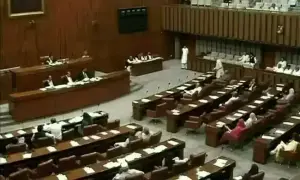
The Senators have done what they did not want - they have endorsed the bill reviving military courts, against their passionately espoused stand from various public platforms that such an action would not only undermine the sovereignty of parliament but also deliver a severe blow to the fundamental rights guaranteed by the Constitution. While some of them likened their act to the Socratic resignation, others said it's defeat of parliament. But a few stuck to their position taken earlier, and either opposed the bill or abstained - a decision that amply suggests that those who showcased their opposition to revival of military courts had voted for it when the crunch came. Crudely put, it means they do not mean what they say publicly. Having raised a storm against reinstatement of the military courts they were expected to oppose the bill, and given their majority in the Senate they could reject it. But now that they haven't, they have got to carry this albatross around their neck. As to why did they do what they did, there is no answer to that, but perhaps a probability that while they didn't have the stomach to be on the wrong side of the military, they were anxious that their image as democrats and custodians of people's fundamental rights remains intact. It was politics; it is not likely to work. What a chicanery that a member had to concede that "we are carrying out an exercise that has already been decided by someone else."
These courts were established with absolute parliamentary consensus and their revival - mandated as it is by the fact that even when they effectively delivered on their task it remains unpunished - indeed an inescapable desideratum. It's not the "defeat of parliament," as a Senator who voted for it said. The truth is that given faulty investigation, poor prosecution and deficiency of evidence the civilian courts have not been able to effectively cope with terrorism cases. Pakistan is not the only country which established military courts; others, including even the most functional democratic countries, also frame special laws to deal with extraordinary situations, as the one presently confronting Pakistan. But having said this one can't help appreciating the Senators' vote to adopt a motion empowering the Senate chairman to nominate Senators to be members of the proposed committee on national security. The committee is expected to oversee fuller implementation of the National Action Plan, something that should have been when it was framed but was acted upon half-heartedly. But this outfit should not be tasked to oversee the working of the military courts. Such a move can undermine the independence of these courts. The amended law would ensure that the accused would be presented before the court within a day of his arrest; recording of eyewitness and forensic material would be governed by Evidence Act 1948 and verdicts of military courts would be appealable. That having been done, the parliament is expected to render them its full and as and when warranted stand at the back of the military courts. This extension in the tenure of military courts is a bitter pill, but then it is the only remedy to treat the cancer of extremism and terrorism.


















Comments
Comments are closed for this article.