


Defence Minister Khwaja Asif tried to deal with a highly sensitive matter in a most casual manner when he disclosed in a media interview that the government has informed Saudi Arabia, in writing, that the recently retired Army chief General Raheel Sharif would soon assume the command of the Saudi-led Islamic Military Alliance to Fight Terrorism (IMAFT). It may be recalled that many eyebrows were raised when a while ago reports surfaced that the General had accepted the Saudi offer to head the alliance. The issue was taken up by the Senate where the Defence Minister said no such request had been received, and that he would inform Parliament of any development in this regard. Prime Minister's Advisor on Foreign Affairs Sartaj Aziz had also promised to make a statement about foreign policy implications of the appointment if and when it happened. Those assurances have now been cast aside, apparently, to avoid having to answer difficult questions. But the issue is not going to go away. The PTI has strongly opposed the decision, reminding the government that at the time the Gulf states had asked for troops for their Yemeni campaign, Parliament had refused to oblige saying Pakistan must not get involved in a Middle East conflict. The party is now preparing to raise the matter in Parliament.
Right from the outset, Pakistan's participation in the alliance has been a subject of serious concern in this country. The government itself at first had shown surprise to find its name included in it, and hesitated to join in. It was in view of the special relationship with the kingdom, nonetheless, that it gave its nod. The underlying unease has been that it would compromise this country's longstanding policy of staying neutral in Middle Eastern affairs, and also undermine its domestic sectarian harmony. It was explained then that Pakistan's role would be only training and capacity-building of the IMAFT force. After the present decision, it is a whole new ballgame. There are some key questions: Will the IMAFT headed by a former chief of Pakistan Army be actually implementing the policy of Riyadh, the alliance leader? Will it - in any manner - add to Pakistan's own defence capacity and capability particularly in relation to its traditional rival India? Will he be able to help unite the Muslim world riven by sectarian divides in accordance with how Lieutenant General Nasir Janjua (retd), the country's national security adviser, sees former army chief's appointment? What is government's response to some analysts' argument that it, as a matter of expediency, has landed the Army in an awkward situation through acceptance of Saudi offer or request?
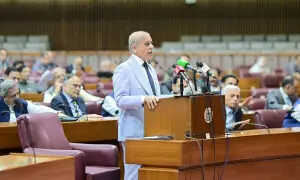
These questions are about Pakistan's interests. And what constitutes Pakistan's 'national interest' must be clearly spelled out by our leadership without any further loss of time. The present issue is a test for the foreign policy establishment's diplomatic skills. Ways need to be found to manage the situation without causing damage to the relationship. Meanwhile, the government has to go to Parliament and explain why it has allowed the general to take such a decision.














Comments
Comments are closed for this article.