


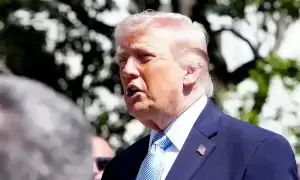
Held at diplomatic arm's-length for years, Russian President Vladimir Putin is pivoting back to centre stage as his admirers and international allies rise to power, a move that analysts say the Kremlin will be quick to exploit. Most notable among newly-elected leaders is Donald Trump, who on the campaign trail loudly proclaimed his esteem for Putin and met with a round of Kremlin applause in return.
In Europe, France's presidential primaries saw former prime minister Francois Fillon, who favours closer relations with Moscow, become the rightwing champion for next year's vote. And in Russia's back yard, pro-Moscow candidates Rumen Radev and Igor Dodon have triumphed in presidential polls in Bulgaria and Moldova respectively.
These elections show how Putin's standing has surged, said independent analyst Maria Lipman. "Russia has been able to considerably strengthen its position on the international scene, and its leader has become attractive in the world," she said. Putin, she said, is riding an "anti-establishment" trend, although unlike figures such as Trump or Radev, he "has been putting this political course into practice successfully for a very long time."
"Leaders who reach out to less educated people, who speak against the establishment, against globalisation... are becoming more and more popular," she said. "Putin fits very well into the image of such a leader." A former KGB officer, Putin has been a bogey figure to many on both sides of the Atlantic. He found himself ostracised after the March 2014 seizure of Crimea, which prompted European and US sanctions that hit Russia's economy hard.
Then, in September 2015, he began a bombing campaign in support Syrian President Bashar al-Assad - a ruthless move that prompted accusations by western countries and watchdogs of complicity in war crimes. Today, much of this criticism has been muted, an "evident" sign of strategic success, Lipman said. Putin has ensured that Assad's departure is now more or less off the table - and Russia has gained a strong bargaining position on other issues as a result.
But Putin's gains have also come as a result of fumbling by the United States, which has made Russia suddenly look like a viable partner, analysts say. "The warm reception for Putin is mainly the flip side of anti-Americanism and a desire to leave a unipolar world, a yearning to find a new balance in the world," said commentator Konstantin Kalachev. The European Union, which had already been weakened by the growing power of populist nationalist movements, suffered a serious blow from Britain's June referendum on EU membership.
Trump then sent shockwaves through European capitals by appearing to question US commitment to Nato - the alliance that has underpinned western European security for nearly seven decades. German Chancellor Angela Merkel, one of the stronger proponents of Russia sanctions who is up for reelection next year, has already expressed worry for Trump's admiration for Putin, and observers say the EU's main France-Germany alliance would be strained by differences in attitudes toward Putin.
"For Putin it makes more sense to negotiate with an out-of-balance Europe," Kalachev said. "It's easier to reach separate agreements." Washington's global authority eroded "after a number of major international errors," said Lipman. A divided and worried Europe "plays into Putin's hands" by fracturing Western solidarity, she said. Easing the restrictions imposed for the Crimea annexation is a priority for the Kremlin.
Combined with low oil prices and structural problems, the sanctions have badly damaged the Russian economy and shrunk Russians' purchasing power. With his new friends, Putin is likelier to find a sympathetic ear for removing the clamp, Lipman said. "The international context allows us to consider the possibility of their softening." In a state-of-the-nation speech on Thursday, Putin struck a conciliatory tone towards the West. "We are not looking for, and have never sought, enemies," he said. "We need friends."









Comments
Comments are closed for this article.