


Finance minister addresses post-budget press conference: ‘We’re now moving forward toward growth’
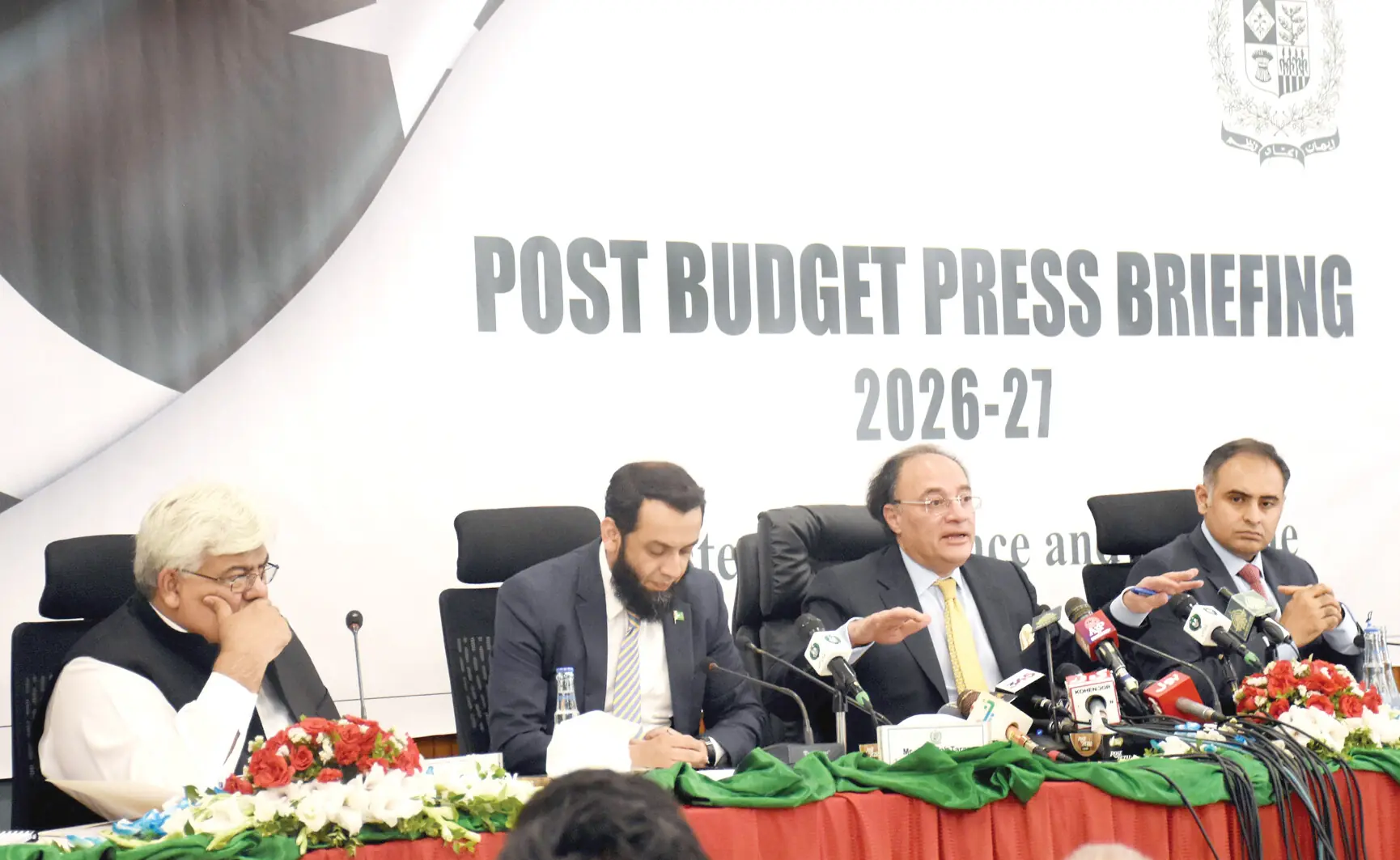

ISLAMABAD: Finance Minister Muhammad Aurangzeb on Saturday said that the 2026–27 Budget reflects the government’s commitment to shifting the economy from stability towards export-led growth, while embedding measures to create an enabling environment that are backed by tax incentives for various sectors.
“In this budget, we have made significant progress in the direction of travel — towards economic growth from economic stabilization, as steps have been taken envisaging exports promotion, including the abolition of advance tax and the proposed abolition of super tax for all exporters”, said Aurangzeb, flanked by Information Minister Attaullah Tarar, Minister of State for Finance Bilal Azhar Kayani, Finance Secretary Imdadullah Bosal, Federal Board of Revenue (FBR) Chairman Rashid Mahmood Langrial and Head of the Tax Policy Office Najeeb Memon, while addressing a post-budget press conference here on Saturday.
The minister called the Budget 2026-27 people-friendly, catering for all sectors, while saying the government has reduced the tax burden on the salaried class, provided additional subsidies, and laid the foundation for export-led growth. Aurangzeb said the government had made “extraordinary progress” in the budget and had fulfilled its promise to provide relief after difficult economic conditions.
READ MORE: Disgruntled salaried group gets some relief as Aurangzeb announces FY27 budget
He said a subsidy of Rs70 to Rs71 billion has been earmarked to ensure a conducive environment for exporters, who will also have access to easy financing at 4.5 per cent. He added that duties on the import of raw materials have been reduced to bring down production costs. He further noted the matter also pertained to “financing rather than just taxation”. He added that an additional subsidy of Rs70 billion has been proposed in the budget to take the Export Refinance Scheme (EFS) “to a different level”. “Some of those have been reflected in the defence budget,” he said, adding that the arrangement was expected to remain in place for the next three years.
On the 7 percent increase in salaries and pensions for all government employees, Aurangzeb said the benchmark was set on the basis of the inflation index and described the raise as “satisfactory,” given the accompanying tax relief. The Finance Secretary said the increase was granted by merging the ad hoc relief provided in 2022 and 2025. However, autonomous bodies will make their own decisions in this regard.
On taxation, the finance czar emphasised the aspects of “both deepening and broadening” the revenue collection. Affirming that digital monitoring and other measures were already leading to additional revenues, he noted that a “new tax model” presented in the parliament yesterday was in design.
“We want to take this towards automation and AI, and reduce human intervention,” he said, mentioning that the retailers’ scheme has been proposed to widen the tax base.
Noting that questions had been raised about economic growth, rather than stabilisation, Aurangzeb asserted: “We have fully utilised the fiscal space available to us. There is more to do […] The feedback we have received so far is that we have set out on the path to economic progress.”
Responding to a question, the finance minister clarified that the petroleum levy was not being increased. However, he acknowledged that the government “keeps interchanging the amount between petrol and diesel”, but there was no proposal to increase it.
Terming population growth an “existential issue”, he affirmed that the government was working on a comprehensive plan. “When the next NFC (National Finance Commission) award is allocated, this particular allocation driver has to be reviewed and has to change,” he said. Speaking about tariffs, the finance minister noted that the government was in the second year of the five-year plan “in terms of bringing the cost down in terms of intermediate goods and the raw material”
Copyright Business Recorder, 2026


















Comments