


The readers would recall that we the three independent economists wrote an open letter to the IMF, published in this newspaper on October 24, 2016. In this letter we presented the other side of the picture, challenging the outcomes of the IMF Programme as propagated by the IMF staff through the review document. The publication of the open letter coincided with the visit of the Managing Director of the IMF in Pakistan. We were expecting, if at all, a response from the IMF itself. Instead, to our utter surprise, we saw a detailed response to our open letter from none other than the Ministry of Finance (MoF), published in this newspaper on November 4, 2016. It is not clear if this was authorized by the IMF.
Notwithstanding whether the MoF was authorized or not, we appreciate the efforts of the MoF for responding to our open letter in great detail. We the three authors of the 'open letter' would like to respond to the points raised by the MoF in its response to the open letter to IMF.
On number of waivers extended by the IMF in a three year program, the MOF has pointed out that it was not sixteen but fifteen waivers thatwere extended to the Pakistani authorities. What is so different between fifteen or sixteen waivers? Also, in seven reviews quantitative performance criteria were suitably adjusted to facilitate their subsequent achievement. The fact is that perhaps never in the history of the IMF did Pakistan receive such a sympathetic treatment in a program. This diluted the reforms in the program and impacted adversely on the outcomes.
On economic growth numbers, our views have been that it has hovered in the range of 3.1 to 3.7 percent during the last three years. The readers would recall the debate on growth numbers that took place between us and the MoF in the pages of this newspaper during the budget 2016-17. We would like to clarify that we never commented on the methodology of the national income accounts. We know it very well that the Pakistan Bureau of Statistics (PBS) uses the System of National Accounts (SNA) 2008 to compute national accounts. What we have challenged is the raw data/inputs that went into the methodology to arrive at inflated growth numbers. It is very simple that if we feed inflated raw data/inputs into the methodology, we get an exaggerated GDP growth rate.
On unemployment, our calculations suggested that the unemployment rate has surged to a 13 years high at over 8.0 percent (including the discouraged worker's effect). The MOF criticised us on the ground that we dramatised our assertion on unemployment by adding discouraged workers. We simply presented the facts which are consistent with the slower economic growth that has prevailed over the last three years. As reported in Pakistan Economic Survey 2015-16, the addition to labor force during 2007-08 to 2012-13 has been, on average, 1.3 million per annum. Why did this addition to labor force slow down to an average of one-half (650,000) during 2013-14 and 2014-15? During the same period the labor force participation rate, both in rural and more so in the urban areas, registered a decline.
The answer is simple. Since economic growth during 2013-14 and 2014-15 has been low, unemployment was rising. In order to show a lower unemployment rate, a large number of labor force entrants were taken out from the sample to arrive at lower unemployment rate. Adjusting for this manipulation, the unemployment rate surges to over 8.0 percent in 2014-15 and urban unemployment rate increases to 11 percent compared to 7 percent in the rural areas.
Various initiatives have been listed by the MoF which are creating more jobs. However, according the budget documents the actual expenditure under these programs was only Rs 28 billion in the last three years against the cumulative allocation of Rs 66 billion. Therefore, the programs have been slow in implementation and unlikely to have had a significant impact on unemployment.
On building foreign exchange reserves through external borrowing, the MoF has disagreed with our assertion that these reserves wore built through accumulating external debt. Pakistan's external debt and liabilities at end-June 2013 stood at $61 billion and by end-June 2016they stood at $73 billion, that is, an addition of $12 billion. Pakistan's foreign exchange reserves at end-June 2013 stood at $6 billion and increased to $18 billion by end-June 2016,a net increase of $12 billion. These are the hard numbers as reported by the State Bank of Pakistan and the IMF.
As regards external financing requirement the MoF has referred to the estimates of the IMF which stand at $10.9 billion in 2016-17, and projected to rise to $13.7 billion in 2017-18. We would argue that these estimates are based on highly optimistic assumption about the rise in exports, imports, remittances, FDI, etc. Our projection of $15 billion or over 5 percent of GDP of external financing requirement for the current fiscal year is based on the ground reality. We have already witnessed a negative growth in exports, remittances and FDI during the first quarter of the current fiscal year. We expect that this trend is not going to reverse substantially during the remaining period of the year. We also expect external financing requirement to rise to $18 billion in 2017-18.
On flotation of Sukuk Bonds, our view is that within two weeks after the end of the IMF Program we rushed to the market to raise one billion dollars, as if we lacked confidence in the sustainability of foreign exchange reserves. Our worry is that the net external borrowing in the first quarter of the current fiscal year amounted to $890 million, while the increase in reserves has been only $348 million. In other words, we borrowed $542 million to finance current consumption (current account deficit) which is not a good sign going forward, with regard to external debt sustainability.
On declining exports, the MoF could only argue that the government is making serious efforts to address the issue without providing any details of the measures that are currently being taken by the government. Exports are continuously on the decline for the last 28 months in a row and the government is still making unspecified efforts to address the declining trend. We believe that senseless taxation to achieve revenue targets under the IMF Program, holding back refunds to jack up revenue, artificial stability in exchange rate created because of heavy external borrowing to bolster external buffers, are some of the factors that have eroded the competitiveness of our exporters. The government has remained silent on these factors and yet expects to address the issue of declining exports.
On the fiscal side, the MoF gave an unduly long explanation on the blatant use of statistical discrepancy in achieving budget deficit target set by the IMF. We believe that the use of statistical discrepancy has always been there owing to the factors listed by the MoF. Our serious concern is regarding the size of the statistical discrepancy which has been far more than the historical average. Furthermore, the choice of the size of the statistical discrepancy has been very close to the amount needed to achieve the IMF dictated budget deficit target.
As regards the decline in non-tax revenue, the MoF provided the justification for a decline in 2015-16. We believe that not only the target for non-tax revenue is not going to be achieved this year but the current expenditure is also understated in the current year's budget. For example, the coalition support fund (CSF) money amounting Rs 170.7 billion is unlikely to be received this year. Similarly, the growth of only 7 percent in current expenditure as budgeted in 2016-17 is likely to be exceeded if the provision made for costs of the rise in salary and the agricultural relief package of over Rs 150 billion are taken into account.
On power sector reforms the MOF quotes the favourable comments made by Nepra in its State of Industry Report of 2014-15 about the improvement in the power load shedding situation, especially that faced by the industry. However, Nepra also states in the Foreword that: 'The Discos did not show any noticeable improvement in their performance and continued with business as usual in the areas of T&D losses, recoveries and technical operations'.
Further, Nepra indicates in the Report that the supply-demand imbalance in peak hours has increased to 5625 MW in 2014-15, as compared to 4759 MW in 2012-13. This represents a jump in the gap of 18%. As such, it is unlikely that there has generally been any significant decline in power outages.
The improvement in access to power by industry is largely limited to the province of Punjab. The four Discos-Gepco, Fesco, Lesco and Mepco-of this province have received as much as 85% of the increased electricity supply from 2012-13 to 2014-15 nationally to industry. The seven other distribution companies have either reduced their supply to industry or increased it only marginally.
The circular debt of the power sector must include the liabilities parked with the Power Holdings Private Limited (PHPL). Even the IMF has highlighted that the total circular debt now exceeds 2% of the GDP. Sooner or later, ways will have to be found to retire this debt if the efficiency level of the sector is to be sustained and even improved. These pending liabilities along with the bottlenecks in transmission could hinder improvement in supply even in the presence of additional generation capacity from 2017 onwards.
The MoF has said that the reduction in fuel costs is reflected in lower tariff through the negative fuel charge adjustment. However, this has effectively been neutralised by levy of a tariff rationalisation surcharge of up to Rs 4 per kwh. Rather than adhoc monthly adjustments, the Nepra Act of 1997 calls for notification of tariff on a quarterly basis. This is not being done. Setting of tariffs quarterly is a better way of reflecting changes in costs.
We look forward to the early publication of the State of Industry report of 2015-16. NEPRA must be recognised for producing such a high quality report every year. This will indicate if the sector has shown any major improvement in efficiency.
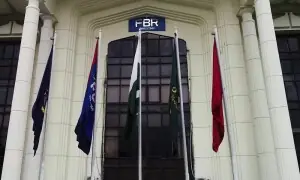
On tax reforms, the fast growth in federal tax revenues, especially in 2015-16, is appreciated. Unfortunately, the steam seems to have gone out of the FBR in the first four months of 2016-17, with a shortfall already of apparently over Rs 80 billion. If this continues for the rest of the financial year, the shortfall could exceed Rs 300 billion, close to 1% of the GDP. This implies that the tax-to-GDP ratio could begin to fall significantly once again. If the Fund Program had continued, a mini budget would probably have been announced, with measures largely to tax more the common man.
The MoF has mentioned that 465,000 notices have been issued during the last three years by the FBR. Why then has the share of income tax revenues raised through demand fallen from 12% in 2012-13 to 7% in 2015-16? The claim is also made that the number of return filers is up by 300,000. Here again the share of revenues with returns and advance tax has fallen from 32% to 27%.
The fastest growth in revenue during the last three years is in withholding taxes. Their contribution to income tax revenue has gone up substantially from 56% to 66%. Many of these taxes have the characteristics of indirect taxes and have created severe distortions in economic activity.
The share of direct taxes in total federal taxes is 35%, not 39% as claimed by the MoF. It has fallen from 37% in 2014-15. According to a World Bank study for the FBR, the cost of direct tax breaks, in terms of revenue foregone, is as much as 1.5% of the GDP, equivalent to almost Rs 450 billion. The real test is if these concessions and exemptions mostly to the rich could be withdrawn.
The maximum rate of import duty has indeed been brought down from 30% to 20%. But, simultaneously, a minimum duty has been levied across-the-board along with regulatory duty on a number of items. The consequence is that effective rate of customs duty on imports has gone up from less than 6% to almost 9%. In particular, why has a regulatory duty been imposed on furnace oil?
The issue of payment of refunds is a serious one. In effort to achieve IMF-mandated targets, the FBR has been increasingly reluctant to make refunds. Consequently, the share of gross revenues paid out as refunds has declined from over 7% in 2011-12 to 2% in 2015-16. This has led artificially to higher net revenues of over Rs 150 billion in 2015-16.
At the end, we would like to express our deep concern on the recent unravelling of the economy as indicated by a decline in exports, remittances and FDI and rise in the current deficit and gross external borrowing, soon after the completion of the IMF Program. Simultaneously, the growth rates of the manufacturing sector and FBR revenues have plummeted, inflation is on the rise and the fiscal deficit is much larger in the first quarter of 2016-17 than budgeted. It is for these reasons that we had raised the question in our open letter that "has the IMF Programme made the economy more sustainable? Once again, the answer is an emphatic NO.














Comments
Comments are closed for this article.