



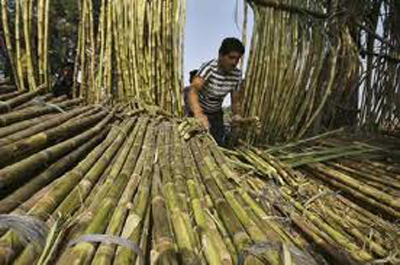
 LONDON: Trade house Sucden Brazil anticipates a modest recovery in sugarcane production in centre-south Brazil to around 520 million tonnes in 2012-13.
Jeremy Austin, director of Sucden Brazil, said aging cane plants would make it hard for farmers to boost production, and that it could take some three years to bring down the average age of the cane to more reasonable levels.
"I would give a range of 500-540 million tonnes (for centre-south Brazil cane production in 2012-13), with a tendency to call it 520 million," Austin told Reuters in a phone interview.
Sucden Brazil estimates 2011-12 centre-south Brazil cane output at 493 million tonnes. The centre-south is the main sugar growing region of Brazil, the world's top sugar producer and exporter.
Austin said damage to cane caused by frost in some growing areas in 2011/12 could harm development of cane to be harvested in 2012/13.
Brazilian sugar growers needed to renovate cane to ensure improved productivity in future years, he added.
"You cannot just turn on a tap and the young, green, tough cane returns," he said.
"I would expect a three-year process minimum to return to a reasonable average age. And that is if prices remain at decent levels to justify the investment."
Austin estimated that the average age of cane in the centre-south of Brazil was 4.0-4.2 years, and said he believed growers should be aiming to reduce the average age to around 3.2 years.
"People this year should be renovating cane at an above average rate, to try to get cane to a reasonable average age," he said.
The average age of Brazilian cane had risen due to the adverse impact on investment of the 2008/9 financial crisis, at a time when cane was plentiful.
Austin said it was more likely that Brazilian mills would allocate cane to make ethanol biofuel after the start of the next centre-south Brazil harvest, due around April, rather than before the crop.
He said he saw "ethanol parity", the sugar price at which mills would switch to ethanol, at around 21 cents a lb. ICE March raw sugar futures stood at 24 cents a lb on Monday.
"The switch is more likely to take place during the crop than during the inter-harvest period," Austin said.
He estimated the Brazilian cost of sugar production at around 21 cents a lb, adding that the figure depended to some extent on the exchange rate between the US dollar and the Brazilian real currency, and on the size of the crop compared to industrial capacity.
Asked to comment on what needed to be done to address the problem of low volumes in Liffe white sugar futures trade, Austin said he believed the exchange needed to incorporate containerised trade into the solution.
"The committee in London must be looking at alternatives, one of which must certainly look to bring in container possibilities," he said.
Austin is scheduled to speak at the Feb. 4-7 Kingsman Dubai sugar conference.
























Comments
Comments are closed for this article.