



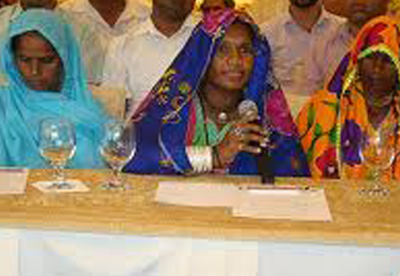
 ISLAMABAD: The year 2011 proved fortunate for the women as a lot of legislative work was done to safeguard their rights and now activists are demanding an appropriate plan of action for implementing women friendly laws.
Talking to APP, Executive Director Women Organization for Rights and Development, Aqsa Khan said a specific commission should be formed for implementing recently passed anti-women practices and acid crime prevention laws.
However, capacity building of police and law enforcing agencies should also be ensured to implement these pro-women legislations.
She said "The year 2011 proved very lucky for the women as progressive legislations were enacted to discourage anti-women practices while acid violence was also criminalized. The criminal justice system, which is gradually improving will provide protection to women from negative customs and traditions besides ensuring secure environment for them."
Aqsa said that such legislations create deterrence against crimes, ensuring protection of life which is a legitimate right of every individual.
Cultural violence, which is not only against human dignity but also a human rights violation, hinders social empowerment of women at every level, she said.
The Senate and the National Assembly played very supportive roles by passing pro-women laws and thus provided a space to put forward women agenda.
The Anti-Women Practices bill consisting of five clauses seeks to penalize evils such as the so-called marriage with the Holy Quran, forced wedlock and depriving women from inheritance.
According to the bill, "Whoever gives a female in marriage or otherwise compels her to enter into marriage, as `badla-e-sulh', wanni, or swara or any other custom or practice under any name, shall be punished with imprisonment from three to seven years and fined upto Rs 500,000."
Besides the bill proposed prohibition of depriving woman from inheriting property, prohibition of forced marriage and marriage with the Holy Quran. The violators will be handed over either imprisonment or a fine of Rs 500,000 for each crime.
The other bill, which is aimed at preventing incidents of throwing acid at women, recommended that whoever hurt by corrosive substance shall be punished with 14 years or life time imprisonment and a minimum fine of Rs one million.
Another legislation `Women in Distress and Detention Fund Act 1996' was also passed recently which will provide financial and legal assistance to the women languishing in the jails on account of different allegations and those who are faced with extreme hardship.
Women rights activist Fauzia Saeed of AASHA said that a lot of legislative work was done in the year 2011 which included aforementioned legislations and amendment to criminalize and define domestic violence.
She said the AASHA continued its struggle until anti-sexual harassment law was passed and now being implemented successfully.
Fauzia said AASHA had set a precedent which must be followed by other organizations to run successful movements and achieve their targets.
She said the implementation of anti-sexual harassment act 2010 continued on a fast track which is quite satisfactory as 100 per cent compliance was ensured on national level while provincial governments were also encouraged to adopt the code of conduct and form inquiry committees which were mandatory according to the law.
Over 450 master trainers were imparted training by Mehargarh which created awareness across the country at grassroots level.
Punjab and Sindh have taken lead in implementing the harassment law and now Balochistan is also expediting its efforts for compliance of the Act, however, Khyber Pakhtunkhwa and Gilgit- Baltistan are lagging behind in this regard, she said.
She also called for changing mindset and said, "Implementation of harassment law must be taken in positive spirit rather taking it defamation for the organization as it is aimed at building healthy environment for the employees at workplaces."
Fauzia Saeed said a web-based database titled `Sexual Harassment Watch' has been launched during the year where organizations are exchanging the information about compliance of law.
She said that efforts will continue till the appointment of provincial ombudspersons and the society made free of harassment.
Another legislation to give autonomous status to the National Commission on Status of Women has been finalized in this year and will be tabled soon in the Parliament.
























Comments
Comments are closed for this article.