


World mobilises after Kadhafi 'crimes' to hold power

TRIPOLI: World powers mobilised on Tuesday to try to halt the bloody showdown between protesters and Libyan leader Moamer Kadhafi's security forces suspected of "crimes against humanity" to keep him in power.
As both the UN Security Council and Arab League called emergency meetings, countries scrambled to evacuate by air, sea and land expats caught up in the violence, which rights groups said has cost up to 400 lives.
Germany demanded that the Security Council take "swift and clear" action on the crisis, as the meeting opened in New York.
Kadhafi himself, after a lightning television appearance overnight to scoff at reports that he had fled, was to make a televised address to the Libyan people on Tuesday.
After more than four decades in power, he was also confronted by mounting defections in Libya's diplomatic corps and the air force after it was allegedly ordered to attack civilians.
Libya's ambassador to Washington, following the lead of a colleague at the United Nations, openly called for Kadhafi to end his "dictatorship regime" and step down.
He said that while anti-regime protesters had seized control of Benghazi, Libya's second-largest city, "Tripoli is burning" and security forces were turning tanks, troops and bulldozers on the population.
"Please, please, please help the Libyan people. Help them. They are burning," the envoy said.
With the turmoil and deadly unrest in oil-rich Libya escalating, the commodity's price shot up eight percent to $93.36 a barrel in New York opening trade on Tuesday.
Meanwhile, in a mass breakout of foreigners, about 10,000 Egyptians were massed at the border in eastern Libya, as hundreds of foreigners, mostly from neighbouring Tunisia and Egypt, scrambled for flights out of Tripoli.
The Netherlands said it was sending a military transport plane to Tripoli to fly out its nationals, Greece chartered a private tanker and made plans for an airlift along with the Ukraine, and Germany kept up its own evacuation flights.
A day after the revolt sparked in eastern Libya spread to the capital, several districts of Tripoli were calm early on Tuesday, including Tajoura, which had seen violent clashes, witnesses told AFP.
Bullet holes riddled walls of Fashlum and Tajoura, where residents mounted neighbourhood patrols. The army, meanwhile, was posted around the diplomatic district of Galgaresh, as seen in videos posted on the Internet.
Libya's state telecoms said disruptions had been caused by a surge on the network, as Internet connections widely used to spread news of the revolt returned to normal and mobile phones were accessible early on Tuesday.
Kadhafi, known for his sense of the dramatic, made a lightning appearance on state television late Monday to scotch "malicious rumours" he had abandoned the oil-rich North African nation he has ruled for more than four decades.
Despite the 22-second appearance, his grip on Libya appeared increasingly shaky as diplomats around the world and two fighter pilots defected with their Mirage F1s to Malta on Monday rather than follow orders to bomb Benghazi.
But state media were mobilised to forcefully deny the reports of massacres and an imminent collapse of the regime.
"They say there are massacres in several cities, towns and neighbourhoods of Libya. We must fight against these rumours and lies," wrote Al-Jamahiriya Two state television on a red ticker.
This information "aims to destroy your morale, your stability and your riches," it added.
The Security Council meeting follows a stark warning by UN human rights monitor Navi Pillay that "widespread and systematic attacks against the civilian population may amount to crimes against humanity."
British Prime Minister David Cameron, on visit to Kuwait, said "reform, not repression" was the way to guarantee stability in the Arab world. "Using force cannot resolve grievances, only multiply them," he warned.
Souhayr Belhassen, head of the International Federation for Human Rights (IFHR), quoted witnesses as saying militias and security forces loyal to Kadhafi were "breaking down doors and pillaging" to quell the revolt.
"It is impossible to remove the corpses from the road; we are shot at from above," one witness was quoted as telling a Libyan rights group.
On Monday, witnesses in Tripoli reported massacres in certain neighbourhoods of the capital after Libyan television announced that security forces were assaulting "dens of terrorists."
But Kadhafi's son, Seif al-Islam, quoted on the television, denied reports the armed forces had bombarded the cities of Tripoli and Benghazi to the east, after Al-Jazeera television reported raids in the capital.
He had earlier warned that the regime would fight "to the last bullet."
Gunfire rattled overnight in Tripoli, where protesters attacked police stations and the offices of the state broadcaster, and set government buildings ablaze, witnesses told satellite news channels and human rights groups.
Rights groups say the government's crackdown has killed between 200 and 400.
A temporary morgue with capacity for 450 bodies has been set up next to the main hospital in the Libyan capital where anti-regime protests are raging, Belhassen said on Tuesday.
Outraged by the violence, Libyan diplomats from the United Nations to Australia have either resigned -- including Tripoli's ambassador to India, Ali al-Essawi, a former trade minister -- or openly protested.
Libya's justice minister, Mustapha Abdeljalil, had also reportedly resigned in protest at "the excessive use of force."
OPEC READY TO MEET ANY SUPPLY SHORTAGE: SAUDI ARABIA
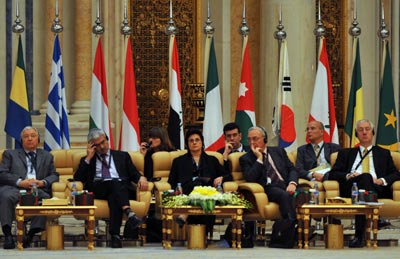
Saudi Oil Minister Ali al-Naimi said on Tuesday that OPEC is prepared to meet any shortage of supplies due to unrest in the Middle East and that its members have sufficient spare capacity to do so.
"There is absolutely no shortage of supply now ... OPEC is ready to meet any shortage in supply when it happens," Naimi told a press conference at the end of a consumer-producer meeting that signed a cooperation charter.
"There is concern and fear but there is no shortage," the minister reiterated in a bid to assure consumer countries that crude oil supplies are guaranteed despite sweeping unrest in the Middle East and North Africa.
Saudi Arabia, OPEC's largest producer, is pumping around 8.4 million barrels per day, but Naimi said the kingdom still has a spare capacity of another four million bpd.























Comments
Comments are closed for this article.