



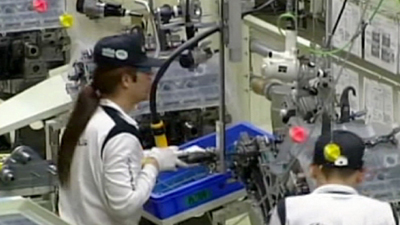
 SEOUL: South Korean factory output unexpectedly shrank and imports fell sharply in November as Asia's fourth-largest economy felt the chill from cooling global demand, but a policy statement showed the central bank still sees inflation as a greater threat.
Industrial output fell by a seasonally adjusted 0.4 percent in November, government data showed on Thursday, marking its fourth decline in five months and widely missing market expectations for a modest recovery from a fall in October.
The data from Statistics Korea also showed factories were operating at 79 percent of their capacity on average in November, the lowest rate in two years, as inventories of finished goods soared on tepid global demand.
Separate data from the central bank showed the country's current account surplus more than doubled from October to a record $4.97 billion in November on a seasonally adjusted basis as imports fell sharply.
"We've been seeing worsening numbers on both the real economic and sentiment fronts. Today's set of indicators added to that and could drag sentiment down in turn," said Yum Sang-hoon, a fixed-income analyst at SK Securities.
The surplus in the current account balance -- the broadest measure of foreign trade in goods and services -- bodes well for the won but the depressed domestic demand behind weak imports is negative for the currency.
Imports in November fell by a seasonally adjusted 5.9 percent from October, the sharpest decline since mid-2008, while exports dropped by 1.3 percent, Bank of Korea data showed.
Both imports and exports fell for a third consecutive month, the longest losing spell since global trade collapsed in 2008 at the beginning of the worst global recession in decades.
NO SIGNAL YET OF RATE CUT
But the central bank said in its 2012 policy statement released after the data that it would maintain the current policy priority on fighting inflation next year, giving no signal of an imminent rate cut to shore up the economy.
"(The Bank of Korea) will strive to stabilise consumer price inflation at the mid-point of the (2 percent to 4 percent) inflation target over a medium-term horizon," it said.
South Korea's economy has managed to hold firm in the face of slowing global demand, growing seasonally adjusted 0.8 percent in the third quarter after a 0.9 percent rise in the second quarter.
But the solid growth was attributed in part to temporary factors such as a soaring number of free-spending foreign tourists, and analysts expect the economy to suffer a steep slowdown ahead.
"The overall trend seems to be economy moving toward a slump," said Oh Suk-tae, head of research at SC First Bank. "The Bank of Korea will likely cut interest rates in the second quarter (of 2012)."
The Bank of Korea raise its policy interest rate by 125 basis points to 3.25 percent since July 2010 but has kept it unchanged since June this year. It next reviews the rate on Jan. 13.





















Comments
Comments are closed for this article.