



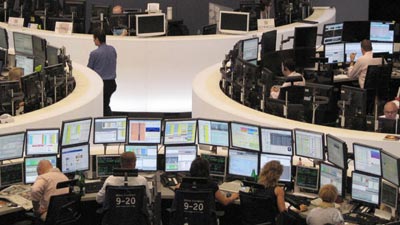
 LONDON: European shares fell and the euro tumbled close to a one-year low against the dollar, as investors fretted over a crucial auction of long-term bonds by Italy on Thursday.
While Italy paid sharply lower rates on Wednesday to raise 9.0 billion euros ($11.8 billion) in a six-month bond sale, providing an early boost to equities, stocks and the euro later fell as investors looked ahead to Thursday's auction.
In late afternoon deals, the euro slumped to $1.2941 -- which was the lowest point since January 11. It later pulled back slightly to stand at $1.2962.
The euro fell to a 10-year low against the yen -- 100.73 yen -- its lowest level since June 2001.
London's FTSE-100, which spent most of the day in positive territory, finished off 0.10 percent at 5,507.4 points.
In Paris the CAC-40 gave up 1.03 percent to 3,071.08 points while in Frankfurt the DAX 30 dropped 2.01 percent to 5,771.27 points.
Milan ended down 0.85 percent after being up over a percentage point.
Madrid dropped 2.01 percent.
Italy raised 9.0 billion euros ($11.8 billion) at a rate of 3.251 percent -- with some analysts suggesting that European banks making use of low-cost European Central Bank money were largely behind the auction's success.
The rate was half the 6.504 percent that Italy was forced to pay in November and also below the level of 3.535 percent it paid in October.
But Italy's aim to sell between 5.0 billion and 8.0 billion euros in bonds maturing in three, seven and 10 years is being looked at as tougher test of Rome's ability to refinance its massive debt at affordable rates.
This week's bond sales were being seen as a bellwether for market sentiment on Italy -- the eurozone's third largest economy -- but also for the euro area as a whole at the end of a year that has questioned the future of the euro.
Italy will have to raise on the order of 450 billion euros next year, with the 7.0 percent rate of return that its 10-year bonds have been trading at on the secondary market seen as financially unsustainable.
"While Italy managed to have a successful auction of short-term six-month debt, market jitters are still there in regards to the 10-year debt on offer by Italy in tomorrow's trading session," said MoneyCorp analyst Mark Deans.
"Italian 10-year yields rallied after dipping initially after the short-term debt auction, moving back above 6.9 percent," he added.
"With the overhanging fear about the eurozone sovereign debt crisis, the open of US cash equity trading saw a flight to safety and a move into safe haven currencies like the Japanese yen and US dollar."
Deans added that thin trading conditions ahead of the year-end were also exacerbating moves in the foreign exchange market.
Italy has spooked international markets this year with its slow growth and a sharp rise on its borrowing costs raising fears of an imminent blow-up of its giant debt -- around 1.9 trillion euros or 120 percent of annual gross domestic product (GDP) -- which would make it difficult for its eurozone partners to bail out.
Adding to investor concerns about a possible credit crunch in Europe was news that the region's banks deposited a record amount of overnight funds at the ECB, after receiving last week a record 489.2 billion euros from the ECB in low-interest loans.
Banks put 452.03 billion euros on deposit for 24 hours at the European Central Bank on Wednesday, beating the previous record of 411.8 billion euros set the previous day, showing that banks continue to be reluctant to lend to each other on the interbank market.
US markets slipped slightly on opening, with the losses deepening and the the Dow Jones Industrial Average down 1.06 percent to 12,161.63 points near midday. The broader S&P 500 gave up 1.08 percent to 1,251.72 points, while the Nasdaq Composite lost 1.14 percent to 2,595.20 points.
Asian equities mostly slipped as eurozone worries overshadowed a strong rise in consumer confidence in the United States.
Tokyo fell 0.20 percent, Sydney fell 1.25 percent and Seoul shed 0.92 percent. Hong Kong slipped 0.59 percent, while Shanghai finished the day 0.18 percent higher.





















Comments
Comments are closed for this article.