


PSX: KSE-100 down over 2,000 points amid escalating ME conflict
- Benchmark index settles at 163,924.31
Pakistan Stock Exchange's KSE-100 Index fell on Thursday due to selling pressure across key sectors, contrasting with Wednesday's rebound and mixed global market performance.
- Selling pressure across key sectors at the PSX.
- Factors behind Wednesday's PSX rebound.
- Global market trends and tech earnings impact.
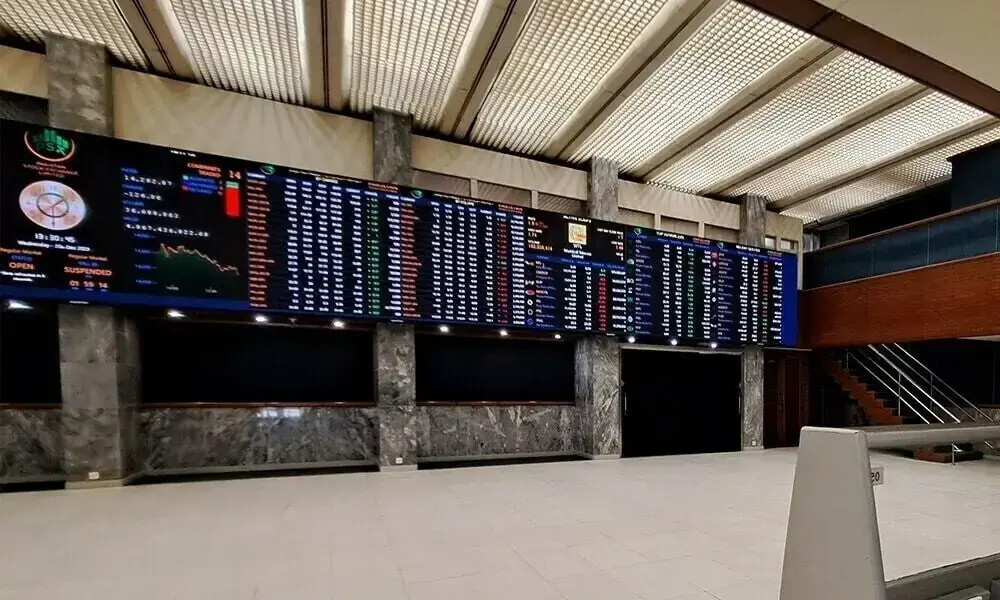
The Pakistan Stock Exchange (PSX) observed selling pressure amid concerns over a broader escalation of conflict in the Middle East, with the benchmark KSE-100 Index losing over 2,000 points during trading on Thursday.
The benchmark index hit an intraday high of 166,180.32 in early trade but came under sustained selling pressure.
Trading remained volatile as the index maintained a steady downward trend, with minor recoveries in the afternoon failing to sustain momentum, dragging the index to an intraday low of 163,782.41.
At close, the KSE-100 settled at 163,924.31, down by 2,006.67 points or 1.21%.
On Wednesday, PSX rebounded as renewed institutional buying, optimism over diplomatic efforts to resolve the US–Iran conflict and expectations surrounding the draft Auto Policy 2026–31 lifted the index. The KSE-100 Index gained 779.34 points, or 0.47%, to close at 165,930.99 points.
Globally, Asian stocks struggled to stay above water in early trade on Thursday, as tech earnings optimism provided only fleeting support amid lingering concerns over AI and uncertainty in the Gulf.
MSCI’s broadest index of Asia-Pacific shares outside Japan was down 0.2%, on track for a fourth straight week of decline. Japan’s Nikkei stock index gave up earlier gains to trade 0.4% lower, while Korean shares were down more than 1%.
US stock futures, the S&P 500 e-minis, were down 0.4% at 7,765.8. Overnight, the tech-heavy Nasdaq led Wall Street to a higher close as better-than-expected earnings reports from market heavyweights helped ease some concerns over the sustainability and profitability of massive AI build-outs.
SpaceX posted its first profit as a public company, Meta reported third-quarter revenue that beat expectations, while AI server maker Super Micro forecast quarterly revenue and profit margin that both topped estimates.
However, Meta’s plan to issue non-voting Class C common stock drew renewed scrutiny on AI spending.




























Comments