


Bata Pakistan Limited: performance and outlook
Bata Pakistan experienced initial growth from 2021-2023 but faced significant declines and losses in 2024-2025 and 1QCY26 due to challenging economic conditions, prompting strategic restructuring.
- Bata Pakistan's financial performance and declining profitability.
- Impact of economic challenges on sales and operational capacity.
- Strategic restructuring, retail rationalization, and production consolidation.

Bata Pakistan Limited (PSX: BATA) was incorporated in Pakistan in 1951 and became public in 1979. The company is engaged in the manufacturing and sale of all kinds of footwear along with sale of accessories and hosiery items. Bafin B.V. (Nederland) is the parent company of BATA whereas the ultimate parent company is Compass Limited, Bermuda.
As of December 31, 2023, BATA has 444 retail outlets across Pakistan. The company has an annual production capacity of 18.394 million pairs.
Pattern of Shareholding
As of December 31, 2025, BATA has a total of 7.56 million shares outstanding which are held by 2032 shareholders. Bafin B.V. (Nederland), the parent company of BATA has the major stake of 75.21 percent followed by NIT & ICP holding 15.21 percent shares of BATA.
Local general public has 5.41 percent stake in the company while insurance companies account for 2.42 percent shares. Around 1.32 percent of BATA’s shares are held by pension funds. The remaining shares are held by other categories of shareholders.
Historical Performance (2021-25)
Except for a decline in 2024 and 2025, BATA’s topline posted reasonable growth in all the years under consideration. Its bottomline declined in 2024 and 2025 with net loss registered in 2025.
The company’s margins which dropped in 2020, recovered for the next two years only to slide back in 2023. In 2024, gross and operating margins picked up while net margin descended. In 2025, all the margins deteriorated. The detailed performance review of the period under consideration is given below.
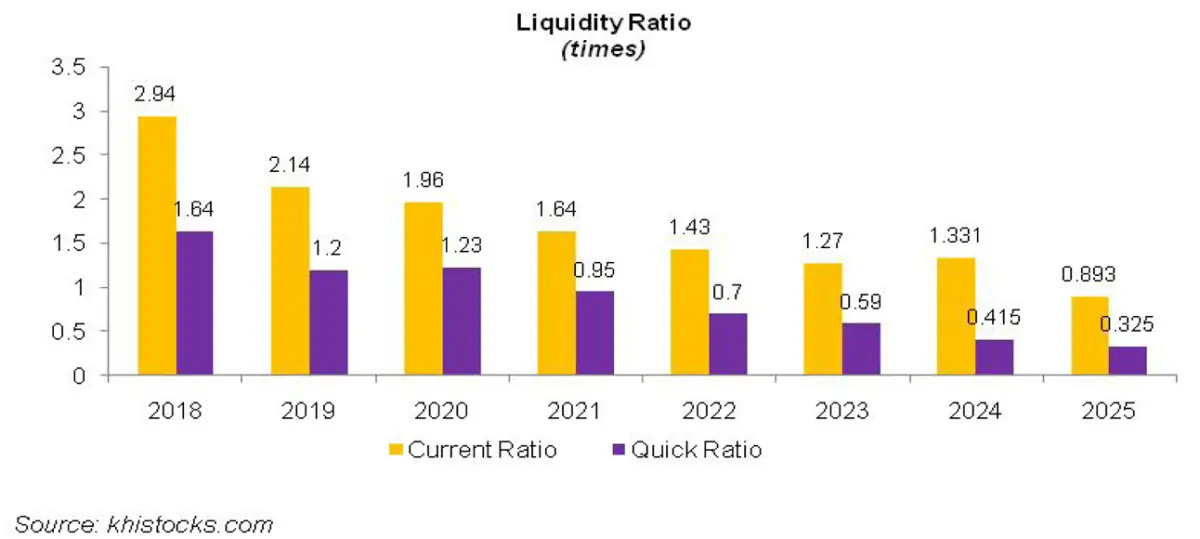
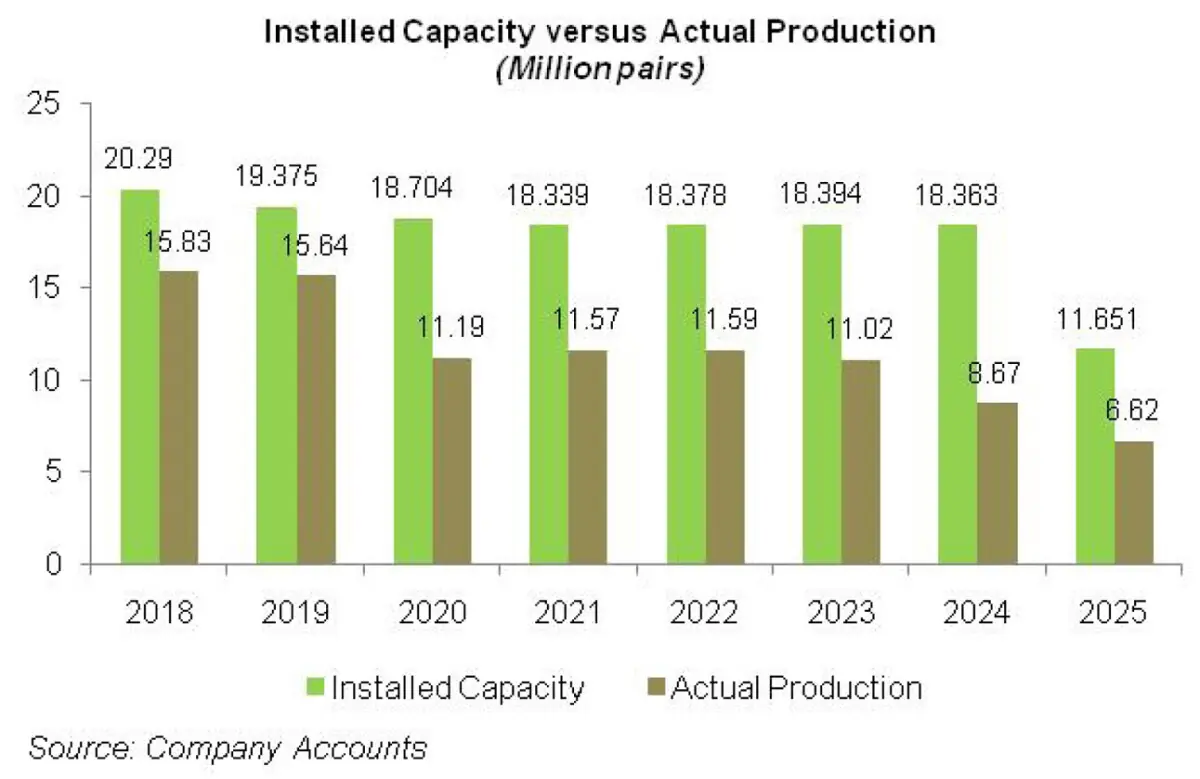
In 2021, BATA recorded 19.41 percent higher net sales to the tune of Rs.13,983.50 million. This was due to change in sales mix, increased volume as well as upward revision of prices. In pursuance of better production and sales mix, the company reduced its production capacity to 18.339 million pairs per annum and operated at 63.1 percent capacity.
Cost of sales ticked up by just 2.29 percent in 2021, resulting in 48.15 percent improved gross profit recorded in 2021 with GP margin of 46.31 percent versus GP margin of 37.32 percent recorded in 2020. Distribution expense grew by 6.80 percent in 2021 due to higher payroll expense, elevated freight charges as well as increased trademark license fee incurred during the year.
Administrative expense grew by 1.58 percent in 2021 mainly because of higher management service fee and increased payroll expense incurred during the year, although, BATA right-sized its workforce to 2274 employees in 2021 from 2287 employees in 2020.
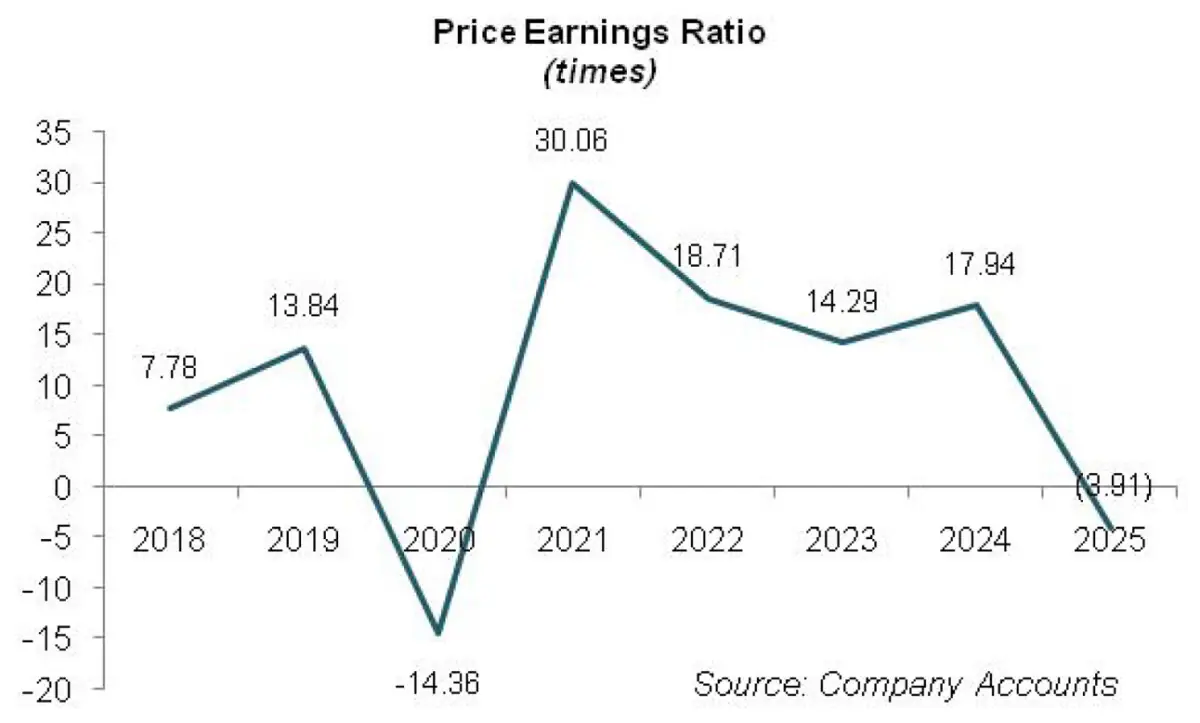
Other expense grew by 46.60 percent in 2021 due to higher profit related provisioning and exchange loss incurred during the year. Other income contracted by 33.28 percent in 2021 due to greater rent concessions received in 2020. The company was able to record operating profit of Rs.1525.93 million in 2021 with OP margin of 10.91 percent. This was against the operating loss of Rs.106.93 million recorded in 2020.
Finance cost slid by 10.29 percent in 2021 due to monetary easing and lesser lease liabilities outstanding. Net profit clocked in at Rs.546.089 million in 2021 with EPS of Rs.72.23 and NP margin of 3.91 percent. This was against the net loss of Rs.627.345 million and loss per share of Rs.82.98 recorded in 2020.
BATA registered net sales of Rs. 17,733.99 million, up 26.82 percent year-on-year in 2022. During the year, BATA slightly increased its annual production capacity to 18.378 million pairs and operated at 63.05 percent capacity. Improved volume, right sales mix, upward price revision and cost cutting measures resulted in 32.64 percent higher gross profit in 2022 with GP margin of 48.43 percent – the highest level achieved to-date.
Distribution expense mounted by 29 percent in 2022 due to considerable hike in payroll expense, trademark license fee, rent as well as advertising and promotion budget incurred during the year. 24.17 percent higher administrative expense incurred during 2022 was the result of higher payroll expense, management service fee as well as travelling charges.
BATA made increased profit related provisioning during the year and also incurred higher exchange loss which translated into 28.29 percent higher other expense in 2022. Other income dropped by 17.73 percent in 2022 due to significantly lesser rent concessions received during the year as well as lower profit earned on bank deposits and investments.
BATA’s operating profit registered 41.6 percent year-on-year rise in 2022 with OP margin mounting to 12.18 percent, Finance cost grew by 4.32 percent in 2022 due to higher discount rate and higher mark-up incurred on WPPF and employees/agents securities and personal accounts.
Higher effective tax rate due to imposition of super tax slightly diluted the bottomline which posted 60.10 percent rise to clock in at Rs.874.288 million in 2022 with EPS of Rs.115.65 and NP margin of 4.93 percent.
BATA’s sales improved by 8.62 percent to clock in at Rs.19,262.62 million in 2023. The company’s production capacity slightly increased to clock in at 18.394 million pairs per annum, however, the company operated at 59.93 percent capacity. The capacity enhancement was particularly done in cemented footwear.
High inflation, Pak Rupee depreciation, hike in commodity prices as well as high energy cost resulted in 10.62 percent higher cost of sales in 2023. Gross profit grew by 6.49 percent in 2023, however, GP margin dwindled to clock in at 47.48 percent. Distribution expense grew by 7.58 percent in 2023 particularly on account of higher payroll expense and elevated level of depreciation charge recorded during the year.
While the company reduced its workforce from 2142 employees in 2022 to 1983 employees in 2023, its payroll expense multiplied due to inflationary pressure. This resulted in 28.80 percent higher administrative expense in 2023.
Other expense grew by 14.60 percent in 2023 due to higher exchange loss and greater provisioning for WWF. Other expense was conveniently offset by 103.20 percent higher other income which was the result of gain on lease modification as well as higher income on investments and bank deposits.
Operating profit thinned down by 2.99 percent in 2023 with OP margin ticking down to 10.88 percent. Despite high discount rate, BATA was able to keep a check on its finance cost which grew by a mere 0.46 percent in 2023. This was due to lesser outstanding lease liabilities in 2023. Net profit grew by 4.80 percent to clock in at Rs.916.288 million in 2023 with EPS of Rs.121.2 and NP margin of 4.76 percent.
In 2024, BATA’s net sales ticked down by 4.83 percent to clock in at Rs.18,332.46 million. During the year, the company not only reduced its annual capacity to 18.363 million pairs but also recorded the lowest ever capacity utilization of 47.21 percent. This resulted in the annual production of 8.67 million pairs of shoes. BATA also significantly reduced its number of retail outlets from 444 in 2023 to 401 in 2024. The decline in production, retail presence and sales volume were the result of tough economic conditions prevailing in the country.
Prolonged period of high inflation significantly squeezed the purchasing power of consumers which kept them at bay from the purchase of non-essential products. Cost of sales slid by 7.89 percent in 2024 resulting in 1.45 percent drop recorded in gross profit for the year.
However, cost control measures and focus on high margin products resulted in the highest GP margin of 49.17 percent in 2024. Distribution expense tumbled by 4.72 percent in 2024 due to lower salaries of sales force as the company reduced its retail presence during the year. Moreover, lesser advertising & sales promotion, trademark license fee as well as repair & maintenance charges also contributed in pushing down the distribution expense in 2024.
Administrative expense ticked up by 4.95 percent in 2024 due to higher payroll expense. This was despite the fact that the company drastically downsized from 1983 employees in 2023 to 1796 employees in 2024. No exchange loss incurred during the year coupled with lesser provisioning done for WWF and WPPF resulted in 50.11 percent lesser other expense recorded in 2024.
Other income also dwindled by 31.19 percent in 2024 due to lesser income from bank deposits and short-term investments as well as thinner gain recorded on lease modification.
BATA recorded 2 percent weaker operating profit in 2024, however, OP margin slightly improved to clock in at 11.20 percent. Finance cost shrank by 11 percent in 2024 due to discount rate cut in the latter half of the year coupled with lesser outstanding liabilities at the end of the year. BATA recorded net profit of Rs.850.73 million in 2024, down 7.15 percent year-on-year. This translated into EPS of Rs.112.53 and NP margin of 4.64 percent in 2024.
In 2025, BATA recorded net sales of Rs.17,776.67 million, down 3 percent year-on-year. During the year, the company focused on the opening of modern format stores and shut down 41 of its loss making retail outlets to bring down the tally to 360 outlets.
In 2025, BATA also switched to cash sale model with its wholesalers rather than offering credit lines. This also affected its turnover in the wholesale segment. Consequently, production volume slid by 23.62 percent in 2025. This resulted in the manufacturing of 6.62 million pairs. Not only this, the company also streamlined its installed capacity from 18.363 million pairs to 11.651 million pairs in 2025.
Cost of sales surged by 15.44 percent in 2025 as the company kicked off 2025 with a very high inventory level due to unsatisfactory sales volume in 2024. This forced the company to clear the stock by offering huge discounts which resulted in 22.12 percent decline in gross profit in 2025 with GP margin falling down to 39.49 percent. While detrimental in the short-run, it was a good step to smoothen the cash cycle and allow the production of fresh inventory.
Distribution expense ticked up by 5.69 percent in 2025 due to higher depreciation expense, greater advertising & promotion expense, increased salaries of workforce and rent expense incurred during the year. Administrative expense also surged by 28.54 percent in 2025 due to higher payroll expense, repair & maintenance expense, management service fee and impairment loss booked on sales tax refundable in 2025.
BATA streamlined its workforce from 1796 employees in 2024 to 1511 employees in 2025. Other expense escalated by 82 percent in 2025 due to exchange loss worth Rs.127.678 million recorded in 2025 as against exchange gain of Rs.47.796 million recognized in the previous year.
Conversely, other income tumbled by 70.54 percent probably due to lesser interest income on account of monetary easing, no exchange gain and lesser gain recognized on the modification of lease.
The most daunting factor was the net impairment loss of Rs.651.81 million booked on financial assets in 2025, up 1761.62 percent year-on-year. This was the impairment booked on long overdue payments from customers. This greatly affected the financial performance of BATA and resulted in operating loss of Rs.1734.37 million in 2025. Before 2025, the company posted operating loss in 2020.
Finance cost surged by 15.48 percent in 2025 due to increased borrowings. BATA registered net loss of Rs.2385.054 million in 2025. This translated into loss per share of Rs.315.48 in 2025.
Recent Performance (1QCY26)
During the first quarter of 2026, BATA registered 8.61 percent stronger net sales to the tune of Rs.5737.841 million. However, this was the result of increased discounts offered to the customers to maintain customer traffic and ensure stable volumes.
Cost of sales surged by 31.60 percent in 1QCY26 due to high inventory cost. This resulted in 12.56 percent diminution recorded in gross profit in 1QCY26 with GP margin clocking in at 41.91 percent versus GP margin of 52 percent registered in 1QCY25.
Increased promotional activity resulted in 1.25 percent higher selling expense in 1QCY26. Administrative expense also surged by 11.51 percent due to inflationary pressure. Other expense dipped by 54.86 percent in 1QCY26 due to lower profit related provisioning and no exchange loss. Other expense was offset by 146.29 percent stronger other income recorded in 1QCY26 likely due to exchange gain.
Operating profit diminished by 62.13 percent in 1QCY26 with OP margin clocking in at 3.84 percent versus OP margin of 11 percent registered in 1QCY25. Finance cost tumbled by 11.60 percent in 1QCY26 due to monetary easing. BATA posted net loss of Rs.149.348 million with loss per share of Rs.19.76 in 1QCY26. This was against net profit of Rs.247.984 million and EPS of Rs.32.80 recorded in 1QCY25.
Future Outlook
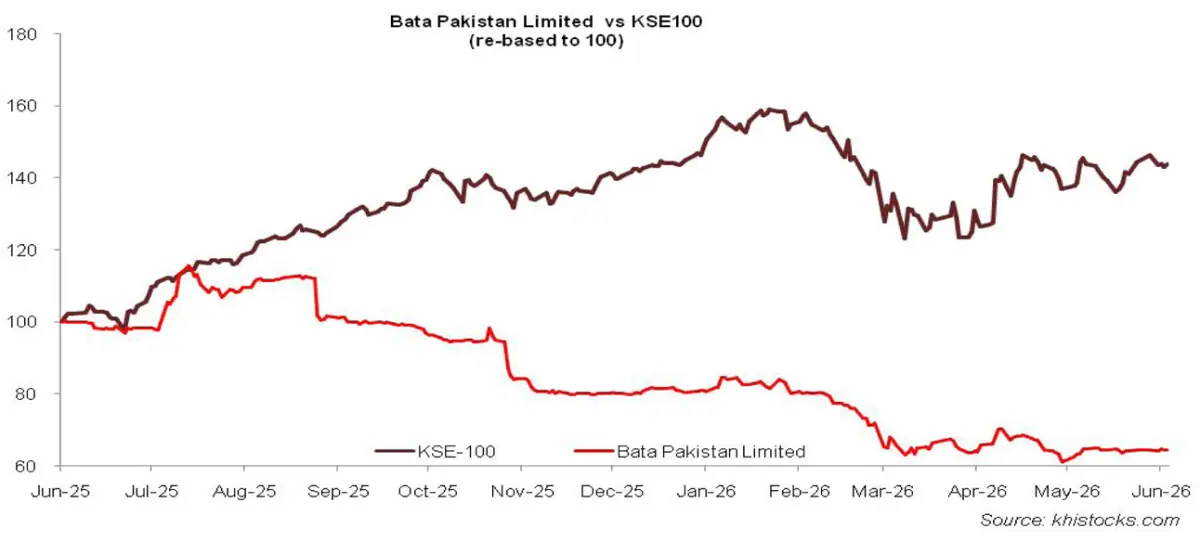
The operating environment remains challenging due to change in the customers’ overall spending patterns. The company is prudently responding to the overall macroeconomic backdrop by clearing its inventory, improving its cash cycle by changing the payment terms with the wholesalers and rationalizing its retail presence. Focus on social media marketing and in-store promotional activities coupled with improving customer retail experience are also the steps in the right direction.
In May 2026, the company also announced the consolidation of its two production lines into a single integrated production facility at Batapur, G.T. Road, Lahore. This was done to ensure lean manufacturing practices and control cost. The company also eyes various export markets to make up for the lean demand in the home market.




















Comments