




The same book ‘How China escaped shock therapy: the market reform debate’ by Isabella M. Weber pointed out that adopting non-shock therapy policies, and within it ‘dual-track’ pricing mechanism had an overall positive impact on China’s economy. She indicated in this regard, ‘On October 20, 1984, the Central Committee adopted the “Decision on Reform of the Economic Structure.” …The core of this new model was essentially to grasp what is heavy and to let go of what is light’ – to borrow from Guanzi’s terminology [as pointed out in the same book ‘The Guanzi is a core text in ancient Chinese economic thought on price stabilization’]…: “Man datory planning will be applied to major products which have a close bearing on the national economy and the people’s livelihood and which have to be allocated and distributed by the state, as well as major economic activities that affect the overall situations.
Other products and economic activities which are far more numerous should either come under guidance planning or be left entirely to the operation of the market, as the case may require.” [quoted from ‘Lou Jiwei, and Zhou Xiaochuan (1984). On the Direction of Reform in the Price System and Related Modelling Methods’].
Moreover, highlighting from the same article, Isabella pointed out in her same book the following: ‘In terms of how to approach reform the decision held, “As the decision-making power of enterprises grows, pricing will be increasingly important in regulating their production, pricing will be increasingly important in regulating their production and operation. It is, therefore, all the more urgent to establish a rational system of pricing. …Pricing is a most effective means of regulation, and rational prices constitute an important condition for ensuring a dynamic yet not chaotic economy. Therefore, reform of the price system is the key to reform the entire economic structure.” …The transformation of China’s agricultural economy, the expansion of the dual-track reform to the heart of the industrial economy… By 1985, the dual-track price system regulated the core of the Chinese economy: grain and basic industrial inputs.’
Policymakers in Pakistan should explore this learning curve in terms of price setting as successfully adopted by China, instead of only reducing the government to mostly a ‘facilitator’ of private sector, and a mere ‘fixer’ of market failures. Hence, the government while formulating and implementing market mechanism, in collaboration with private sector, should follow the ‘dual-track’ pricing mechanism that will likely allow delivering better price discovery in terms of orienting and supporting consumption, and production for reaching rationalized profits, greater affordability, and competitiveness gains. Adopting this system will help salvage the state-owned enterprises (SOEs) in particular from their otherwise mostly loss-making low-value outcomes in general to providing rationalized profits, productivity and competitiveness gains.
Also read: Learning from China’s economic philosophy and policy – I
On the contrary, this is around the time, around late 1980s when Pakistan, on the other hand, started actively pursuing neoliberal and austerity policies both inside and outside of IMF programmes, and has overall continued pursuing these policies since then. This neither put Pakistan on any sustained macroeconomic stability, nor economic growth. In fact, Independent Evaluation Office (IEO) of the IMF in its 2002 report ‘Evaluation of prolonged use of IMF resources’ published by IMF pointed out in this regard: ‘Pakistan is one of the most prolonged users of IMF resources and has been under IMF-supported programs almost continuously since the late 1980s. …Pakistan’s economic history over the last 30 years can be subdivided in two periods. From 1970 to the late 1980s, Pakistan enjoyed an impressive growth performance (6–7 percent a year on average). Fiscal and external imbalances were large during most of that period but unlike in many other developing countries, they did not lead to hyperinflation or to a debt crisis… However, the picture deteriorated markedly from the late 1980s onward, as growth faltered and the continued failure to rein in the fiscal and current account deficits led the debt—which had been accumulating for over two decades—to become unsustainable.’
Since then, sadly, not much has changed in terms of the standard neoliberal and austerity orientation of IMF programmes, and even though voices against its underlying neoclassical, and closely related neoliberal/austerity misgivings have risen ever so loud in policy circles, and more generally even in terms of public activism. In the meantime, Pakistan continued to prescribe to these policies almost continuously since the late 1980s, whereas its next-door neighbour, China, has adopted a more gradual, incremental policy pathway in a non-neoliberal non-austerity way, with a meaningfully strong footprint of government in both real and financial sectors. This has provided sustainable high growth rates overall in a sustainable macroeconomic way, while the dividends of growth have seen deep inclusivity, allowing sharp and significant decrease in poverty, along with in a mission-oriented way China has made a significant move in greening the economy, and adopting artificial intelligence.
In doing all this, unlike Pakistan, its economy has not been going through a boom-bust cycle. Moreover, there appears to be a huge gap in terms of learning, and seeking China’s support in moving towards clean, and much cheaper energy than the current heavily fossil-fuel based energy basis of Pakistan’s economy, not only negatively impacting the environment and being a heavy economic burden on consumers, and producers, but also holds a significant proportion of what constitutes the country’s twin deficit. Once again, the 75th anniversary of our diplomatic relations with China should provide an opportunity in terms of how the two countries can forge a deeper economic, and environmental relation, not to mention learning from China’s pharmaceutical, and bio-tech industry. To reiterate, the underlying economic philosophical underpinnings in China by going against the tide of neoliberal/austerity economics allowed much-needed fiscal space, along with significantly directing its overall financial sector in a meaningfully planned and incentivized way to deliver outcomes in these, and other related directions.
Pointing out the main economic orientation of China, noted economist, Professor Richard D. Wolff, pointed out in an interview that ‘China is a… unique developmental program. That has to be understood. Whatever the phrase socialism with Chinese characteristics means, and it means different things to different people, it has meant for me watching the following. That they are not capitalist in the way that we normally define the United States, Britain, Western Europe, and all of that. Why? Because the private enterprise is not the nearly universal form of producing and distributing goods and services. On the other hand, China is not the Soviet Union. It is not the government, owns and operates, all industry, and much of agriculture. No, it is not that. It is determinately neither the one, nor the other. Well, then what is it? The answer is, it is a hybrid. It is a hybrid because roughly half of its economy is private capitalist enterprises, both Chinese and non-Chinese. And the other half is state-owned and operated enterprise, China. And the whole thing is managed by a very powerful government, which in turn, is supervised by the Communist Party of China.’
Policymakers in Pakistan overall, including a number of successive finance and planning ministers, should think on these lines of ‘hybrid’ economic orientation, with a meaningful role of government working under a whole of government approach and forging a symbiotic relationship with the private sector, and a well-oriented financial sector into delivering efficient, and sustainability providing, inclusive, green, and high-tech economic dividends in a mission-oriented way. A lot of lessons could have been learnt from China, and a much deeper, and broad-based partnership is long over-due; not to mention although deep significance of CPEC, which should be moved into the second phase with full vigour, but understanding that the relationship between the two countries needs to appropriately broad-based by learning from the underlying economic philosophical underpinnings of China.
Combined with the Chinese experience, there is a need to learn from social democratic model of the Scandinavian countries, the ‘Nordic Model’, which, in turn, has a lot common with the Chinese economic model in terms of greater role of government, and purpose-driven, mission-oriented approach to moving towards green economy. For instance, Denmark has made huge strides in greening the economy, where the Danish Energy Agency pointed out: ‘In Denmark, we are experiencing a transformation of our energy system from black to green. …From depending entirely on imported fossil fuels, we now have a world record security of electricity supply of 99.99 pct. with more than 80 per cent of our electricity supply coming from renewable energy. We have achieved this while maintaining national economic growth. The Danish Government has set a target to reduce greenhouse gas emissions by 70 pct. by 2030.’
Here, it needs to be indicated that Denmark is also celebrating its 75th diplomatic relations anniversary with China, whereby a May 21 ‘Beijing Post’ published article ‘China and Denmark enhance collaboration on green innovation’ highlighting the deep cooperation between the two countries, especially with regard to supporting each other with regard to transitioning to green economy, pointed out the following: ‘Senior officials and scholars from China and Denmark have committed to enhancing cooperation in green innovation during the China-Denmark Green Research & Innovation Day, marking the 75th anniversary of diplomatic relations between the two nations. …During the event, which took place in both Beijing and Copenhagen, [science and technology minister for China] Yin [Hejun] highlighted the urgency of international cooperation in addressing global challenges such as climate change, advocating for joint efforts in advancing sustainable development.’
Furthermore, in the ‘Green Joint Work Programme’ between the two countries, it was pointed out in that document that ‘In November 2021, the Foreign Ministers of the People’s Republic of China and of the Kingdom of Denmark committed to reaching agreement on a “Green China-Denmark Joint Work Programme” building on and consolidating bilateral cooperation in accordance with the Comprehensive Strategic Partnership. …The two sides agree on this new Green Joint Work Programme for the period of 2023-2026, to promote areas of mutual interest while recognizing obligations under the Universal Declaration of Human Rights and the United Nations Charter. …China and Denmark share a strong commitment to sustainable green and low-carbon transition and both have set ambitious goals to address climate change and reach carbon neutrality. The two sides agree that China and Denmark should take global leadership to achieve the Paris Agreement goals, while adhering to the relevant principles of the United Nations Framework Convention on Climate Change. …Through this Green Joint Work Programme, China and Denmark will cooperate closely on climate change mitigation and adaptation as well as energy transition.’
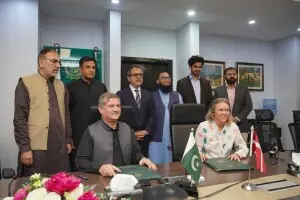
In his recent visit to China, it is hoped that Pakistan’s PM, and his economic team significantly built on partnerships in green energy on the lines perhaps as done by Denmark, for instance. Here, it needs to be pointed out that although it is important for economic advancement of the country to open its economy to Chinese retail, and e-commerce, including providers of AI solutions, through forging partnership with ‘Alibaba’, for instance, among other companies – including learning opportunity that this will provide to the local retail- and AI related sectors – the PM and his economic team should plan deeply in terms of creating support for local industry, and other economic sectors, including AI, on one hand, and protecting local business, including small-and-medium enterprise, and AI related companies, especially the start-ups domestic companies, on the other, from immense competition that the highly developed retail, and AI companies will bring to Pakistan’s economy.
Copyright Business Recorder, 2026
The writer holds a PhD in Economics degree from the University of Barcelona, and has previously worked at the International Monetary Fund. His contact on ‘X’ (formerly ‘Twitter’) is @omerjaved7
















Comments