



Roshan Packages Limited (PSX: RPL) was incorporated in Pakistan as a private limited company in 2002 and was converted into a public limited company in 2016. The principal activity of the company is the manufacturing and sale of corrugation and flexible packaging material.
Pattern of Shareholding
As of June 30, 2025, RPL has a total of 141.90 million shares outstanding which are held by 5251 shareholders. Directors, CEO, their spouse and minor children have the majority stake of 68.17 percent in the company followed local general public holding 26.19 percent shares of RPL. The remaining shares are held by other categories of shareholders.
Historical Performance (2021-25)
Except for a decline in 2025, RPL’s net sales grew over the under consideration. Its bottomline enlarged in 2021 and then nosedived in the subsequent two years. RPL’s net profit picked up in 2024 only to slide back in 2025. The margins follow an irregular pattern.
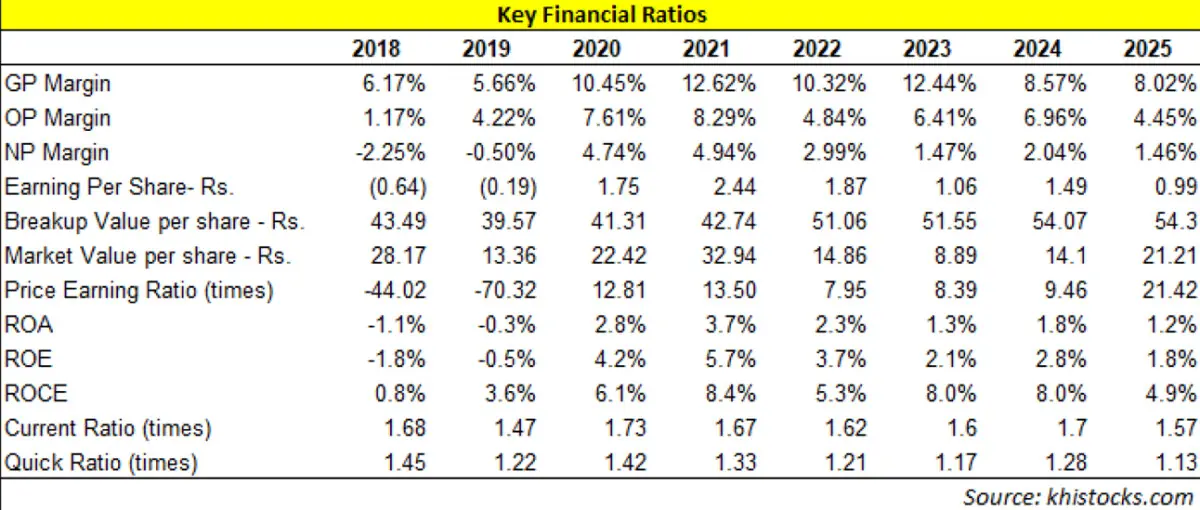
All the margins registered growth in 2021 and decline in 2022. In 2023, gross and operating margins rebounded while net margin continued to slide. In 2024, gross margin plunged while operating and net margins picked up. All the margins contracted in 2025. The detailed performance review of the period under consideration is given below.
In 2021, RPL’s topline boasted 33.69 percent year-on-year rise to clock in at Rs. 6995.84 million. This was on the back of 7.9 percent increase in sales volume which clocked in at 38,369 MT.
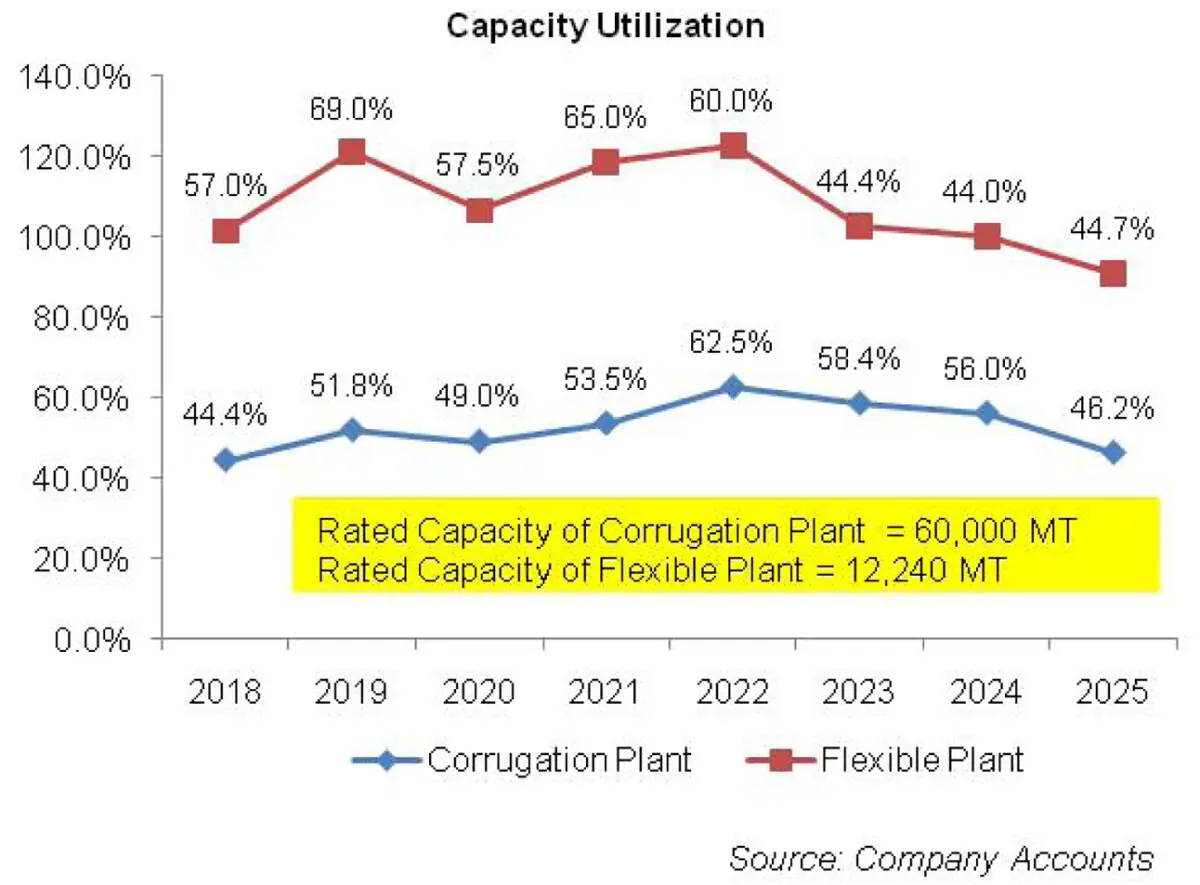
After the outbreak of COVID-19, people became more aware about hygiene and the importance of proper packaging. This buttressed the demand of packaging products. Moreover, the culture of online shopping and online food deliveries further propelled the demand of packaging material. Owing to demand growth, the company’s operated its corrugation plant at 53.5 percent and flexible plant at 65 percent capacity in 2021.
The number of employees also grew from 434 in 2020 to 483 in 2021. Cost of sales grew by 30.45 percent year-on-year in 2021 resulting in 61.47 percent growth in gross profit. GP margin climbed up to 12.62 percent in 2021 from 10.45 percent in 2020.
Administrative and selling expense grew by 20.27 percent and 19.22 percent respectively in 2021 on account of higher payroll expense, travelling and conveyance as well as freight charges. Other expense grew by 106.30 percent year-on-year in 2021 due to higher provisioning for WWF and WPPF.
While the company recognized exchange gain due to improvement in the value of local currency in 2021, lower profit on bank deposits and short-term investments as well as lower interest income on loan to related parties on the back of lower discount rate pushed the other income down by 32.28 percent in 2021.
Operating profit grew by 45.62 percent year-on-year in 2021 with OP margin growing up to 8.30 percent from 7.61 in 2020. Finance cost fell by 49.97 percent year-on-year in 2021 due to monetary easing and lesser borrowings. Net profit grew by 39.40 percent year-on-year in 2021 with NP margin of 4.94 percent.
EPS surged to Rs.2.44 in 2021. This was against the EPS of Rs.1.75 and NP margin of 4.74 percent recorded in 2020.
The demand remained robust in 2022 with 26.73 percent year-on-year growth in topline which was recorded at Rs.8865.56 million. The company dispatched 44,884 MT of packaging material in 2022. The capacity utilization of corrugation plant increased to 62.5 percent, however, flexible plant operated at a reduced capacity of 60 percent in 2022.
Besides higher dispatches in 2022, the company also rationalized its customer portfolio and focused on top-tier local and international corporate customers which resulted in improved prices. However, rise in the cost of imported raw materials coupled with Pak Rupee depreciation and higher utility charges pushed the cost of sales up by 30 percent year-on-year in 2022. This suppressed the GP margin to 10.6 percent in 2022.
The number of employees grew to 565 in 2022 owing to higher capacity utilization. This coupled with inflationary effect pushed up the payroll expense, resulting in 18.41 percent year-on-year rise in administrative expense in 2022. Selling expense grew by 44.23 percent year-on-year in 2022 on the back of increased advertising and promotion budget and freight charges.
Other expense multiplied by 207.54 percent in 2022 due to massive exchange loss on the back of depreciation in the value of Pak Rupee. Other income also slipped by 8.12 percent year-on-year in 2022 due to lesser profit on bank deposits and short-term investments.
Operating profit plummeted by 25.98 percent year-on-year in 2022 with OP margin sliding down to 4.84 percent. 49.82 percent year-on-year increase in finance cost due to higher discount rate and increased short-term and long-term borrowings translated into 23 percent year-on-year drop in net profit which clocked in at Rs.264.71 million in 2022 with NP margin of 3 percent. EPS also plunged to Rs.1.87 in 2022.
RPL’s topline posted 15.58 percent year-on-year growth to clock in at Rs.10246.69 million in 2023.
While the company’s sales volume slid by 9.78 percent to clock in at 40,493 MT in 2023, prolonged emphasis on top-tier local corporate and multinational clients enabled RPL to attain price rationalization. This coupled with cost optimization resulted in 39.26 percent higher gross profit in 2023. GP margin also jumped up to 12.44 percent in 2023.
RPL’s corrugation plant operated at 58.43 percent capacity and produced 35,060 MT of packaging material in 2023.
The capacity utilization of flexible plant stood at 44.38 percent in 2023 resulting in the production volume of 5433 MT. Administrative and selling expense posted a year-on-year rise of 32 percent and 37 percent respectively in 2023 on account of high inflation which drove up payroll expense, utility expense, travelling and conveyance expense as well as freight and carriage charges.
RPL streamlined its workforce from 565 employees in 2022 to 516 employees in 2023. Other expense slid by 27.23 percent year-on-year in 2023 due to lower exchange loss incurred during the year.
Conversely, other income grew by 50.99 percent year-on-year in 2023 due to higher discount rate which pushed up the profit on deposits. Operating profit strengthened by 53 percent in 2023 with OP margin rising up to 6.41 percent.
Finance cost surged by 90.44 percent year-on-year in 2023. While borrowings considerably reduced in 2023, high finance cost was the result of excessive monetary tightening over the year. Net profit slashed by 43.21 percent year-on-year in 2023 to clock in at Rs.150.338 million with EPS of Rs.1.06 and NP margin of 1.47 percent.
In 2024, RPL’s topline grew by a marginal 0.85 percent to clock in at Rs.10,333.52 million. While sales and production volumes remained steady during the year, supply chain impediments due to blockage of Red Sea and Black Sea led to delays in raw materials procurement and also increased the prices of essential raw materials.
Production delays of major customers due to raw material shortages also affected the demand of packaging materials in 2024. Cost of sales swelled by 5.30 percent on account of high inflation, Pak Rupee depreciation and heightened energy tariff.
Weaker demand didn’t allow RPL to pass on the impact of cost hike to its customers. Resultantly, gross profit dwindled by 30.51 percent in 2024 with GP margin sliding down to 8.57 percent.
Administrative and selling expense slid by 7.50 percent and 67.88 percent respectively in 2024 due to curtailed advertising budget as well as lower payroll expense due to rightsizing of employees from 510 employees in 2023 to 461 employees in 2025. Other expense plunged by 58.56 percent in 2024 as no exchange loss was incurred in 2024.
Other income mounted by 85.33 percent in 2024 on the back of higher income from bank deposits and short-term investments, superior interest income on loan granted to Roshan Sun Tao Paper Mills (Private) Limited, dividend income, exchange gain and liabilities written back.
Controlled operating expenses and robust other income enhanced RPL’s operating profit by 9.59 percent in 2024 with OP margin jumping up to 6.96 percent. Finance cost dropped by 5.59 percent in 2024 due to lower outstanding liabilities which resulted in a gearing ratio of 8 percent in 2024 versus 16 percent in the previous year.
Net profit grew by 40.53 percent to clock in at Rs.211.263 million in 2024. This translated into EPS of Rs.1.49 and NP margin of 2 percent in 2024.
In 2025, RPL’s net sales tapered off by 6.51 percent to clock in at Rs.9660.69 million. This was on the back of thinner sales volume recorded during the year due to constrained demand from key sectors. Accordingly, capacity utilization also registered a significant decline in 2025.
Cost of sales fell by a lower magnitude of 5.94 percent in 2025 due to heightened energy tariff and spike in the prices of essential raw materials. This resulted in 12.56 percent diminution in gross profit in 2025 with GP margin falling down to 8 percent. Lower sales volume translated into 5.30 percent downtick in distribution expense in 2025.
Conversely, administrative expense mounted by 20.45 percent in 2025 due to higher payroll expense as RPL expanded its workforce to 506 employees in 2025. Other expense fell by 12.91 percent in 2025 due to lower provisioning done for WWF and WPPF which overshadowed the impact of exchange loss incurred during the year.
Other income plummeted by 72.34 percent in 2025 due to lower interest income from bank deposits, short-term investments and loan to related parties. Moreover, no exchange gain was recognized in 2025. RPL recorded 40.31 percent thinner operating profit in 2025 with OP margin falling to 4.45 percent.
Finance cost dipped by 36.82 percent in 2025 due to monetary easing. This was despite the fact that outstanding borrowings drastically increased during the year which pushed up the gearing ratio to 20 percent in 2025.
Net profit weakened by 33.24 percent to clock in at Rs.141.04 million in 2025. This translated into EPS of Rs.0.99 and NP margin of 1.46 percent in 2025.
Recent Performance (9MFY26)
During the nine-month period of the ongoing fiscal year, RPL recorded 15.84 percent stronger topline to the tune of Rs.8170.48 million. This was on the back of improved sales volume, upward price revision and focus on high-margin segments.
However, elevated energy cost and lag in passing on the impact of cost pressure to the customers resulted in 6.30 percent dip in gross profit in 9MFY26. GP margin also deteriorated from 8.71 percent in 9MFY25 to 7 percent in 9MFY25.
Administrative expense surged by 13.26 percent in 9MFY26 apparently as the company is expanding its workforce to manage increased demand and cater to the specific demands of key customers. Distribution expense also ticked up by 1.67 percent in 9MFY26 due to higher sales volume. Other expense fell by 59.61 percent in 9MFY26 apparently due to lesser provisioning done for WWF and WPPF.
Other expense was wiped off by 17.58 percent higher other income recognized during the period which was supposedly due to higher interest income on the back of increased short-term investment, greater loans to subsidiary and higher bank balances in 9MFY26. Operating profit dwindled by 14.24 percent in 9MFY26 with OP margin clocking in at 3.78 percent versus 5.10 percent in 9MFY25.
Despite monetary easing, finance cost escalated by 37.33 percent in 9MFY26 due to increased short-term and long-term borrowings. RPL recorded 66.44 percent thinner net profit to the tune of Rs.49.336 million in 9MFY26. This translated into EPS of Rs.0.35 and NP margin of 0.60 percent in 9MFY26. This was against the EPS of Rs.1.04 and NP margin of 2.084 percent recorded in 9MFY25.
Future Outlook
The company has significantly streamlined its customer portfolio to include FMCG and essential commodities segment where demand is expected to remain stable. Increasing population and urbanization will keep the demand of FMCG and essential commodities buoyant in the coming times and so will the demand of packaging materials.
The company’s focus on backward integration by investing in Roshan Sun Tao Paper mills will ensure the availability of brown paper promising timely and cost effective production.





















Comments