


Autos: Recovery changes gears
Pakistan's auto industry experienced a strong 39% recovery in FY26, driven by improved economic conditions and new models, though future growth faces policy uncertainty.
- The economic factors fueling the auto industry's strong recovery.
- Market shifts, including the rise of SUVs and new Chinese brands.
- Future outlook and policy uncertainties impacting the auto sector.

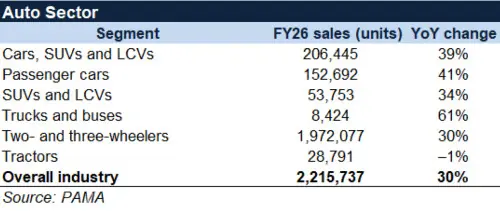
Pakistan’s automobile industry closed FY26 with a strong recovery. Sales of passenger cars, SUVs and LCVs reached 206,445 units, up 39 percent year-on-year. Including motorcycles, three-wheelers, tractors and commercial vehicles, total industry sales crossed 2.2 million units, growing 30 percent.
The reasons are fairly straightforward. Inflation eased, interest rates came down and auto financing returned. Consumer auto loans reached a record Rs369 billion by May 2026, up 36 percent year-on-year. New models and the arrival of more brands also brought buyers back to showrooms.
But this was not the old auto market making a comeback. The market emerging from the downturn looks quite different.
Pak Suzuki remained the volume leader, with sales rising 34 percent to more than 97,000 units. Alto alone sold 62,000 units, showing that the mass market still revolves around the most affordable locally assembled car.
At the other end, SUVs and crossovers continued to gain ground. Sazgar was the year’s standout performer, with four-wheeler sales jumping 77 percent to more than 19,000 units. Haval remained popular, while Tank 500 helped the company achieve record monthly sales in June-26.
Honda volumes increased 53 percent to around 28,000 units, while Indus Motor sales rose 34 percent to nearly 45,000. Hyundai grew more slowly at 18 percent. While established Japanese assemblers still have scale and customer loyalty, newer Chinese-linked brands are competing aggressively with feature-rich vehicles.
The recovery extended beyond cars. Truck and bus sales surged 61 percent, suggesting an improvement in logistics, industrial and infrastructure-related activity. Two- and three-wheeler sales increased 30 percent to almost two million units. This shows that most consumers still prefer affordable and fuel-efficient transport. Tractors were the only weak segment, with sales declining 1 percent.
June ended the year on a strong note. Car, SUV and LCV sales reached 22,741 units, rising 4 percent year-on-year and 29 percent from May. But the monthly numbers were uneven. Passenger-car sales fell 14 percent, while SUV and LCV volumes jumped 73 percent. Some of the monthly increase also came from buyers who made purchases before expected budget-related price increases.
The auto sector outlook is cautiously positive but clouded by policy uncertainty.Sales momentum may continue into FY27, supported by auto financing, new models and stronger competition. However, delayed policy clarity, higher taxes on hybrids, pending CKD tariff relief and lower duties on imported vehicles could raise prices, delay investment and put pressure on local assemblers. In short, demand remains encouraging, but policy uncertainty is the biggest risk.




















Comments