


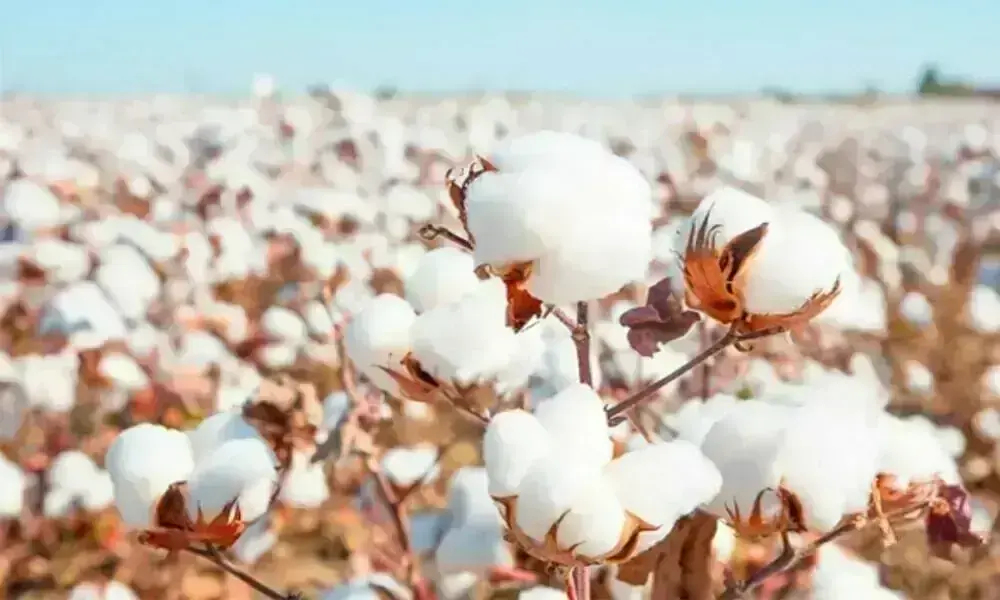
EDITORIAL: Pakistan’s cotton collapse is no longer merely an agricultural problem. It has become a recurring economic penalty.
The Overseas Investors Chamber of Commerce and Industry (OICCI) estimates that cotton production has fallen from around 14 million bales at its peak to just 6.85 million bales this year, costing the economy between $2 billion and $3 billion annually through additional imports and lost export earnings.
More troubling still, the report concludes that regulatory delays and inconsistent policymaking, rather than any shortage of technology or investment, have become the principal obstacles, preventing agriculture from realising its potential.
That finding deserves far more attention than the headline numbers. Pakistan has always possessed a natural comparative advantage in agriculture.
Fertile land, one of the world’s largest contiguous irrigation systems and generations of farming experience should have made agriculture one of the country’s greatest competitive strengths.
Instead, successive governments have steadily transformed that advantage into a missed opportunity through poor policymaking, bureaucratic inertia and regulatory uncertainty. The result is visible across the sector, but nowhere more starkly than in cotton.
This matters because cotton extends well beyond the farm.
The textile industry, which earns roughly 60 percent of Pakistan’s export revenue, depends heavily on domestic cotton. Every decline in local production forces mills to rely more heavily on imported fibre, increasing pressure on already fragile foreign exchange reserves while reducing the competitiveness of the country’s largest export industry.
At a time when Pakistan struggles constantly to generate sufficient export earnings, allowing the supply chain feeding its flagship export sector to deteriorate reflects a remarkable failure of economic management.
The report’s diagnosis is refreshingly candid. Climate shocks and pest infestations have undoubtedly contributed to weaker production, but policy failures have amplified the damage.
Delays in approving improved seed varieties, poor seed quality, blanket restrictions on pesticide ingredients without credible transition arrangements and slow regulatory decision-making have all reduced productivity that should have been improving rather than deteriorating.
Unfortunately, cotton is only one example.
The report identifies the same pattern across maize, potatoes, dairy and tobacco. Hybrid maize technology capable of substantially raising yields remains trapped in implementation delays despite the recent approval of the National Biotechnology Policy.
Potato productivity continues to lag behind international benchmarks because certified processing seed remains scarce.
Pakistan ranks among the world’s leading milk producers, yet only a small proportion of milk is processed while inadequate cold-chain infrastructure allows significant production to be lost before it reaches consumers. These are different sectors suffering from remarkably similar administrative failures.
Perhaps the most frustrating aspect is that none of this is inevitable.
The report notes that investors have already introduced advanced seed technology, crop protection products and precision farming techniques into Pakistan. The expertise exists.
The investment appetite exists. The opportunities certainly exist. What repeatedly stands in the way is an official machinery that moves too slowly, regulates too inconsistently and often appears incapable of translating sound policy into practical implementation.
This pattern extends well beyond agriculture. Across multiple sectors of the economy, governments have demonstrated an unfortunate ability to identify the right reforms while delaying their execution until the underlying opportunity has already begun to disappear.
As the OICCI rightly observes, the direction of policy is often correct. It is the pace of implementation that continues to impose enormous economic costs.
The recommendations contained in the report are hardly revolutionary. Faster approval of seed varieties, predictable pesticide regulation, stronger action against counterfeit seed, reduced post-harvest losses and improved credit access for small farmers all represent practical reforms rather than ambitious experiments.
None requires technological breakthroughs. What they require is administrative competence and political will.
Pakistan’s agricultural decline is therefore not primarily a story of nature turning against farmers. It is increasingly becoming a story of governance turning against one of the country’s greatest economic strengths. The latest OICCI report should serve as another warning.
Whether it becomes another document acknowledged briefly before being forgotten, or finally prompts meaningful reform, now depends almost entirely on the government itself.
Copyright Business Recorder, 2026




















Comments