


Oil climbs as traders assess shipping flows; big monthly gain in sight
- Brent futures were up $1.14 or 1.3%, at $90.17 a barrel
Oil prices dipped Friday but are set for a monthly gain, as Middle East tensions and Strait of Hormuz flows influence markets despite ongoing US-Iran talks.
- Monthly oil price increases despite daily dips.
- Middle East tensions and Strait of Hormuz flows.
- Saudi Arabia's multinational maritime defense coalition.


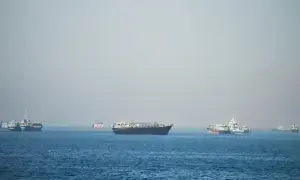
NEW YORK: Oil prices rose on Friday and were on track for a big monthly gain as reports that some tankers were forced to turn around in the Strait of Hormuz prompted traders to reassess shipping flows through the key waterway.
Brent futures were up $1.14 or 1.3%, at $90.17 a barrel at 11:17 a.m. ET (1517 GMT), while U.S. West Texas Intermediate crude was up $2.35, or 2.8%, to $85.94 a barrel.
For July, Brent and WTI were on track to finish up 24%.
Iran’s Revolutionary Guards stopped two tankers from transiting the Strait of Hormuz, while four others changed course, Fars News Agency reported.
Traffic through strait
However, two very large crude carriers carrying oil loaded from the Gulf did exit the strait on Friday, although traffic through the waterway remained thin, according to Kpler ship-tracking data.
Twenty-nine commodity vessels passed through the Bab el-Mandeb Strait on Thursday.
“The market has stopped trading the war and started trading the shipping data,” said Ole Hvalbye, market analyst at SEB Research.
Talks between Iran and Oman on managing the Strait of Hormuz continue, according to the Iranian Labour News Agency, despite Iran rejecting Oman’s proposal for joint management of the waterway.
Saudi Arabia is seeking to lead a coalition to boost defence cooperation in the Bab el-Mandeb Strait, the Red Sea and the Gulf of Aden, all chokepoints for energy supplies.
Geopolitical risks remain
A drone strike that sparked fires on two gas vessels in Egypt’s Mediterranean port of Damietta has raised a new threat to shipping through the Suez Canal, one of the last major export routes available to Saudi oil amid the expanding U.S.-Israeli war with Iran.
Before the conflict, a fifth of global oil and liquefied natural gas supplies passed through the Strait of Hormuz.
Elsewhere, Ukraine’s military said it hit Russia’s Volgograd oil refinery overnight on Friday, causing a fire at the facility.
In Kazakhstan, Tengizchevroil, the operator of the giant Tengiz field, has resumed oil exports via the Georgian port of Batumi for the first time since March, two sources told Reuters.
Supply of the five North Sea crude oil grades underpinning the dated Brent benchmark will average about 467,000 barrels per day in September, down from 474,000 bpd in August, loading programmes showed.
Oil prices are expected to rise further this year as shipping disruptions in the Strait of Hormuz and Red Sea threaten oil flows and heighten supply risks, a Reuters poll showed.
The July survey of 31 economists and analysts forecast that Brent crude would average $85.22 a barrel in 2026, up from June’s forecast of $84.50.

























Comments