


India's Skyroot launches Vikram-1 in first private orbital rocket mission
- The Vikram-1 rocket lifted off from the Satish Dhawan Space Centre in Sriharikota

BENGALURU: Indian space startup Skyroot Aerospace on Saturday launched the country’s first privately developed orbital rocket, a key test of national efforts to compete for a bigger share of the global commercial launch market.
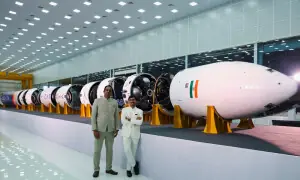
The Vikram-1 rocket lifted off from the Satish Dhawan Space Centre in Sriharikota at 0635 GMT, leaving behind a plume of fire and smoke, carrying several customer payloads and in-orbit experiments on its maiden orbital mission, dubbed “Mission Aagaman”.
It successfully injected its payload into a 450 km orbit about 15 minutes later, making India the third country to achieve orbital launch capability through private enterprise.
The launch, which was initially planned to take off at 0600 am GMT, was put on hold temporarily, before it was rescheduled.
The mission is intended to validate the rocket’s propulsion, avionics, telemetry, guidance, navigation and control systems in flight while collecting data for future commercial launches, Skyroot said.
“Mission Aagaman is a grand success,” the company said in a statement. “This is a test flight. We will be doing a few of these before we move into routine commercial flights,” it added.
Founded in 2018, Skyroot is among a new generation of Indian space startups that have attracted backing from global investors following the sector’s liberalisation.
It became the first space-sector company in the country to hit a $1 billion valuation earlier in the year.
The Indian mission comes amid intensifying competition in the global small satellite launch market, where startups are seeking to challenge incumbents led by Elon Musk’s SpaceX.
Governments across Europe and Asia have also stepped up support for domestic launch companies to secure independent access to space as commercial and defence demand accelerates.
Standing about 22 metres (72 feet) tall, Vikram-1 is designed to carry payloads of up to 350 kg into low-Earth orbit. The launch vehicle uses three solid-fuel stages and a liquid-fuel orbital adjustment module powered by a 3D-printed engine, technologies the company says are being flown for the first time in India.
The rocket is carrying several experimental and customer payloads from Indian and overseas organisations, including technology demonstration satellites and in-orbit experiments.
The launch follows the Hyderabad-based company’s Vikram-S mission in 2022, which became the first privately developed rocket to reach space from Indian soil on a suborbital flight
India opened its space sector to private investment in 2020, allowing startups to build rockets, satellites and launch services, activities that were for decades provided by the government’s Indian Space Research Organisation.
The government aims to increase India’s share of the global space economy to $44 billion by 2033 from about $8 billion currently, betting that private companies can help it compete in a market dominated by players in the United States, Europe and China.


























Comments