


Bangladesh urges China to reduce trade gap
- Rahman is on a three-day trip to China, which began on Wednesday, his first visit to the country since he became prime minister in February
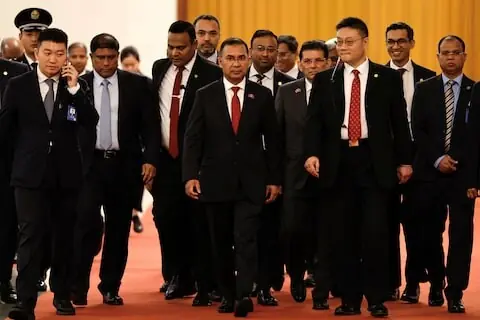

BEIJING: Bangladeshi Prime Minister Tarique Rahman met with Chinese President Xi Jinping in Beijing on Friday, where he urged a reduction of the trade gap, diversification of exports and China’s support in implementing his country’s major projects.
Rahman is on a three-day trip to China, which began on Wednesday, his first visit to the country since he became prime minister in February.
Dhaka is seeking to deepen ties with China, one of its largest trading partners and development financiers.
The visit also carries broader diplomatic significance, as Rahman seeks to balance ties with both Beijing and New Delhi. His predecessor, Sheikh Hasina, was widely seen as closer to India, and while relations between Dhaka and New Delhi have improved since Rahman took office, disagreements, including over border tensions, remain.
Rahman told Xi that in order to reduce Bangladesh’s trade deficit, China could help diversify Bangladesh’s exports to the country.
“We request China to consider import our fresh mangoes, jackfruit, guava, aquatic products, raw leather, jute products and pharmaceutical products,” Rahman said, according to a media pool report.
Bangladesh needs China’s support in “implementing our major signature projects and upgrading and modernisation of our existing industrial units,” he added.
Bangladesh joined China’s Belt and Road Initiative in 2016, Xi’s flagship infrastructure and development strategy aimed at connecting Asia, Africa and Europe.
Bangladesh’s premier looks to China, Malaysia for investment, jobs in first trip
China is willing to work with Bangladesh to import more high quality products from Bangladesh, support Chinese enterprises in investing in the country and expand cooperation in emerging industries such as new energy, the digital economy and artificial intelligence, according to a Chinese government statement.
Rahman met with Premier Li Qiang on Thursday where they signed multiple cooperation agreements to solidify bilateral ties, state media reported.
Bangladesh owes China $6.2 billion, World Bank data shows, with the Beijing-based Asian Infrastructure Investment Bank having lent a further $2.3 billion. Delhi has lent its neighbour just $1.6 billion.
Meanwhile, Chinese firms have invested a further $7.7 billion, around half of which was in Bangladesh’s energy sector, data from the American Enterprise Institute think tank shows.
China has become more cautious about financing, said Chim Lee, senior analyst at the Economist Intelligence Unit in Beijing.
“Not least because it tends to be looking for key logistics corridors these days that can be scaled up, and Bangladesh is a bit tricky because it just doesn’t provide the same kind of corridor as say Central Asia or Myanmar,” Lee said.


























Comments