


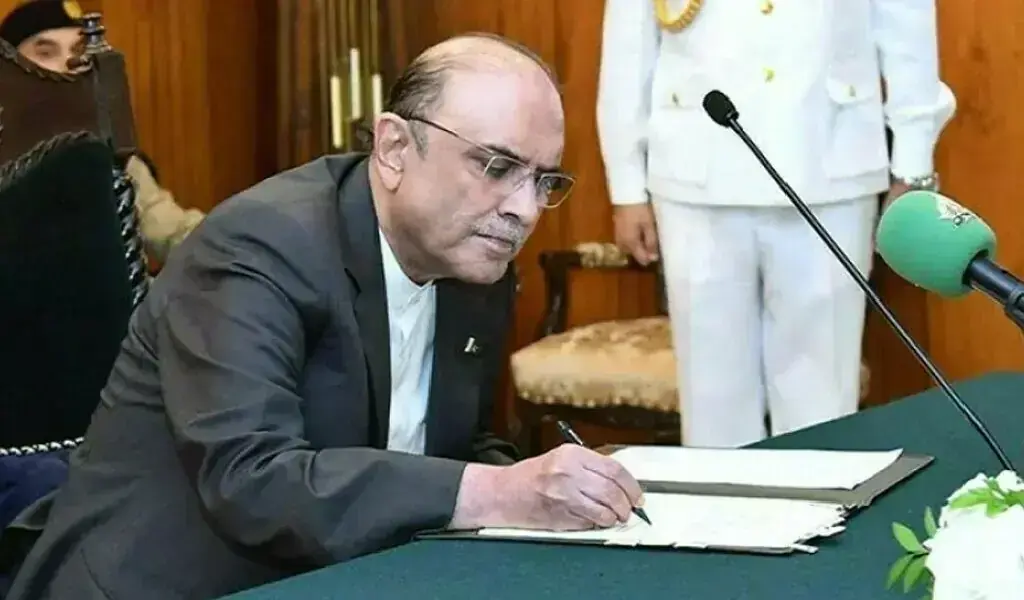

ISLAMABAD: President Asif Ali Zardari inked Finance Bill 2026, enforcing taxation/policy and enforcement measures of Rs1.02 trillion for fiscal year 2026-27, from July 1, with heavy reliance on indirect taxes and withholding taxes to meet the ambitious tax collection target of Rs15,264 billion in next fiscal year.
It is learnt that the President Asif Ali Zardari has approved the Finance Bill 2026.
Finance Act 2026 would be enforced from July 1, 2026 with tax relief at the import stage having revenue implications of Rs143.4 billion on imports.
Finance Act 2026 would reduce Customs Duty, Additional Customs Duty, Regulatory Duty, and exemptions under the Fifth Schedule, with reductions proposed on thousands of tariff lines and the removal of redundant exemption entries from July 1 2026. The reforms are expected to reduce the overall average tariff while carrying an estimated revenue impact of approximately Rs143.4 billion.
READ MORE: Budget 2026-27: NA passes Finance Bill 2026 amid opposition walkout
According to sources, the Finance Bill was sent to the President for approval a day earlier by the National Assembly Secretariat.
The President approved the bill on the advice of the Prime Minister. A signed copy of the approved Finance Bill has been received by the National Assembly Secretariat, sources added.
Following President Asif Ali Zardari’s assent, the Finance Bill 2026 will come into effect from July 1, 2026.
According to the details of the proposed measures for the next fiscal year, the revenue impact of Taxpayer Services and Facilitation Enhancement Programme would have a revenue impact of Rs144 billion.
The expansion of the Third Schedule of the Sales Tax Act would generate an amount of Rs91 billion.
The initiative of the Faceless Auto Tax Office - Algorithmic Settlement Ramp-offs would result in an additional collection of Rs85 billion.
The Production Data Integration and Real-Time Sectoral Verification Framework are estimated to collect Rs85 billion in 2026-27.
The Retailer Formalisation and POS Integration Scheme are expected to generate an amount of Rs82 billion and Supply Chain Digitalisation Policy would collect an amount of Rs75 billion.
The structured ADR-Led Revenue Realisation - “ADRC Throughput Optimisation” would generate an amount of Rs45 billion. In the next fiscal year, the Conditionality Framework for High-Value Economic Participation would generate an amount of around Rs43 billion.
The introduction of sales tax on industrial importers (including additional 3 percent on “misuse” of industrial imports)/tax arbitrage would collect an amount of Rs40 billion.
The Windfall tax on refineries can collect an amount of Rs36 billion and increasing minimum turnover tax for certain classes of distributors from 0.25 to 0.5 percent would result in collection of Rs35 billion.
The Risk-Based Customs Valuation and Intelligence-Led Border Compliance Framework has the capacity of an additional collection of Rs33 billion.
If the government allows reduced sales tax rate on hybrid vehicles to expire on June 30, 2026, this would have a revenue impact of Rs31 billion.
The federal excise duty (FED) on POL products that are used for adulteration but not chargeable to PDL @ Rs80/litre (white spirit, solvents) would generate Rs29 billion.
The application of withholding taxes on purchases from unregistered entities to individuals and association of persons (AOPs) will generate Rs28 billion.
The recalibrating withholding taxes on different categories of services has the capacity to collect Rs27 billion.
The Graduated Penalty Rationalisation Framework for Systemic Filing Non-Compliance has revenue impact of Rs26 billion.
The expiring sales and income tax exemptions in tribal areas on imports has revenue implications of Rs23 billion.
The Special excise duty on luxury items and high-end EV vehicles has the revenue impact of Rs20 billion and increasing withholding tax on sales of government securities has a revenue impact of Rs11 billion.
If the steel industry and trading houses are subjected to minimum tax, it has a revenue impact of Rs10 billion.
The Clause 46A: Minimum tax on steel sector to introduce parity with other sectors has revenue impact of Rs5 billion.
A proposal to remove exemption from withholding tax on supplies by trading houses would generate Rs5 billion.
Other policy measures have revenue implications of Rs4 billion whereas the tax rate on Capital Gain on shares of non-filers can generate Rs2 billion.
Toll manufacturing for informal customers – recovering due tax has a revenue impact of Rs2 billion in 2026-27.
Copyright Business Recorder, 2026





















Comments