


PM tells NA: US-Iran deal could ease global tensions
Prime Minister Shehbaz Sharif welcomed the US-Iran understanding, hoping it eases global tensions, and highlighted Pakistan's key role as a facilitator amid a confrontational National Assembly session.
- Pakistan's role in facilitating US-Iran diplomatic talks.
- Domestic political disputes and parliamentary confrontations.
- Prime Minister's defense of electoral legitimacy and provincial development.
- Opposition's concerns over constitutional violations and regional issues.
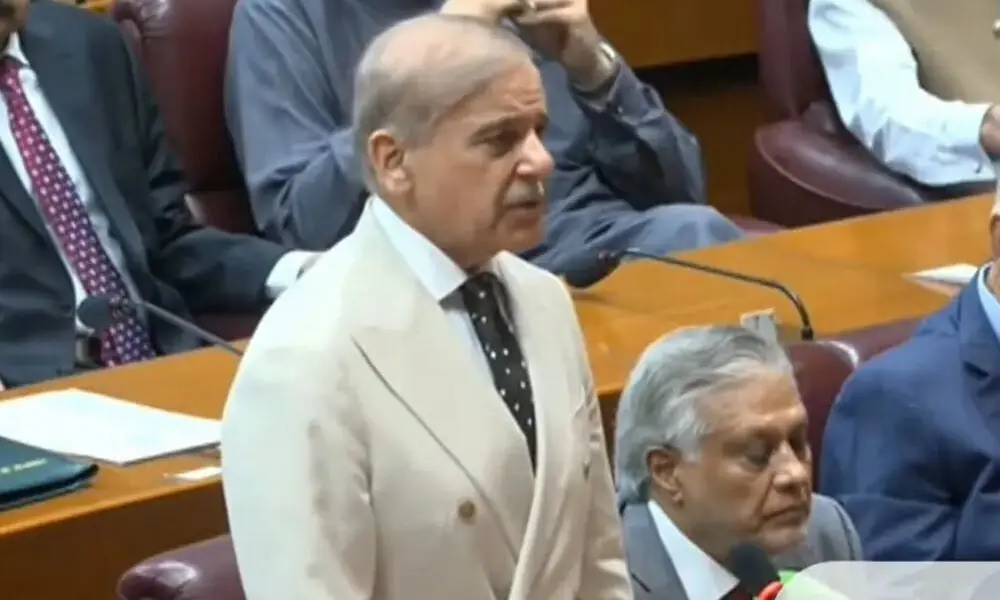

ISLAMABAD: In a cautiously upbeat signal amid lingering geopolitical fault lines, Prime Minister Shehbaz Sharif on Tuesday welcomed the latest US-Iran understanding, saying he hoped it could evolve into a “long-lasting agreement” capable of easing wider global tensions.
His remarks came during a charged National Assembly sitting that ended in an opposition walkout after a heated exchange with Pakistan Tehreek-e-Insaf (PTI)-backed opposition leader Mehmood Khan Achakzai.
The session, already tense over domestic political disputes, escalated into repeated interruptions and sharp rebuttals from both the prime minister and National Assembly Speaker Ayaz Sadiq.
READ MORE: US-Iran talks: PM says satisfied with successful conclusion
Amid the parliamentary confrontation, the prime minister briefly shifted focus to foreign policy, referencing weekend diplomacy in the Swiss resort town of Burgenstock, where US and Iranian delegations held extended talks with Pakistan and Qatar acting as facilitators.
The discussions, he added, stretched for hours past midnight into early Monday and concluded with a joint statement outlining 60 days of technical negotiations on Iran’s nuclear programme, ballistic missile concerns, and frozen assets.
“Pakistan tried its best, with complete sincerity, to bridge the distance between the two sides,” he said, adding that the outcome had already helped project a “positive narrative” for Pakistan internationally.
He noted that major international newspapers had highlighted Pakistan’s role, calling it recognition that “billions of rupees” in publicity spending could not have bought.
Shehbaz congratulated the House and the nation for what he described as Pakistan’s “historic and key role” in facilitating the diplomatic engagement.
He also referred to the arrival of Iranian President Masoud Pezeshkian in Islamabad, saying discussions with Tehran would focus on strengthening bilateral ties and warning against politicising the moment.
Turning to domestic politics, the prime minister dismissed opposition claims about electoral illegitimacy, arguing that if the 2018 elections that brought PTI to power were considered valid, then the 2024 elections should be viewed through the same lens, calling for consistency in political judgement.
He also defended his earlier remarks on Balochistan’s resources and his desk-thumping during a previous speech, linking them to Pakistan’s diplomatic outreach and increased provincial allocations under the National Finance Commission (NFC) Award.
National progress, he added, depended on balanced development across all provinces, insisting that “Pakistan will not progress until all four provinces progress.”
The session grew increasingly confrontational as Achakzai criticised the NA Speaker’s conduct and accused the government of constitutional violations, including the disqualification of 14 PTI lawmakers.
He also condemned the life sentence awarded to Baloch Yakjehti Committee activist Dr Mahrang Baloch and raised concerns over unrest in Azad Jammu and Kashmir (AJK).
From the opposition benches, Achakzai challenged the government’s definition of national unity, arguing that Pakistan was not an abstraction but a federation of Khyber Pakhtunkhwa, Balochistan, Sindh and Punjab.
“Why don’t you see KP as part of Pakistan,” he asked, accusing the government of sidelining regions and “trampling the Constitution.”
Speaker Sadiq pushed back forcefully, saying he would not allow remarks against Pakistan, the armed forces or the judiciary.
He accused the opposition of procedural obstruction and inconsistency, noting they continued to exceed speaking limits while questioning the legitimacy of Parliament itself.
In unusually sharp remarks, he described the opposition as being in a “state of confusion,” stressing that democratic institutions must be respected even amid political disagreement.
Copyright Business Recorder, 2026















Comments