


From green haven to concrete zone: Shakarparian’s slow disappearance
Islamabad's Shakarparian green belt is rapidly shrinking due to extensive tree cutting for urban development and memorials, leading to environmental degradation, rising temperatures, and public outrage.
- Transformation of Shakarparian into an urban development hub.
- Extensive tree felling for new memorials and infrastructure projects.
- Environmental impacts, including rising temperatures and air quality.
- Concerns regarding transparency and environmental impact assessments.
- CDA's sapling plantation efforts amidst ongoing deforestation.

Shakarparian, once a lush green expanse in Islamabad, is steadily shrinking as urban development continues to expand. What was previously a natural, forested area within the Margalla Hills National Park has gradually been transformed into a hub for various landmarks.
Today, the area hosts the Parade Ground, Pak-China Friendship Center, Islamabad Club, Gun and Country Club, Lok Virsa, an open-air theatre and several upscale hotels.
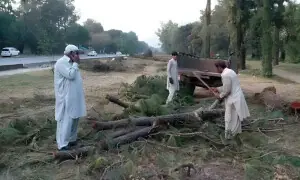
More recently, the situation has worsened due to extensive tree cutting.
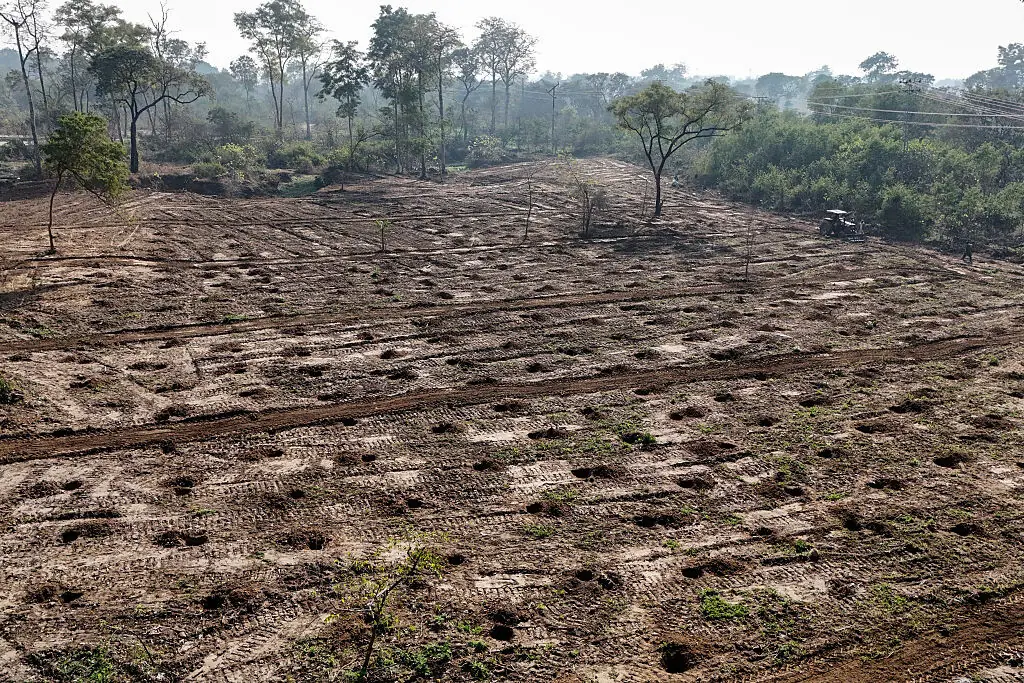
Fully grown trees were removed along a section of the green belt on the Expressway in H-8, where a memorial site is under construction, according to Hassan Khan, who is campaigning against this move. “The felling of these trees has further impacted the greenery of Shakarparian, as this site is across this park area,” he said.
The impact of this activity is clearly visible to residents.
“Now, while walking through this area, the cool breeze and the chirping of birds are no longer to be found. Instead, there is noise, dust, and heat,” said Sughra Saleem, a medical sciences student who often walks there in the evenings.
The Capital Development Authority (CDA) has ordered the felling of thousands of trees on various grounds, with defence and housing priorities often placed above environmental concerns.
In Islamabad, once celebrated as one of South Asia’s greenest capitals, the sound of chainsaws now echoes where birdsong once defined the landscape. “Recent large-scale tree cutting across key areas of the city—particularly near Shakarparian, Chak Shahzad, and sectors linked to infrastructure —has triggered public outrage and legal challenges,” environmentalist Yousaf Khan said.
Thousands of mature trees have been felled over the past year, with some removals directly linked to road construction and projects tied to housing schemes. Environmental groups, including WWF-Pakistan, have warned that this is not merely about removing allergenic species but part of a broader pattern of land clearing for urban expansion.
The consequences are already becoming evident. Scientists and climate experts warn that Islamabad has lost a significant portion of its green cover, contributing to rising temperatures, deteriorating air quality, and an intensifying urban heat island effect. Over the decades, the city’s temperature has increased by nearly 5°C, with deforestation and unchecked construction playing a major role.
Urban trees—which are vital for regulating climate, stabilising soil, and sustaining biodiversity—are disappearing at a much faster rate than they are being replaced. Once envisioned as a meticulously planned “garden city,” Islamabad is increasingly transforming into a concrete-dominated landscape, leaving its residents more vulnerable to pollution, extreme weather, and growing ecological imbalance.
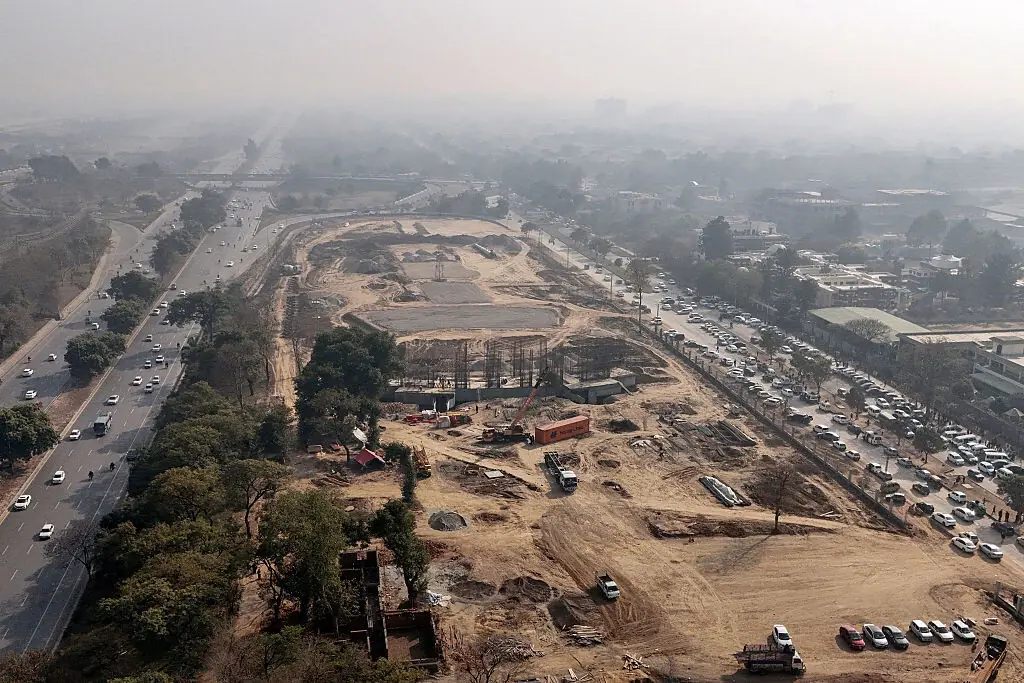
WWF-Pakistan’s field observations show that while some tree removal is linked to Paper Mulberry management for public health reasons, significant vegetation loss is associated with unplanned infrastructure development. Along the H-8 Islamabad Expressway and the Margalla Enclave Link Road, land clearing has resulted in urban tree and vegetation cover loss across five hectares and 10–15 hectares respectively.
According to WWF, at the H-8 Islamabad Expressway site, large-scale land levelling and excavation have been observed, with on-site information indicating plans for monument construction.
Time-series Google Earth images show a steady increase in land clearing from approximately 1.5 hectares in 2023 to about 6.5 hectares by 2025. This expansion includes previously undisturbed land, resulting in an estimated ecological loss of around five hectares. No active plantation or green landscaping measures were visible at the time of analysis, indicating that clearing is ongoing at a rapid pace and raising concerns about the absence of environmentally conscious planning.
Muhammad Ibrahim Khan, Director Forests at WWF-Pakistan, said, “Any infrastructure-related tree removal must be preceded by legally compliant environmental impact assessments (EIAs), followed by transparent disclosure and avoidance-first planning to ensure long-term ecological integrity.”
CDA spokesperson Shahid Kiani said that to restore greenery, the authority has requested 45,000 saplings from the Ministry of Climate Change to compensate for the removal of around 30,000 mature trees in Islamabad. He added that “the requested saplings include indigenous species such as Arjan, Kachnar, Amaltas, Jacaranda, Tecoma, Siris, and Phulai to support the upcoming plantation drive and restore the city’s green cover”.
Director General of WWF, Hammad Naqi Khan, said that plantation alone is not the main issue — the real concern is transparency. He highlighted a lack of consultation and openness from city managers. According to him, WWF has shared its recommendations through letters and reports, outlining ways to help preserve the capital’s greenery.
The article does not necessarily reflect the opinion of Business Recorder or its owners.
The author is a journalist with 17 years of experience across newspapers, television, radio, and digital platforms.




















Comments