


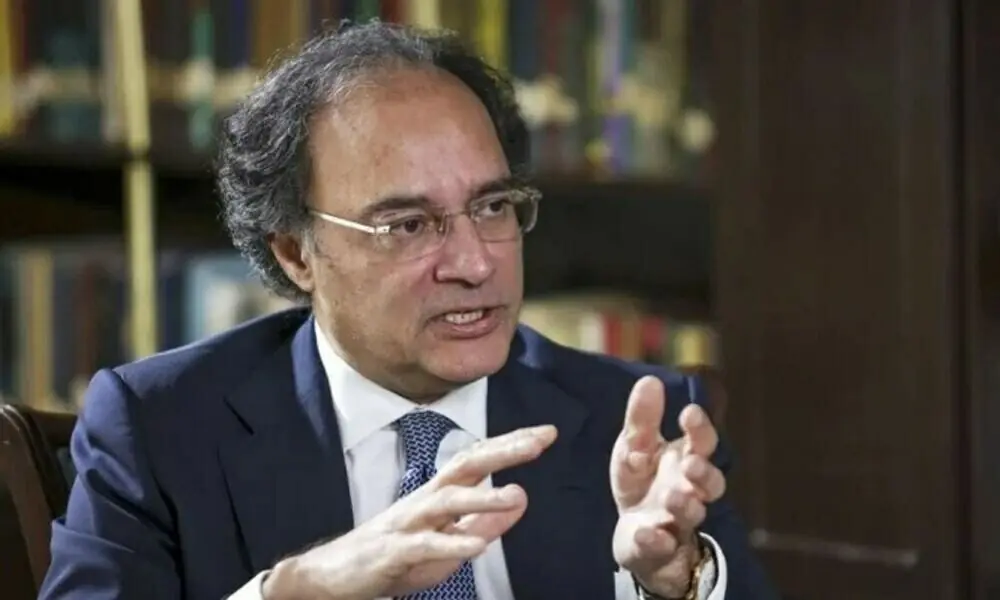

ISLAMABAD: In a pointed yet conciliatory overture to the opposition, Finance Minister Muhammad Aurangzeb on Sunday urged Pakistan Tehreek-e-Insaf (PTI) to return to the standing committees of both National Assembly and Senate, praising their input during last year’s budget cycle as “commendable”.
Winding up the debate on cut motions on the different ministry’s demands for grants, Aurangzeb struck a noticeably inclusive tone on the floor of the House.
Addressing PTI lawmakers Mubeen Arif and Osama Mela – whom he singled out for their command of economic jargon – he said the government valued “constructive opposition” at committee level and would welcome their return “without hesitation”.
“We felt the absence of members Mubeen Arif and Osama Mela this year,” he remarked, adding that their proposals would not merely be heard but actively considered should they rejoin the process.
The minister maintained that ongoing reforms at the Federal Board of Revenue (FBR) would help the government meet next fiscal year’s tax targets.
He insisted the policy direction was shifting away from simply increasing the tax burden towards structural reform – both in taxation and in the energy sector, as highlighted by the Power Ministry – alongside changes in debt servicing and pension systems.
Aurangzeb said economic indicators had improved markedly compared to “two to two-and-a-half years ago”, crediting the direction of the government under Prime Minister Shehbaz Sharif.
He recalled that when the government assumed office in 2022, no allocations had been made for the Public Sector Development Programme (PSDP), with development funding reportedly constrained to the point of quarterly disbursement difficulties.
On macroeconomic indicators, he cited growth at 3.7 per cent, while claiming debt servicing had been reduced progressively from 75 per cent of GDP to 70 per cent and then to 68 per cent.
He further said tax revenues had doubled compared to last year and insisted no new taxes had been imposed on the masses.
Turning to youth employment, Aurangzeb said the government was pursuing an “ecosystem-based” approach and urged provinces to replicate Sindh’s public-private partnership model in development planning.
He expressed confidence that ongoing reforms would enable the government to meet its revenue targets in the coming fiscal year.
On regional developments, he referenced the ceasefire between the US and Iran, saying its early impact was already visible through recent reduction in petroleum prices, and expressed cautious hope that stability would hold. The otherwise technocratic tone of the debate was repeatedly punctured by opposition interventions. PTI’s Zain Qureshi questioned the performance of the FBR’s Point of Sale system and warned that debt had become an increasingly heavy drag on the economy.
Shahida Akhtar Ali of JUI-F called for salary increases for public sector employees in line with inflation, while other lawmakers raised a familiar catalogue of grievances: unpaid salaries for university staff in Balochistan, limited development gains from CPEC projects, concerns over Independent Power Producers, delays in the merged districts, and demands for widening the tax base instead of increasing rates.
Calls also echoed across the House for infrastructure development in under-served regions, including highways, bridges and interchanges, alongside criticism of unemployment, fiscal mismanagement and what several members described as persistent neglect of southern Punjab.
Planning Minister Ahsan Iqbal stepped in to dispel what he called “longstanding confusion” over the Lahore Orange Line Metro Train project, insisting it was fully financed by the Punjab government and did not draw from the federal exchequer.
He categorically stated the project lay outside the China-Pakistan Economic Corridor (CPEC) financing framework, adding: “The federal government did not contribute a single rupee.”
In a brief departure from the chamber’s usual temperature, Power Minister Awais Leghari personally crossed the floor to receive an electricity bill presented by PTI’s Sanaullah Mastikhail, who had highlighted a sharply inflated charge of 1,200 units linked to an overseas acquaintance’s household.
The gesture drew rare appreciation from the opposition lawmaker, with the minister thanking him for raising the issue – a fleeting moment of procedural civility in an otherwise combative sitting.
Earlier, Defence Minister Khawaja Asif delivered one of the day’s most politically charged interventions, warning against what he described as a growing “Vigo Dala culture” around Parliament – a reference to expanding convoy-style security movements using Toyota Hilux vehicles. He cautioned that increasingly elaborate protocol arrangements and security-linked privileges were projecting an image of unchecked authority rather than accountable governance. He also criticised symbolic displays such as flag-laden ministerial convoys, calling for what he termed a “cultural reset” in political conduct.
Asif further raised concerns over parliamentary discipline, alleging lax control over visitor access to sensitive areas and the casual recording of proceedings.
NA Speaker Ayaz Sadiq responded by directing members to strictly observe entry protocols, stressing that parliamentary rules were not optional etiquette but binding procedures requiring full compliance.
In a separate development, the House approved a motion moved by PTI acting chairman Barrister Gohar Ali Khan to restore PTI lawmaker Iqbal Afridi, ending his suspension.
Copyright Business Recorder, 2026
























Comments