


FY26 growth target missed on 2025 floods, ME conflict, Trump tariffs
Pakistan's economy grew 3.7% in FY2025-26, missing its 4.2% target due to external shocks, yet achieved record size and improved fiscal health, demonstrating resilience amid global challenges.
- Reasons for missing the 4.2% growth target.
- Pakistan's economy reaching a historically high size.
- Improved fiscal deficit and rising foreign exchange reserves.
- Growth across agriculture, manufacturing, and services sectors.


ISLAMABAD: Growth target of 4.2 percent set for the outgoing fiscal year 2025-26 has been missed by 0.5 percent and estimated at 3.7 percent due to three exogenous factors, notably the Middle East conflict, the floods in September, and the Trump tariffs.
This was stated by Finance Minister Muhammad Aurangzeb while unveiling the Economic Survey 2025-26 presented traditionally a day prior to the presentation of the budget for the next fiscal year.
He was flanked by the Planning Minister Ahsan Iqbal, Chairman Federal Board of Revenue Rashid Langrial and the head of the department that authored the Survey, Dr. Raja Hasan M. Mohsin, the Economic Advisor.
READ MORE: FY26 Economic Survey: Economy remains fragile despite recovery claims
The growth rate is higher than last year’s growth of 3.18 percent but falls short of its target of 4.2 percent, said Aurangzeb, adding that it is a story of resilience and discipline shown during the outgoing fiscal year.
The finance minister said that GDP growth in fiscal year 2023 was -0.2 percent, 2.6 percent in fiscal year 2024, and 3.2 percent in fiscal year 2025.
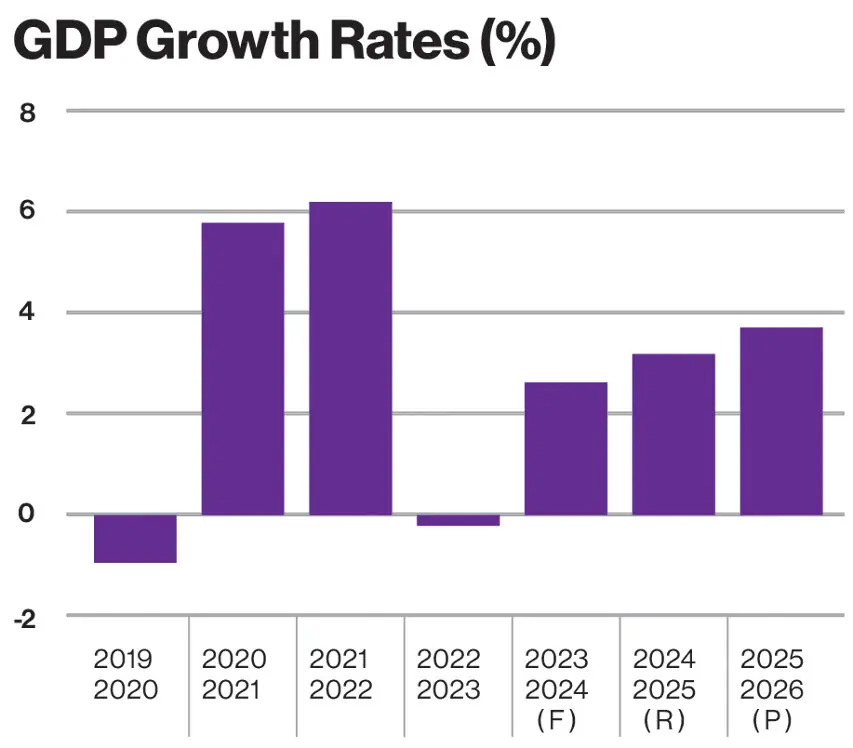
Earlier, GDP growth was estimated to exceed 4 percent, but it did not happen due to the ongoing conflict in the Middle East. “But having said that, we have still reached a historically high size of the economy at Rs126.9 trillion,” he said.
The country’s economy had risen above USD452 billion, with per capita income increasing 9 percent to USD1,901, which was USD1,751.
He said the country began the outgoing fiscal year with uncertainty due to tariffs. “Then, by the end of July, we reached a point where we could be in a competitive position with respect to our exports, especially to the US,” he added. Then there were floods in August and September 2025, followed by a regional conflict in March this year.
“These challenges tested Pakistan’s resilience,” he said, adding that the government was able to deal with them and remained on the path of moving from stabilization to growth. Pakistan faced three major challenges and addressed them effectively. “These factors affected not only Pakistan and the region but the entire world,” he said, noting that global growth had also slowed.
The finance minister said that the government has successfully negotiated the first-order impact of the conflict, but its impact would be felt in the coming months.“Our oil imports, which shot up above USD1 billion in April, were lowered to half a billion dollars in May, because we are now trying to manage the inflows,” he said.
“Whereas, the second-order impact of this conflict is being observed in the rising inflation rate, which has led to an increase in the policy rate,” he said.
Aurangzeb added that he remains optimistic that the country’s leadership mediating efforts would be successful. “But the reality is that the energy infrastructure has been hit and continues to be hit. We are taking that into vis-à-vis our contingency,” he added.
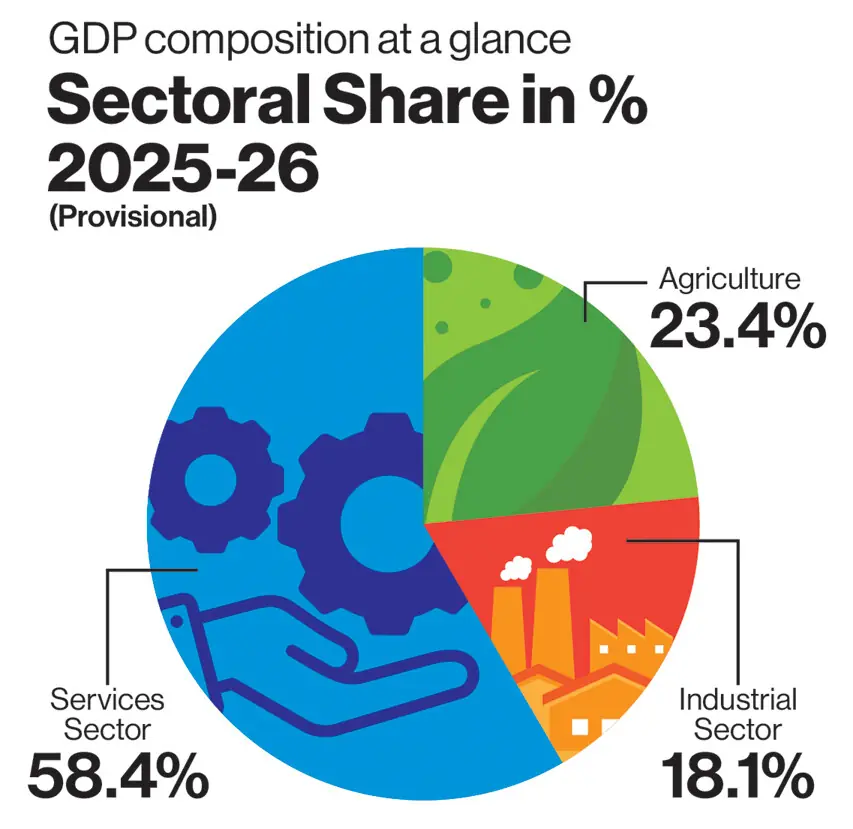
“We have not only increased the size of the economy but also achieved broad-based recovery,” he said, adding that the country had reached the largest economic size in its history. The agriculture sector recorded growth of 2.9 percent, with good growth seen in the crops sector.
“The improvement owes to effective macroeconomic management, better fiscal account, growth in the LSM sector, resilience of the agriculture sector to floods of 2025, exchange rate stability, and reforms under the IMF Extended Fund Facility (EFF) Programme,” it stated. Aurangzeb also pointed out that global growth had reduced to 3.1 percent from 3.7 percent due to the factors he elaborated on earlier in the press conference.
Giving a sector-wise breakdown, he said growth in agriculture was recorded at 2.89 percent, compared to 1.53 percent in the last fiscal year. “This was despite floods,” he said, adding that the crop sub-sector showed positive growth. It was recorded at 1.44 percent, the finance minister said. He added the livestock sector also “continues to go from strength to strength”.
Aurangzeb said 6.1 percent growth was recorded in large-scale manufacturing (LSM) in fiscal year 2026, which was the highest in the last four years. He elaborated that positive growth was seen in 16 of LSM’s 22 sub-sectors. “So it’s not one single sector that is leading or contributing to this 6.1 percent turnaround in LSM. It is broad-based growth,” he said.
“To give you some examples, there was a 10 percent increase in the demand for cement, 17 percent for fertiliser, 5 percent for petroleum, 31 percent for automobiles, and 9 percent for mobile phones.”
Noting that the services sector made up close to 58 percent of GDP, he said 4.09 percent growth was recorded in this sector in the outgoing fiscal year. “This, too, is the highest in the last four years,” he said.
Aurangzeb particularly mentioned communication and information services, which he said recorded a growth of 7.52 percent. The growth in this sub-sector in fiscal year 2026 was also the highest over the past four years.
He said 175,000 new investors have entered the equity sector, and for the first time in 20 years, 11 initial public offerings (IPOs) have been completed this year. It is often mentioned that some companies have left the country, but at the same time, many global firms, including Aramco, Alibaba, Turkish Petroleum, Veon, and Google, have also increased their investments, he said. “We remain in contact with all friendly countries, including Saudi Arabia and China,” he added. The government admitted low investment savings and regulatory burden, while saying that has to move in right direction and at great speed.
He said 40 to 45 percent of the debt is concessional, long-term, and bilateral, and the debt-to-GDP ratio is continuously declining.
Remittances are expected to cross USD41 billion this year, with the UAE contributing over USD1 billion out of total inflows of USD4.2 billion in May alone. “The UAE has supported us for the longest time, and we are thankful to them. The only responsibility of a borrower is when someone asks them to pay back, you pay back,” Aurangzeb said.
Foreign exchange reserves stand above USD17 billion, and by the end of June, the State Bank expects them to exceed USD18 billion. Overall, foreign exchange reserves reached USD22.6 billion.
The survey document stated that the fiscal deficit “narrowed significantly” to 0.7 percent of GDP (Rs 856.4 billion) from 2.6 percent of GDP (Rs 2,970 billion) in the corresponding period last year. Further primary surplus also improved to 3.2 percent from 3 percent, the survey document said.
Aurangzeb said that tax revenues had increased by 10.1 percent, and markup payments saw a decrease of 23 percent, which he said increased fiscal space.
“The increase in tax revenues was contributed to by growth in both federal and provincial tax collections. FBR tax collection increased by 10.1 percent to Rs9,305.9 billion, while provincial tax revenues increased by 25.8 percent to Rs860.7 billion,” the survey document stated.
On this, Aurangzeb said digital production monitoring had been introduced in various sectors, and he particularly mentioned the cement and sugar sectors. “In these sectors, we have received Rs60 billion additional revenue because of digital production monitoring,” he said, adding that this mechanism was also being introduced in other sectors. Moreover, he said AI-based audit selection had yielded an additional Rs34 billion in revenue.
He also said that the government intended to increase the number of merchants using digital payments to two million by June 2026, and “we are close to about 1.7 million. So, we are getting there”.
He said the government planned to increase the number of digital banking users to 120 million by June 2026 and had exceeded that target, as the number had reached 133 million. “First, we get demand for broadening the tax net, but when we start enlarging the tax base, we get criticism,” the finance minister said. The government has identified 3.5 to 4 million small shopkeepers for tax net expansion.“Any organizational culture, such as nepotism, does not change in a couple of years,” he added.
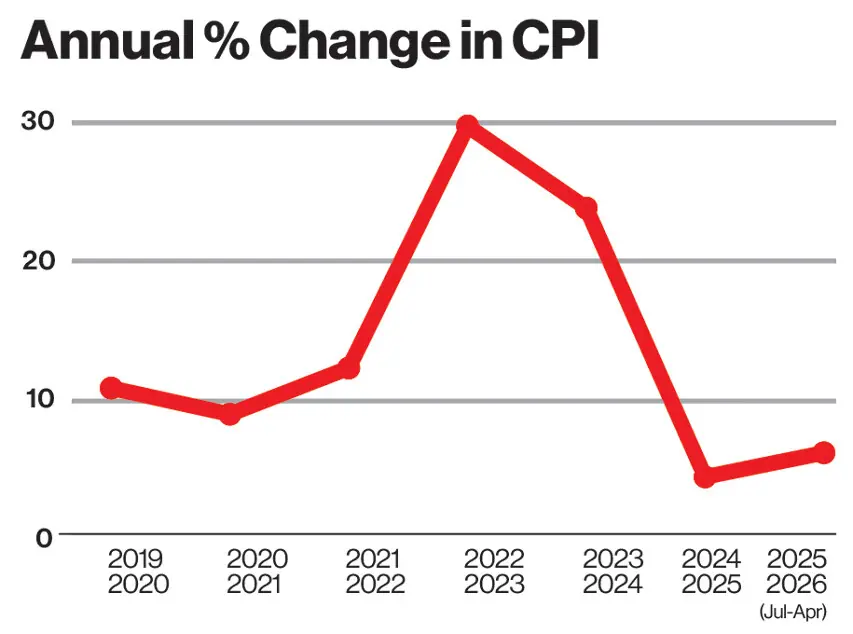
According to the economic survey, CPI inflation for the period between July-April 2025-26 was recorded at 6.2 percent, against 4.7 percent during the same period last year.
“Inflation measured by the sensitive price indicator (SPI) stood at 4.1 percent as against 4.8 percent during the same period last year. The inflation remained broadly stable during the first three quarters of fiscal year 2026.
However, the emergence of an external shock amid geopolitical tensions at the end of the third quarter has increased its vulnerability to renewed price pressures, warranting continued vigilance and timely policy response to preserve macroeconomic stability,” the survey document said. Aurangzeb argued that inflation had been decreasing over the years.
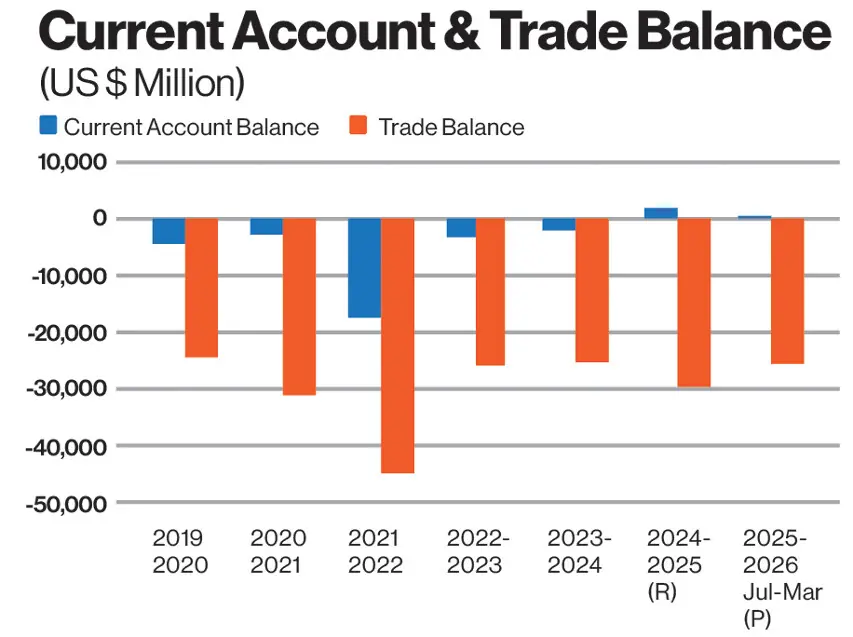
The survey document stated that on the external front, the current account recorded a marginal surplus of USD72 million during July-March 2025-26 compared to a surplus of USD1.7 billion in the same period last year.
“Workers’ remittances remained a key source of external sector support, rising by 8.2 percent to 30.3 billion,” it said. In this regard, Aurangzeb said a debate had been ongoing regarding exports and remittances. But it was not an “and/or discussion. This is an and /and discussion”, he said.
Acknowledging that there was a need to increase exports, he argued that remittances were also an important structural component of economies that were compared to Pakistan in this regard.
“We can debate how much remittances should be contributing to the GDP and to what extent we should rely on them, but remittances are and would remain a very important component of our external balancing position as we move forward,” he said.
The finance minister said the decline in the country’s exports was led by the food sector. “In the food sector, our rice exports have declined by USD1.1 billion,” he said, adding that a decline of USD403 million was recorded in sugar exports. Overall, a decline of around USD1.5 billion was recorded in food exports, he said.
On the other hand, he said, textile exports had increased. He also highlighted the increase in the export of sports goods, mentioning that the football that was to be used during the upcoming FIFA World Cup was manufactured in Pakistan.
He said that from July-May 2025-26, 18 percent growth was recorded in the export of sports goods. The minister said the country’s IT exports had crossed USD3.8 billion, expressing hope that they would reach USD4.5 billion. In this connection, he said the freelancer export was now touching USD900 billion.
He said the country’s foreign exchange reserves currently stood at USD17 billion, hoping that they would reach USD18 billion by the end of June. “This will give us three months of export cover, which is an internationally recognized standard, and this should allow us to further upgrade over the course for the next year,” he said.
According to the economic survey, foreign exchange reserves stood at USD20.6 billion as of April 17, including USD 15.1 billion held by the State Bank of Pakistan, “reflecting strengthened external buffers”.
Replying to a question regarding negotiations with the IMF on budget, he said that negotiations are positive. Regarding another question on retaining provincial’s share, the minister said that it would be for more than year for strategic purposes. He also said that a new tax operating model would be announced in the budget on Friday (today).
The finance minister said if local industrialists invest, foreign investors will also come. He said USD600 million was invested in the privatization of PIA.
Companies from the telecom and energy sectors both entered and exited the market, while foreign companies also participated in the 5G spectrum auction.
The finance minister said the country’s debt currently stands at 68% of GDP.
Agricultural loans increased by 22%, while another figure showed a 15% rise in agricultural lending. He said the government is bringing austerity measures for small farmers. A total of Rs90 billion has been approved for low-income housing. Aurangzeb said the end rate in the housing sector will be fixed for 10 years.
The finance minister said efforts are underway to reduce energy costs. He said cross-subsidies for industries have been abolished to reduce financing costs for the industrial sector. Three power distribution companies will be privatized this year. The policy rate increased due to regional conflict, he added.
The literacy rate in the country has reached 63%. The finance minister said positive results of difficult economic reforms have started to emerge. He added that the textile sector remains central to exports, while the petroleum sector grew by 5%. Panda Bonds were also successfully launched during the year.
Aurangzeb further said the Pakistan Stock Exchange investor base had exceeded 563,000, with a record 11 new companies listed this year. He noted that over 39,000 companies had been registered, bringing the total to more than 297,000.
According to him, private sector credit increased by Rs 934 billion during July–March, while agricultural financing reached Rs 2.162 trillion.
The Planning Minister said Pakistan has failed to build an export-led economy. “Nine million overseas Pakistanis send USD40 billion annually while 250 resident Pakistanis make only around USD40 billion in exports,” he said. “Exports must meet our external sector requirement, which is a structural flaw as the country couldn’t achieve that.”
He stressed that political consistency is essential for growth, evident in all neighbouring countries. “Either we will crawl or leapfrog – we cannot afford to crawl now,” Iqbal said, adding that Pakistan receives only USD1.5 billion to USD2 billion in foreign direct investment due to a lack of policy continuity.
The minister noted that the country had suffered due to a lack of continuity in economic policies, emphasizing the need for consistency and a forward-looking approach to national development. “We must move forward with a positive mindset and ensure policy continuity to maintain economic progress,” he said.
Speaking on the occasion, FBR Chairman said the tax authority had eliminated the culture of favoritism within the institution and was working to improve governance and efficiency.
He explained that changes in the dollar exchange rate can affect sales tax collection levels, adding that a stronger exchange rate may result in lower sales tax receipts in certain sectors.
The FBR chairman stated that revenue collection stood at USD32.6 billion in June 2024 and increased to USD41.9 billion in June 2025. He added that revenue is expected to exceed USD46.4 billion by June 2026, indicating continued growth in tax receipts.
Langrial also praised Prime Minister Shehbaz Sharif and the government leadership for supporting reforms aimed at eliminating the culture of recommendations and undue influence within the FBR.
He said institutional reforms and improved governance measures have contributed to greater transparency and efficiency in the country’s tax administration system.
Retuers adds:Pakistan’s annual economic survey projected real GDP growth at 3.7% for the fiscal year ending June 2026, according to the report released on Thursday.
Here are some details from the report:
-
Average CPI inflation was seen at 6.7% in the July-May period, the survey said, adding that price stability was broadly preserved despite the Gulf conflict and its impact on energy prices.
-
The South Asian nation’s current account deficit was at $252 million in the July-April period.
-
Pakistan’s trade deficit from July to March stood at $23.53 billion, the document showed.
-
Fiscal deficit was at 0.7% of GDP in the July-March period, which the survey said was the strongest fiscal performance in decades.
-
The primary surplus was seen at 3.2% of GDP and public debt by the end of March was 83,285 billion rupees, the document showed.
-
Overall, fiscal performance remains encouraging, the survey said, supported by expenditure control, revenue mobilisation, provincial surpluses, and ongoing fiscal reforms.
Copyright Business Recorder, 2026




















Comments