


Oil prices fall to one-week low after US pauses attacks on Iran
- Brent crude futures fell $7.10, or 7.3%, to $89.68 a barrel
Oil prices tumbled 5% as the US and Iran paused strikes, raising hopes for diplomatic de-escalation and improved shipping safety in the Strait of Hormuz.
- Impact of US-Iran conflict on global oil prices.
- Diplomatic efforts to de-escalate regional tensions.
- Shipping disruptions in key Middle East waterways.

NEW YORK/LONDON: Oil prices fell to a one-week low on Monday after the United States abruptly suspended a campaign of air strikes against Iran over the weekend, raising hopes of a diplomatic solution that would de-escalate the conflict and allow shipping to resume in the Strait of Hormuz.
Brent crude futures fell $7.10, or 7.3%, to $89.68 a barrel by 11:48 a.m. EDT (1548 GMT). They fell as low as 9.5% earlier in the session to $87.55 a barrel.
U.S. West Texas Intermediate crude futures fell to $83.18 a barrel, down $6.14, or 6.9%. They dropped as much as 8% earlier in the day.
Both contracts hit their lowest levels since July 20 earlier in the session.
Brent futures last week crossed $100 as the conflict, which has reduced oil shipments via the Strait of Hormuz, spilled over to the Red Sea, hindering exports from the world’s top exporter, Saudi Arabia, via the Bab el-Mandeb strait to Asia.
The U.S. ambassador to the United Nations, Mike Waltz, told “Fox News Sunday” and other U.S. media that President Donald Trump had decided to pause U.S. attacks to allow more time for diplomacy.
Trump on Monday told Axios News that the United States is in “very deep talks with Iran”, but threatened he is ready for “strong military action” if diplomacy fails.
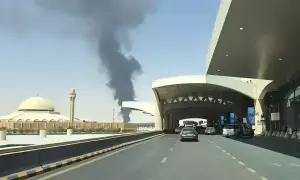
Oil prices pared losses throughout the day even as Saudi Arabia’s air defences intercepted and destroyed drones launched from Iraq, while Yemen’s Houthis claimed they targeted a number of sensitive crude oil supply and transport sites linking eastern Saudi Arabia to the critical Red Sea oil export hub of Yanbu.
“The market seems to be forever seeking good news from an arena that really is not providing any,” said PVM analyst John Evans.
“A stay of military strikes might seem an improvement, but it does not come with any guarantees that oil will soon flow from the area… prices will only continue lower if high prices once again dent demand, not questionable mini-ceasefires.”
Outlook uncertain with no signed framework
Oil markets are likely to be highly volatile in response to updates around the unofficial ceasefire between the United States and Iran, with industry analysts warning that the physical flow of oil remains constrained despite the truce.
“Shipping volumes remain heavily depressed after a brief mid-June ceasefire, limiting Middle East exports and forcing longer, costlier reroutes via Suez for Saudi Red Sea cargoes,” said Alex Hodes, director of energy market strategy at brokerage StoneX.
Fewer than 10 commodity vessels passed through the Strait of Hormuz daily during the weekend, shipping data from Kpler showed.
“Flows fell to something like 15% of pre-war levels, against a normal run rate of roughly 20 million barrels a day of crude, condensate and products. A political pause doesn’t put a single extra barrel on the water right here and now,” said Ole Hvalbye, market analyst at SEB Research.
In addition, ship traffic through the Bab el-Mandeb strait fell on Sunday after Yemeni Houthis attacked Saudi oil installations along the Red Sea coast, although a third Chinese supertanker exited via the Bab el-Mandeb strait.
Elsewhere, Kazakhstan, among the world’s 10 biggest oil producers, has more than halved its daily oil output following the closure of the main exporting terminal in Russia’s Black Sea over drone attacks, an industry source said on Monday.
The energy ministry later said the Caspian Pipeline Consortium’s Black Sea terminal had resumed oil loadings.

















Comments