


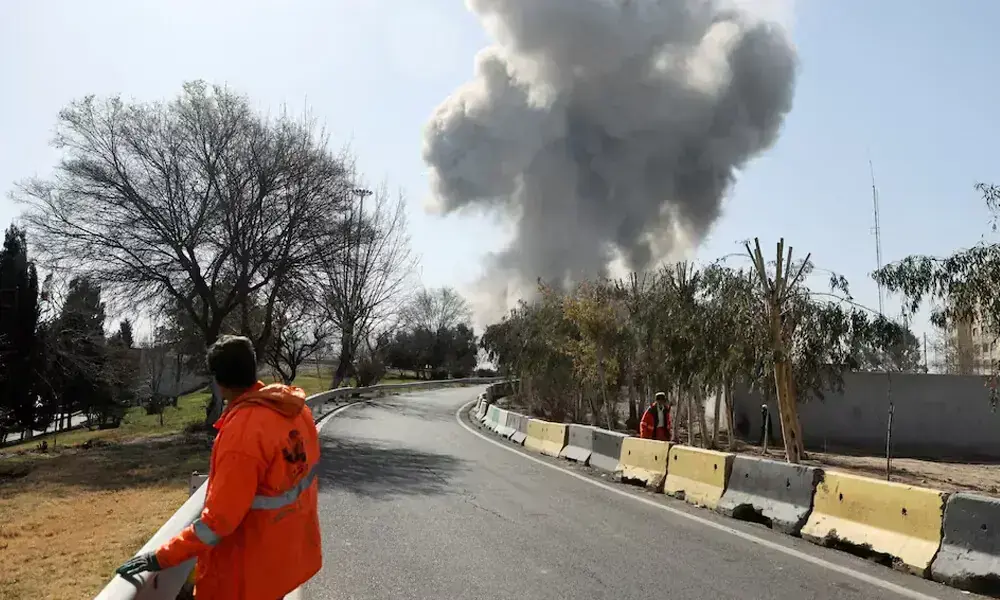

Modern state behaviour is outpacing the codification of international law. Take the Lotus case, for example, which reached The Hague in 1927; that was almost twelve years after the underlying collision. The Law of the Sea Convention took twenty-four years to negotiate, an even longer arc. The customary laws that somewhat govern the world’s oceans today took a century of constant state practice, with each new precedent shaping the legal architecture which allowed the time for legal evolution. The slow pace was an assumption that helped build the system.
Today, however, that assumption no longer holds for international law. The 2025 India-Pakistan conflict reshaped South Asian deterrence calculus in just ninety-six hours. Even the Russia-Ukraine war condensed the EU’s defence doctrine into thirty months. More than sixty days into the Iran war, and we are seeing an operational bilateral transit regime across the Strait of Hormuz; a sovereignty claim over an international strait being formally negotiated through
Pakistani mediators. In parallel, China’s chokepoint enforcement at Scarborough Shoal and the Taiwan Strait shows a strikingly similar pattern. States are, in practice today, shaping in weeks what classical doctrine assumed required generations.
Practice, it appears, is outpacing doctrine, and three forces are driving this compression. The first is information. State actions today are visible globally within hours, not months. Every coastal state, especially the one that is weighing a sovereignty claim, gets to observe in real time any international developments. Iran’s sovereignty claims have been visible to every coastal state in real time. In previous eras, the gap between an action and the international system’s acceptance of it was measured in decades. Today it is measured in news cycles.
Convergence has also played a crucial role. Major and middle powers are reaching for similar instruments at chokepoints around the world, and the instruments work in similar ways because the underlying problem is the same. The China Coast Guard barrier installed at Scarborough Shoal between April 10 and 11, inside the Philippines’ exclusive economic zone, is operationally indistinguishable from a coastal-state interdiction at a contested transit corridor. Similarly, Chinese aviation advisories that have effectively closed civilian airspace over portions of the Taiwan Strait approaches for forty days operate on the same principle as the US blockade at Hormuz. China was already moving in this direction. The Hormuz episode has accelerated and legitimized the move.
Last but not least, silence has played its part. Customary law has never been built only on practice. It also requires what international lawyers call opinio juris, the belief by states that the practice reflects legal obligation rather than mere convenience. Silence narrows the gap between tolerated practice and accepted rule. The American blockade announced on April 13 has been operating for several weeks, and what it interdicts is the commerce of third-party neutral states. Pakistani, Malaysian, Thai, and Filipino shipping has been swept up alongside Iranian vessels for the offence of trading with a country with which the United States is not formally in a declared war. This directly confronts the rights of neutrals, a principle of customary international law articulated at least since the Declaration of Paris in 1856. Yet no major naval power has formally challenged the legal basis of the action. There has been no sustained, multilateral challenge at the UN that has constrained the practice. The states with the most exposure have negotiated quiet bilateral arrangements rather than invoking treaty rights. Singapore’s Foreign Minister Vivian Balakrishnan is the rare voice publicly defending the treaty architecture in Parliament. Most of the region has chosen pragmatic accommodation, which is a defensible immediate response and a structurally consequential long-term one.
The legal tension underlying these adaptations has not been named clearly enough. Article 44 of UNCLOS, governing transit passage through international straits, contains the explicit phrase “there shall be no suspension of transit passage.” This is a hard legal floor, written specifically to prevent any state, whether Iran or the United States, from closing the gate on global commerce. The American blockade announced on April 13 attempts to suspend a right that the law declares unsuspended. Trump’s stated standard that “no one who pays an illegal toll will have safe passage on the high seas,” explicitly authorizes the seizure of third-party tankers beyond the strait. This makes the interdiction of Pakistani, Malaysian, Thai, Filipino, and Indian shipping difficult to reconcile with established principles of the law of the sea and naval practice.
On May 4, the Pentagon launched Project Freedom, deploying guided-missile destroyers and 15,000 service members to escort stranded neutral shipping through the same strait the US Navy is simultaneously blockading against Iran-bound vessels. The contradictory legal posture is now formal US policy, calibrated by flag-state alignment rather than treaty principle. Iran’s parliamentary national security chair has declared the operation a ceasefire violation. Within twenty-four hours, Trump suspended the escort component citing Pakistani mediation and progress toward a deal, while keeping the blockade in full force. Marc Weller, Director of the International Law Programme at Chatham House, has put the implication plainly: if the Hormuz blockade stands, “maritime freedom would be in severe jeopardy at chokepoints all around the globe.”
The replication is already visible within the conflict itself. Iranian officials have now formally threatened to close the Bab el-Mandeb Strait through Houthi proxies if the blockade continues. Alaaeddin Boroujerdi, Deputy Head of the National Security Committee in the Iranian
Parliament, has said that “the importance of Bab el-Mandeb may be no less than that of the Strait of Hormuz.” The threat reinforces a pattern already in place. No US aircraft carrier has transited Bab el-Mandeb since 2023, and the USS George H.W. Bush carrier strike group, which entered CENTCOM on April 23, sailed around the Cape of Good Hope rather than risk the chokepoint.
US’s partner, Israel, has already applied this precedent to its advantage. On April 30, Israeli forces intercepted at least 22 vessels of the Global Sumud Flotilla near Crete, roughly 1,100 kilometres from Gaza. The previous farthest Israeli interception of an aid flotilla had been 72 nautical miles from Gaza, making this latest action nearly eight times more distant from the conflict zone. The 211 detained activists are being moved to Greek ports under Israeli custody. The structural logic mirrors the Hormuz argument. A belligerent state has asserted the authority to interdict third-party civilian vessels in international waters, far from any active war zone, on the grounds that the cargo is bound for a blockaded territory. Former senator Mushtaq Ahmed Khan, who was detained by Israeli forces aboard the first Global Sumud Flotilla in October 2025, may again be among those captured. The investigation into Pakistani nationals on board is ongoing.
Interestingly, Pakistan’s position appears, for now, unusually insulated from this changing reality. Deputy Prime Minister and Foreign Minister Ishaq Dar has been at the centre of the Hormuz mediation since the war began. In late April and again on May 1, Iran delivered phased proposals to Washington through Pakistani channels, including a 14-point peace plan covering non-aggression guarantees, the lifting of the US blockade, and a deferred nuclear track. Pakistan has also taken custody of 22 crew members from the seized Iranian container ship M/V Touska, holding them as part of a “confidence-building measure” before their return to Iran along with the repaired vessel from Pakistani waters. Both sides have entrusted Islamabad with handling the most sensitive elements of the standoff, from message-carrying to seized assets and personnel.
The reason Pakistan continues to get the call is structural. A US precedent at the Strait of Malacca would adversely affect US partners in the Far East, particularly Japan, South Korea, Singapore, and Taiwan, all of whom depend on freedom of transit through the strait for their energy and trade lifelines. Hormuz, in turn, has hit the Middle East, Europe, and the wider set of nations hostile to the Iranian regime. Pakistan, however, remains a vital partner to both China and Iran. Pakistan’s strategic partnership with Beijing, anchored by CPEC, makes interdiction by China at Malacca less likely under current alignments. The long border and active diplomatic relationship with Tehran secures Pakistani access at Hormuz. The architecture rewarding alignment and penalizing neutrality places Pakistan in the rare position of being aligned with both chokepoint controllers in the regime now taking shape.
Classical doctrine assumed the international system moved slowly enough for the law to catch up. That assumption was wrong before Hormuz, and Hormuz is making the wrongness visible. The question is no longer whether customary international law can absorb the speed of contemporary state practice. The question is whether anything can.
Copyright Business Recorder, 2026
The writer is an economist and an educationist




















Comments