


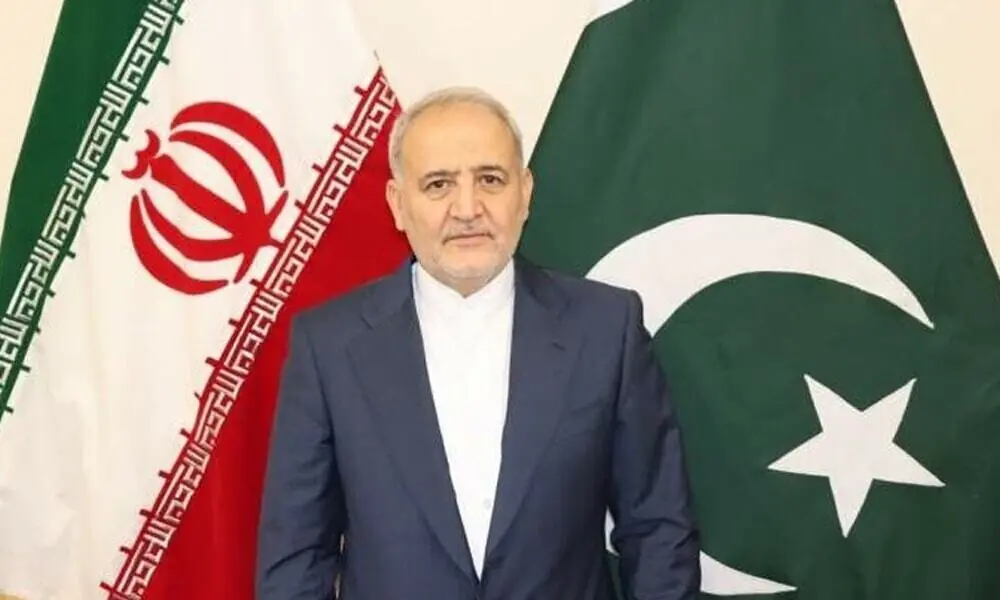

ISLAMABAD: Iran’s Ambassador to Pakistan Reza Amiri Moghadam has said that Tehran views its relationship with Islamabad as a top priority among neighbors, predicting the emergence of a new regional alignment once the ongoing conflict involving the United States and Israel ends.
Speaking at a roundtable hosted by the Center for International Strategic Studies (CISS) here on Friday, the ambassador thanked Pakistan for what he called steadfast support during difficult times and for helping facilitate dialogue between Washington and Tehran, according to a media statement issued by the think tank.
Moghadam said despite Tehran’s ties with other countries, including India, Pakistan remains Iran’s key regional partner.
“Iran’s relationship with Pakistan remains a priority and continues to grow stronger,” he said, describing the two countries as bound by brotherly ties.
He said Iran has pursued friendly relations with all neighboring states, but hinted that the war could reshape the regional order by weakening U.S. influence and further isolating Israel.
Moghadam suggested that a new geopolitical alignment could emerge involving Israel, India, the United Arab Emirates, and Somaliland, while separately forecasting the potential for a broader regional cooperation between Iran, Turkiye, Saudi Arabia, Egypt, and Pakistan after the war ends.
The discussion brought together diplomats, academics, and policy practitioners to examine Pakistan-Iran relations and the wider regional environment as hostilities continue under a delicate ceasefire.
Pakistan’s former envoy to Iran and the UAE, Amb. Asif Durrani said Gwadar and Iran’s Chabahar port should be treated as complementary rather than competing, arguing that Gwadar could serve as a “mother port” to strengthen connectivity and trade integration across the region.
Durrani said Pakistan’s diplomatic posture reflects a calculated balancing act, engaging with the United States while maintaining close ties with Iran.
Explaining Islamabad’s approach to the conflict, he said it should be viewed as a deliberate strategy aimed at de-escalation, extending the ceasefire, and pursuing a lasting settlement while safeguarding regional stability and economic security.
Dr. Nazir Hussain, a former dean at Quaid-i-Azam University, said Pakistan and Iran share deep historical and cultural bonds and have recently increased efforts to coordinate on border trade and institutional engagement.
He said both countries still have significant untapped potential for cooperation in energy, trade, and regional connectivity, adding that Islamabad and Tehran increasingly see each other as essential partners for stability and development.
CISS Executive Director Amb. Ali Sarwar Naqvi said Pakistan played a constructive role in facilitating a ceasefire between the United States and Iran on April 7, followed by hosting direct bilateral talks held April 11-12, describing the engagement as rare after decades of strained relations.
Amb. Naqvi said Pakistan’s mediation efforts continue following the ceasefire extension and that Islamabad remains committed to supporting initiatives aimed at regional peace.
CISS Director of Research Dr. Bilal Zubair said diplomacy and negotiations remain the only viable path forward, expressing hope that sustained engagement will lead to de-escalation and long-term peace in the region.
Copyright Business Recorder, 2026




















Comments