


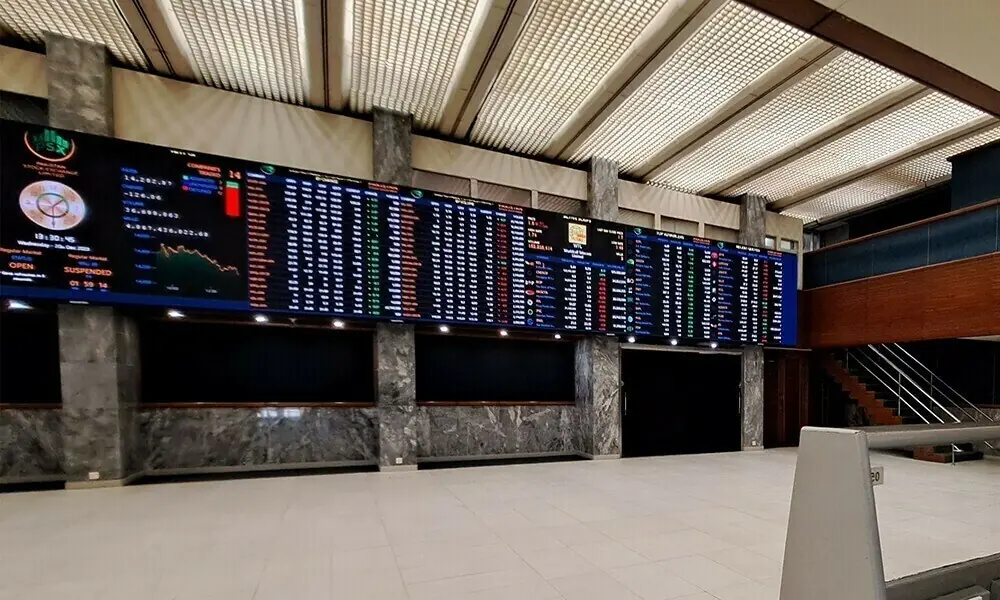

KARACHI: Pakistan’s equity market endured another week of sustained pressure as persistent geopolitical uncertainty and tightening financial conditions dampened investor sentiment.
The benchmark KSE-100 Index declined by 4.5 percent, shedding 7,677.87 points on a week-on-week basis to close at 162,994.17 points, compared to an opening level of 170,672.04 points.
In addition, BRIndex performance also reflected the bearish trend. The BRIndex100 declined from an opening level of 18,913.08 points to close at 17,794.03 points, down 1,119.05 points, with total turnover of 3.01 billion shares. Similarly, the BRIndex30 dropped from 69,161.17 points to 62,311.84 points, registering a decline of 6,849.33 points, with turnover recorded at 1.82 billion shares.
The market remained under stress throughout the week, primarily due to escalating tensions in the Middle East that disrupted global energy flows. International oil prices surged sharply, with Brent crude reaching a four-year high of $126 per barrel, marking a 20% week-on-week increase, amid continued disruptions in the Strait of Hormuz. The spike in global oil prices raised concerns over imported inflation and external account pressures, prompting a policy response from the central bank.
In this backdrop, the Monetary Policy Committee raised the policy rate by 100 basis points to 11.50%, effective April 28, 2026, in a bid to counter inflationary pressures arising from external supply shocks. The rate hike further reduced equity market attractiveness and accelerated selling pressure across key sectors.
On the external front, investors closely tracked developments related to Pakistan’s engagement with the International Monetary Fund (IMF). The IMF Executive Board is scheduled to review Pakistan’s third tranche under the Extended Fund Facility (EFF), along with the second review under the Resilience and Sustainability Facility (RSF), on May 8, 2026. The review involves a potential disbursement of $1.2 billion, which authorities expect to secure after meeting most of the program’s conditions, although investor participation remained cautious ahead of the outcome.
Meanwhile, structural inefficiencies in the domestic economy continued to weigh on sentiment. The power sector’s circular debt increased by Rs224 billion during the first eight months of FY26, reaching Rs1.84 trillion, underscoring persistent challenges in the energy chain.
In the fixed income market, the government raised Rs1.37 trillion through Treasury bills, significantly exceeding the target of Rs650 billion, reflecting strong demand at higher yields. Yields increased by 21 to 83 basis points across tenors, indicating tightening liquidity conditions. However, the State Bank of Pakistan rejected all bids in the Pakistan Investment Bond (PIB) auction due to elevated yield expectations from investors.
Average daily traded volume in the ready market declined by 19.2 percent to 973.84 million shares, compared to 1.21 billion shares in the previous week. In value terms, average daily turnover dropped by 21.1 percent to Rs35.96 billion, from Rs45.61 billion, while dollar-denominated turnover also decreased by 21.1 percent to USD129 million, down from USD163.53 million.
The overall market capitalization of the Pakistan Stock Exchange also declined in line with the index, falling by 4.5 percent to Rs18.02 trillion, compared to Rs18.88 trillion a week earlier. In dollar terms, market capitalization dropped to USD64.65 billion from USD67.70 billion.
Sector-wise performance remained broadly negative, reflecting a widespread sell-off across equities.
The Engineering sector led losses with a decline of 7.1 percent, followed by Exploration & Production (E&Ps) and Technology & Communication sectors, both down 6.4 percent, Oil Marketing Companies (OMCs) falling 6.0 percent, Banks declining 5.7 percent, Cement down 5.4 percent, Pharmaceuticals losing 5.3 percent and Chemicals decreased by 5.0 percent. Power and Refinery sectors fell 3.9 percent and 3.8 percent, respectively, while Fertilizer declined 3.7 percent, Textile Composite fell 3.0 percent, and Food decreased 1.6 percent. Autos remained the only sector posting a gain of 0.9 percent.
Trading activity by sector showed that Refinery stocks dominated volumes with a 13% share, followed by Technology & Communication at 11 percent, Banks and Food sectors at 10 percent each, Investment Banks at 8 percent, while other sectors collectively accounted for 48 percent of total volumes.
On the corporate front, HCAR emerged as the top gainer, rising 25.3 percent to close at Rs228.85, followed by MEHT up 7.0 percent to Rs247.20, INDU gaining 6.6 percent to Rs2,142.51, PAKT increasing 3.6 percent to Rs1,398.98, MTL up 2.4 percent to Rs524.04, APL advancing 2.3 percent to Rs587.49, and ILP edging higher by 1.8 percent to Rs81.61.
On the losing side, YOUW led the decline, falling 21.4 percent to Rs6.23, followed by NBP down 17.6 percent to Rs175.76, SSOM losing 16.3 percent to Rs422.26, GADT declining 14.9 percent to Rs254.67, SSGC dropping 13.0 percent to Rs24.70, while JVDC and NML both fell 11.6 percent, closing at Rs119.04 and Rs138.77, respectively.
Overall, the week highlighted the vulnerability of Pakistan’s equity market to external shocks, particularly rising oil prices and geopolitical uncertainty, compounded by domestic monetary tightening and structural economic challenges, keeping investor sentiment subdued and market direction negative.
Copyright Business Recorder, 2026

























Comments