


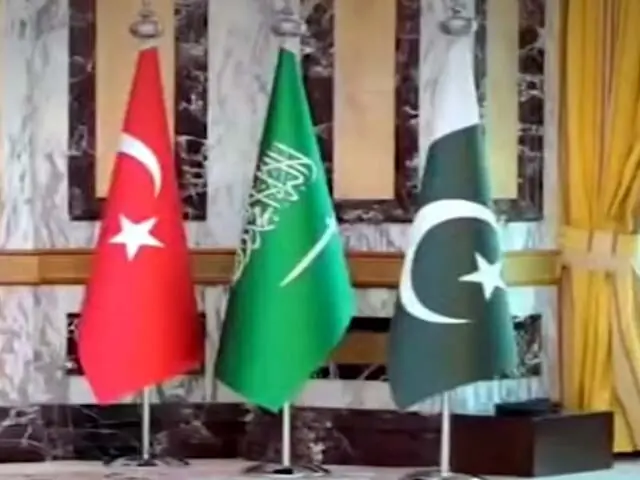

ISLAMABAD: As Pakistan, Saudi Arabia and Turkiye formally signed the Makkah Joint Defence Agreement, a trilateral defence pact aimed at strengthening collective security, strategic coordination and defence cooperation, security sources on Friday described the accord as a defensive, non-aggressive alliance that is not directed against any country.
According to the sources, the agreement is intended to prevent conflict through credible deterrence while enhancing regional stability and strategic self-reliance, rather than relying on external security guarantees.
They rejected suggestions that the framework constitutes a ‘Muslim NATO’ or provides any form of nuclear umbrella, saying its objective is to institutionalise longstanding defence cooperation.
READ MORE: PM Shehbaz arrives in Saudi Arabia to discuss regional situation
They said that the agreement brings together the complementary strengths of the three countries, with Pakistan contributing its battle-hardened armed forces and strategic expertise, Saudi Arabia its economic strength and regional influence, and Türkiye its advanced defence industry and technological capabilities.
Security sources said the pact would deepen intelligence sharing, strategic coordination, military cooperation and defence planning among the three countries while laying the foundation for broader collaboration in emerging security domains.
Brig Ashfaq (retd), a defence analyst, described the agreement as the emergence of a new collective security framework among three strategically important Muslim countries, saying its greatest significance lies in the institutionalisation of strategic trust.
He said Pakistan contributes military experience and strategic deterrence, Türkiye brings an advanced indigenous defence industry, while Saudi Arabia offers economic strength and regional influence, creating a complementary partnership.
He said it was too early to describe the arrangement as a NATO-type alliance or a ‘’Muslim NATO’, stressing that its primary objective is to prevent conflict through credible deterrence.
He added that the immediate priority would be to translate the political commitment into practical institutional mechanisms.
He said defence-industrial collaboration, including technology transfer, joint production, research and development, and cooperation in drones, missiles, air defence and electronic warfare systems, could eventually become the partnership’s most strategically significant pillar.
Commenting on the development, Dr Mehmet Ozkan, Professor of International Relations at the Turkish National Defence University, described the agreement as one of the most significant strategic developments in the Middle East since the outbreak of the Israel-Gaza conflict in October 2023.
He said the pact represents a fundamental shift in cooperation among Muslim countries from traditional political and economic engagement to hard security and defence, calling it a “game-changing” initiative with the potential to reshape regional security architecture.
Ozkan said the partnership is expected to evolve gradually, initially focusing on three key pillars: defence-industrial cooperation, joint military exercises and the development of a shared strategic doctrine. Progress in one area, he said, would reinforce cooperation in the others.
Copyright Business Recorder, 2026





















Comments