


Pakistan’s power crisis also transmission crisis

Unless the grid is strengthened urgently, cheaper electricity will remain stranded, costly generation will keep being dispatched, and load-shedding will continue to haunt a country that already has enough capacity on paper.
Pakistan’s electricity debate is obsessed with generation. Every few months, the conversation returns to fuel prices, capacity payments, circular debt, and which power plant should or should not have been built. All of that matters. But one of the most expensive failures in the system now sits elsewhere: the transmission network. Pakistan is not only paying too much for power because of what it buys. It is paying too much because it cannot move cheaper electricity to where it is needed.
That failure is no longer a technical footnote. It is a national economic problem.
The basic logic is simple enough for anyone not trapped in bureaucratic jargon. If cheap power is available in one part of the country, but the system cannot evacuate or transmit it efficiently, then the grid is forced to dispatch more expensive plants closer to demand centres. Consumers then pay higher tariffs, industry loses competitiveness, and the country continues to suffer load-shedding and voltage instability despite having generation capacity that, in theory, should have eased the pressure.
This is not a theoretical complaint. NEPRA’s latest transmission performance review says the overloaded Jamshoro and Matiari grid stations and their associated lines constrained power flow to only 1,800 MW under normal operating conditions, far below the available system capacity of 4,500 MW. The result was the curtailment of up to 1,750 MW of cheaper available power, along with frequent load-shedding and voltage problems. In plain language: Pakistan had cheaper electricity available, and the system still could not deliver it.
That one fact should change the entire energy-policy conversation.
For years, policymakers have behaved as if high tariffs are simply the unavoidable result of imported fuels, exchange-rate pressure, and inherited contracts. Those factors are real. But the transmission bottleneck has become one of the main reasons the country keeps dispatching expensive electricity while cheaper alternatives remain underutilized. This includes wind, local coal, imported coal, hydel in some corridors, and other lower-cost sources that should be doing more of the heavy lifting. Should we mention Thar and NJ as another issue where we started making power without retransmission? Cost of that take the much-delayed 500 kV Lahore North Grid Station. NEPRA has repeatedly flagged it as a critical project needed to reinforce the transmission network in Punjab and to allow the system to benefit fully from the Matiari-Lahore HVDC line. That HVDC line was built to move large volumes of electricity from the south to the north. But if the receiving end is weak or incomplete, then the promise of the line remains only partly realized. That is not planning. That is building half a bridge and congratulating yourself on connectivity.
What if we do it this way that there aero several gaps in the grid or areas where grid needs rejuvenation that are making it difficult to move the electricity in key areas of the grid.
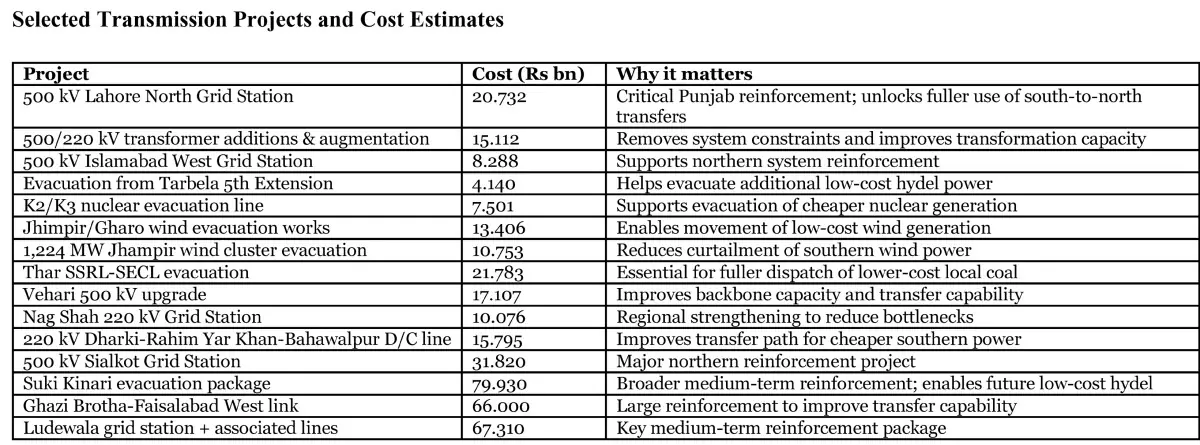
• Lahore North is only one piece of a much larger repair bill. Projected costs in NTDC’s (now NGC’s or National Grid Company of Pakistan Limited’s) own revised investment plan show the scale of the work needed. The Lahore North project itself is priced at about Rs 20.7 billion. Strengthening transformation capacity through extension and augmentation of existing grid stations is another Rs 15.1 billion.
• Evacuation from the Thar SSRL-SECL coal plants is about Rs 21.8 billion.
• Wind-evacuation related projects in Jhimpir and nearby clusters together run into the tens of billions.
• Suki Kinari which connects evacuation is nearly Rs 80 billion.
• The Ghazi Barotha-Faisalabad West link is around Rs 66 billion. Ludewala and its associated transmission line package is about Rs 67.3 billion. None of this is cheap. But none of it is remotely as expensive as continuing to run a system that strands low-cost power and forces high-cost dispatch year after year.
A realistic estimate suggests Pakistan needs roughly Rs 200 billion to Rs 300 billion for urgent transmission fixes that would materially reduce avoidable expensive generation and bring real relief on reliability. It’s not a big amount, given our political projects are larger than this amount. A broader 3-to-5-year reinforcement package that more fully unlocks cheaper generation could run around Rs 350 billion to Rs 500 billion.
These numbers are less than the power sector’s annual capacity payments alone are already well into the trillions of rupees. In other words, Pakistan is paying a recurring fortune every year for a broken dispatch outcome that could be improved by grid investments costing a fraction of that burden.
Indicative transmission projects underpinning the estimate are set out below.
This is where the conversation about reform needs to grow up. Too often, the state treats transmission as a slow-moving engineering problem while the real policy drama is staged elsewhere. That mind-set is wrong. Transmission is not just hardware. It is the central link between cheap generation and affordable tariffs. If the wires are weak, the whole system becomes expensive. If the bottlenecks persist, every claim about least-cost planning becomes a joke.
The implications go far beyond tariffs. Transmission weakness also blocks market reform. Pakistan cannot build a serious electricity market, encourage wheeling, support CTBCM evolution, or attract private investment into competitive supply if the network itself cannot reliably carry power to where it needs to go. Open access on paper means very little if the system operator must keep falling back on expensive dispatch because the grid cannot handle the alternatives. A market cannot function on aspiration alone. It needs physical capability.
The same is true for privatization and industrial policy. Industry cannot be expected to remain on-grid if it is asked to pay for a system that delivers both high tariffs and poor reliability. Investors will not trust distribution reform or supply competition if the transmission backbone remains a constraint on least-cost outcomes. Export competitiveness, already battered by energy prices, suffers further when transmission failure becomes another hidden tax on production.
There is also a political economy lesson here. Transmission projects are less glamorous than ribbon-cutting ceremonies at power plants. They do not offer the same optics. But they often deliver more real value. Strengthening the grid does not merely add capacity. It lets the country use the capacity it already has more intelligently. That is why transmission should no longer be treated as an afterthought in energy planning. It should sit near the centre of the reform agenda.
The policy response should be clear. First, the urgent transmission package should be ring-fenced and fast-tracked, with implementation tracked publicly against deadlines. Second, projects that unlock the largest volumes of stranded cheap power should take priority over politically attractive but less economically important additions. Third, regulators and the system operator should be required to show, in plain numbers, how each major transmission addition reduces curtailment, lowers expensive dispatch, or improves reliability. Fourth, the financing of these projects should be viewed as cost-defraying reform, not discretionary spending. When the grid is forcing the system to burn more expensive electricity, transmission investment is not a luxury. It is a tariff-reduction strategy.
Pakistan’s power crisis is not just a generation crisis, a circular-debt crisis, or a fuel-pricing crisis. It is also a transmission crisis. Until that is acknowledged, the country will keep making the same mistake: paying for cheap power it cannot use, paying again for expensive power it does use, and then asking consumers and industry to foot the bill for both.
The grid is now the bottleneck through which tariff relief, industrial competitiveness, market reform, and reliability must all pass. Strengthen it urgently, and the system begins to make sense. NTDC (NGC) must now gear up to overcome its shortcomings by removing bottlenecks, executing priority projects on time, and building the transmission capability without which tariff relief, industrial competitiveness, market reform, and reliability will remain impossible.
Copyright Business Recorder, 2026

PUBLIC SECTOR EXPERIENCE: He has served as Member Energy of the Planning Commission of Pakistan & has also been an advisor at: Ministry of Finance Ministry of Petroleum Ministry of Water & Power
PRIVATE SECTOR EXPERIENCE: He has held senior management positions with various energy sector entities and has worked with the World Bank, USAID and DFID since 1988. Mr. Shahid Sattar joined All Pakistan Textile Mills Association in 2017 and holds the office of Executive Director and Secretary General of APTMA.
He has many international publications and has been regularly writing articles in Pakistani newspapers on the industry and economic issues which can be viewed in Articles & Blogs Section of this website.




















Comments