


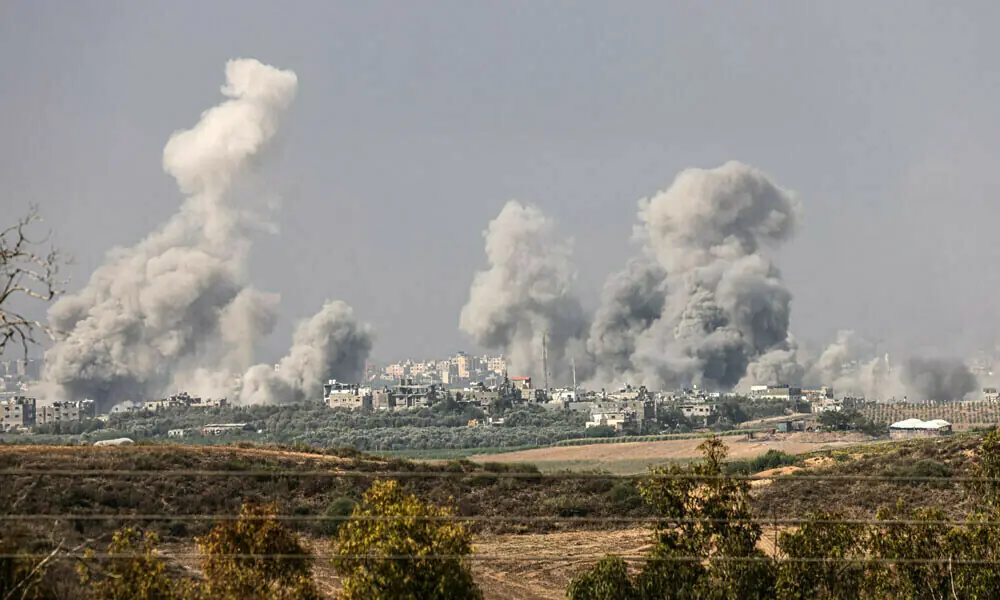

Even as the US and Iran seek to cement a ceasefire, Israel is seizing more territory from its neighbours in preparation for a long, drawn-out conflict across the Middle East.
Israel’s creation of “buffer zones” in Gaza, Syria and now Lebanon reflects a strategic shift after the attacks of October 7, 2023, one that puts the country in a semi-permanent state of war, six Israeli military and defence officials told Reuters.
The approach also acknowledges a reality the officials said had become increasingly clear after two-and-a-half years of conflict: Iran’s clerical leadership, Hezbollah in Lebanon, Hamas in Gaza and militias across the region cannot be eliminated outright.
“Israel’s leaders have concluded that they are in a forever war against adversaries who have to be intimidated and even dispersed,” said Nathan Brown, of the Carnegie Endowment for International Peace.
The US and Iran agreed on Wednesday to a pause in fighting while they negotiate a broader end to the war, which erupted on February 28. Israel agreed to halt its attacks on Iran but says it will not stop its campaign against Iranian-backed Hezbollah.
Hezbollah joined the war on March 2 by firing rockets at Israel, which then launched a ground invasion of southern Lebanon to clear a buffer zone up to the Litani River - a broad swathe of land that makes up about 8% of Lebanese territory.
Israel has ordered the area’s hundreds of thousands of residents to flee and is in the early stages of destroying homes in Shi’ite Muslim villages that it believes have been used by Hezbollah to store weapons or stage attacks.
A senior military official, who requested anonymity to discuss security matters, said the aim was to “clear” an area stretching 5-10 km beyond the border, putting Israeli border towns out of range of Hezbollah rocket-propelled grenade fire.
In some Lebanese villages close to the border, Israeli troops found evidence that nearly 90% of homes contain weapons or equipment linking them to Hezbollah, the official said.
That means the homes are viewed as enemy military positions that must be destroyed, according to the official who said that many southern Lebanese villages sat on hilltops, giving them a direct line of sight into Israeli towns or army positions.
The use of buffer zones represents a new security doctrine that “border communities cannot be protected from the border”, according to Assaf Orion, a retired Israeli brigadier general and former head of military strategy.
“Israel no longer waits for the attack to come,” he added. “It sees an emerging threat and it attacks it preemptively.”
Once the buffer against Hezbollah is secured, Israel will have seized or occupied territory in Lebanon, Syria, the West Bank and the Gaza Strip, where it remains in control of over half the territory after an October ceasefire with Hamas.
Under the ceasefire, Israel is meant to withdraw from all of Gaza as Hamas disarms, though the chances of that happening in the near future appear slim.
“We have established security belts deep beyond our borders,” Israeli Prime Minister Benjamin Netanyahu said in a video message released by his office on March 31.
“In Gaza - more than half of the Strip’s territory. In Syria, from the Mount Hermon summit until the Yarmuch River. In Lebanon - a vast buffer zone that thwarts the threat of invasion and keeps anti-tank fire a distance away from our communities.”


























Comments