


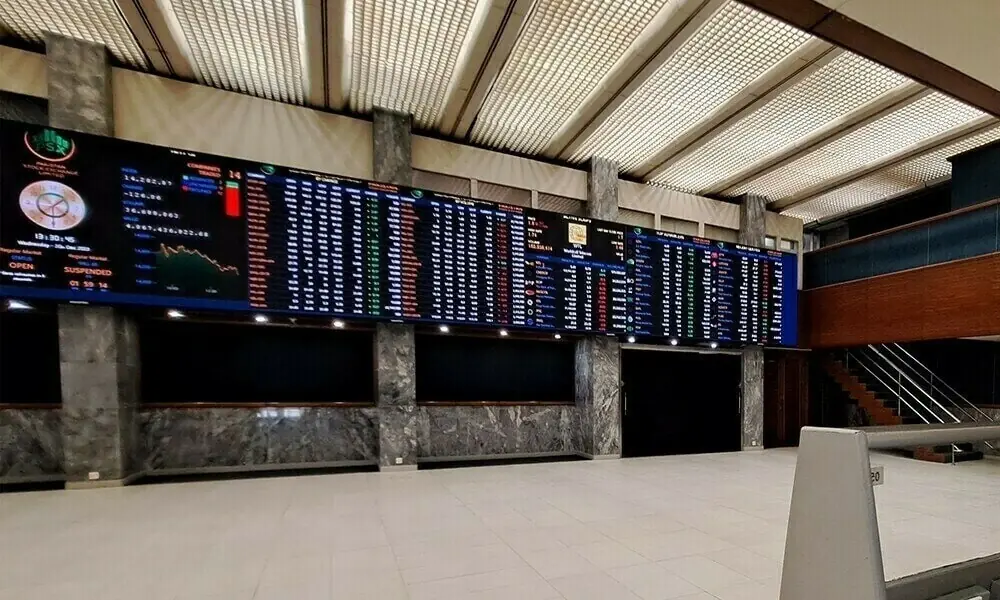

KARACHI: Pakistan’s stock market remained under sustained pressure during the week ended March 13, 2026, as heightened geopolitical tensions, domestic security concerns and macroeconomic uncertainty continued to weigh heavily on investor sentiment.
The benchmark KSE-100 Index extended its losing streak, declining by 3,629.92 points on a week-on-week basis, representing a drop of 2.3 percent to close at 153,866.17 points compared with the previous week’s closing level of 157,496.09 points. The market remained volatile throughout the week as investors trimmed positions and adopted a cautious stance in the face of external and domestic headwinds.
The latest decline follows an even steeper fall witnessed during the previous week, when the market had shed more than 10,500 points. The combined downturn has pushed the benchmark index close to a 19 percent retreat from its peak level of 189,167 points recorded in January 2026, highlighting the depth of the ongoing correction in the equity market. Analysts noted that escalating geopolitical risks across the region, coupled with domestic security concerns, have dampened investor confidence and triggered persistent selling pressure across multiple sectors.
The BRIndex100 opened the week at 17,723.96 points and closed at 17,306.10 points, registering a decline of 417.86 points over the period. Despite the decline in index levels, trading activity remained relatively strong, with total weekly turnover in the BRIndex100 reaching approximately 1.76 billion shares. Similarly, the BRIndex30 also recorded a notable decline during the week. The index opened the week at 62,680.60 points and closed at 60,874.17 points, posting a drop of 1,806.43 points during the period. The index recorded weekly total turnover of around 1.21 billion shares.
Market participants remained cautious ahead of key macroeconomic developments during the week. The International Monetary Fund (IMF), in its End-of-Mission statement following the third review of the Extended Fund Facility (EFF) and the second review under the Resilience and Sustainability Facility (RSF), acknowledged that considerable progress had been made in discussions with Pakistani authorities. However, the IMF also indicated that deliberations would continue in order to assess the potential impact of recent global developments on Pakistan’s economy.
Monetary policy developments also influenced investor behaviour. The State Bank of Pakistan (SBP), in its Monetary Policy Committee meeting held during the week, decided to keep the policy rate unchanged at 10.5 percent. The central bank noted that the inflation outlook remained broadly consistent with earlier projections and that recent macroeconomic indicators largely aligned with the expectations outlined after the January policy meeting.
Energy prices also remained a key concern for the market. Pakistan, being a net energy importer, is particularly vulnerable to fluctuations in international oil prices. During the week, the government increased petrol prices by Rs55 per litre, which raised concerns about inflationary pressures and their possible impact on economic activity and corporate profitability. Data released by the Pakistan Bureau of Statistics (PBS) showed that the Sensitive Price Indicator (SPI) rose by 1.89 percent on a week-on-week basis, largely driven by the increase in petroleum product prices.
On the external front, remittance inflows remained relatively strong despite a marginal monthly decline. Workers’ remittances during February 2026 remained above the US$3 billion mark, with the United Arab Emirates emerging as the largest contributor. Meanwhile, the State Bank of Pakistan’s foreign exchange reserves were reported at US$16.34 billion, providing some cushion to the country’s external sector despite prevailing uncertainties in global markets.
Trading activity on the Pakistan Stock Exchange weakened significantly during the week as investors adopted a defensive approach. The average daily traded volume on the ready market dropped sharply to 451.46 million shares compared with 657.99 million shares in the previous week, representing a decline of 31.4 percent. Similarly, the average daily traded value on the ready board fell to Rs26.54 billion, down from Rs36.22 billion a week earlier, indicating a contraction of 26.7 percent in overall trading activity. In dollar terms, average daily turnover declined to USD95 million compared with US$129.63 million during the previous week.
Overall market capitalization on the Pakistan Stock Exchange also declined during the week. The total market capitalization stood at Rs17.33 trillion compared with Rs17.70 trillion recorded in the previous week, reflecting a drop of around 2.1 percent. In US dollar terms, market capitalization decreased to US$62.04 billion from USD63.34 billion previously, mirroring the decline observed in the benchmark index.
Sector-wise performance during the week remained largely negative, with most major sectors posting declines. The automobile sector emerged as the worst performer with a decline of 6.4 percent, followed by the cement sector which fell by 5.6 percent. Fertilizer stocks also came under pressure, registering a drop of 3.7 percent, while oil and gas marketing companies declined by 3.6 percent. The power sector posted a decline of 3.5 percent, while banks and pharmaceuticals also ended the week in negative territory. Exploration and production companies, chemicals, engineering and textile composite sectors also recorded moderate losses.
A few sectors managed to show resilience despite the overall market weakness. Refinery stocks were among the top performers with gains of around 5 percent, while the technology and communication sector recorded a modest increase of about 0.5 percent. Food sector stocks also remained relatively stable, posting only marginal declines compared with other sectors.
In terms of trading activity, the power sector dominated market volumes, accounting for approximately 17 percent of the total traded shares during the week. Commercial banks followed with a share of around 12 percent in overall trading volumes, while the technology and communication sector contributed roughly 11 percent. Investment banks accounted for about 8 percent of the total traded volume, whereas oil and gas marketing companies represented around 7 percent of market activity. The remaining 45 percent of trading volume was distributed among various other sectors.
Despite the overall bearish trend, several stocks managed to register notable gains during the week. Among the top performers was AICL, which surged by 10.1 percent to close at Rs75.31. LOTCHEM followed with a gain of 9.0 percent to end the week at Rs22.29, while HINOON advanced 7.1 percent to settle at Rs898.92. Other notable gainers included PGLC, which rose 6.7 percent to Rs13.13, YOUW which gained 6.2 percent to Rs4.27, ENGROH which increased 6.1 percent to Rs271.00, and PABC which climbed 4.5 percent to close at Rs93.28.
On the losing side, SAZEW emerged as the worst performer, plunging 13.6 percent to close at Rs1,842.55. FCCL followed with a decline of 10.6 percent to Rs39.19, while MUREB dropped 10.5 percent to Rs836.97. GHNI also shed 10.5 percent to close at Rs680.23, while DGKC declined by 9.3 percent to Rs166.32. Other notable laggards included PKGS, which fell 9.2 percent to Rs659.62, and AIRLINK which dropped 8.4 percent to close at Rs139.68.
Overall, the week ended with the KSE-100 Index closing at 153,866.17 points after opening at 157,496.09 points, reflecting the continued pressure on Pakistan’s equity market amid geopolitical uncertainties, macroeconomic concerns and cautious investor sentiment. Market participants are expected to remain watchful in the coming weeks as developments related to global energy prices, the IMF program and domestic economic indicators continue to shape the direction of the market.
Copyright Business Recorder, 2026




















Comments
Comments are closed for this article.