


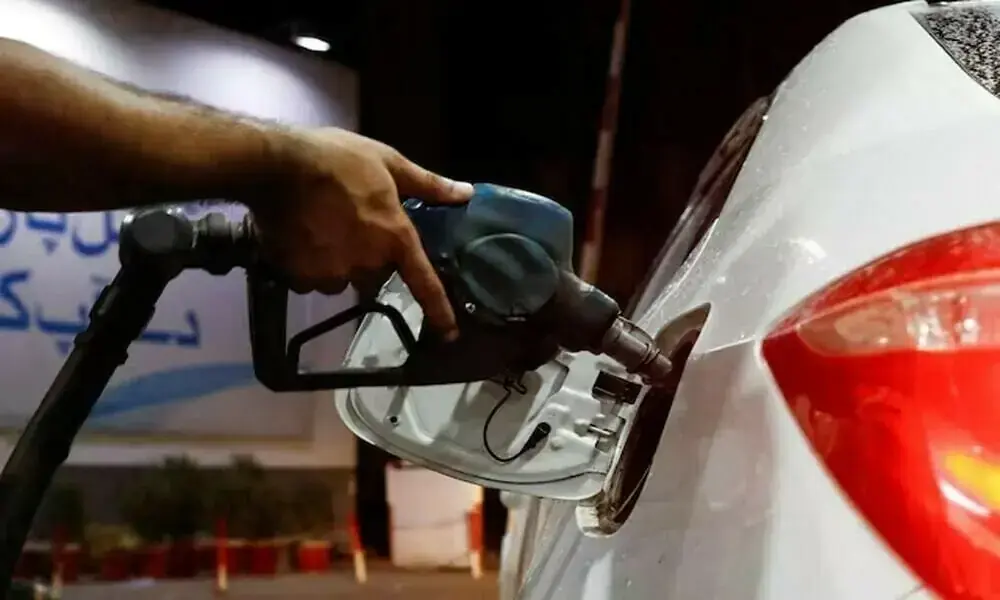

ISLAMABAD: The federal government will absorb a Rs 23 billion hit to keep fuel prices steady. This subsidy, paid as a price differential to OMCs, ensures that petrol and high speed diesel (HSD) rates remain unchanged for the week starting March 14, 2026.
The payment will be made from Prime Minister’s Austerity Fund. The documents available with Business Recorder revealed that the government will pay the price differential of Rs 75.05 per litre and Rs 49.63 per litre on HSD and petrol respectively to OMCs. The estimated price differential claims of OMCs for the period of March 14-20 is Rs 23 billion would be paid by Oil and Gas Regulatory Authority (OGRA) after verification audit of invoices from OMCs.
Finance Division has obtained approval of the Cabinet for creation of the Prime Minister’s Austerity Fund and Economic Coordination Committee (ECC) for allocation of a sum of Rs 27.1 billion to the Fund. An amount of Rs 23 billion will be transferred to OGRA for settlement of price differential claims.
READ MORE: Petrol, HSD prices hiked by Rs55 per litre
According to actual calculation, cost of import of petrol had gone up by Rs 46.89 per litre from Rs 190.94 per litre to Rs 237.82 per litre. Rate of petroleum levy (PL) remains at Rs 105.37 per litre, however IFEM rate raise by Rs 2.75 per litre from Rs 5.85 to Rs 8.60 per litre.
On HSD, the cost of supply raised by Rs 72.41 per litre from Rs 257.78 per litre to Rs 330.19 per litre. Rate of PL rest at Rs 55.24 per litre, however, IFEM has increased by 2.64 per litre from Rs 3.83 per litre to Rs 6.47 per litre.
Pakistan imports more than 85 percent of its crude oil from Saudi Arabia and the United Arab Emirates by way of a single maritime route via the Strait of Hormuz. The escalating conflict in the region has blocked that route and shocked the economy.
Some experts said that in coming days price of global oil price and supply constrains have impact the economy.
Pakistan has started importing crude oil through alternative routes, including shipments via the Red Sea, to maintain energy supplies following disruptions in the Strait of Hormuz. Also a discussion is underway to import crude oil from Russia.
The effective closure of the Strait of Hormuz has abruptly thrust two alternative oil pipelines into the global spotlight, one in Saudi Arabia and another in the United Arab Emirates.
The first is Saudi Arabia’s East-West pipeline network, or Petroline, a roughly 750-mile system that transports crude across Saudi Arabia, connecting Abqaiq on the oil-rich kingdom’s eastern Gulf coast to the port of Yanbu on the Red Sea.
The second smaller pipeline is the UAE’s Abu Dhabi Crude Oil Pipeline (ADCOP), or the Habshan–Fujairah oil pipeline. Spanning around 248 miles from onshore oil facilities at Habshan to Fujairah, the pipeline is estimated to handle 1.5 million barrels per day, with a reported total capacity of close to 1.8 million barrels per day.
The maritime security environment in the Middle East further deteriorated with Yemen’s Houthi movement is signaling that it intends to resume attacks on commercial shipping in and around the Red Sea after a pause of several months.
On March 11, 2026, on the request of Oil Companies Advisory Council (OCAC), State Bank of Pakistan (SBP) issued notification allowing authorised petroleum dealers to import crude oil/ petroleum products on CIF basis for a period of 60 days from the date of issuance of the circular letter. The OCAC sought temporary approval of CIF imports with war-risk premium allowance for crude oil, refined petroleum products, base oil and allied material in light of the ongoing Middle East conflict.
In the prevailing circumstances, it stated that obtaining adequate marine and war-risk insurance cover has become extremely difficult.
On March 9, Ali Pervaiz Malik said importing Russian crude is not a viable option. Speaking to private channel, he said there are several challenges in procuring Russian oil, including financial constraints.
“Russian Urals is a very heavy crude,” he said. In Pakistan, most refineries are old hydroskimming petroleum refineries, except for the Pak-Arab Refinery Company (PARCO) refinery.
“When heavy crude is refined in hydroskimming refineries, it generates a large amount of furnace oil,” Malik said. A carbon levy is imposed on furnace oil under the International Monetary Fund’s Resilience and Sustainability Facility (RSF) because it is considered a highly polluting fuel.
Copyright Business Recorder, 2026




















Comments
Comments are closed for this article.