


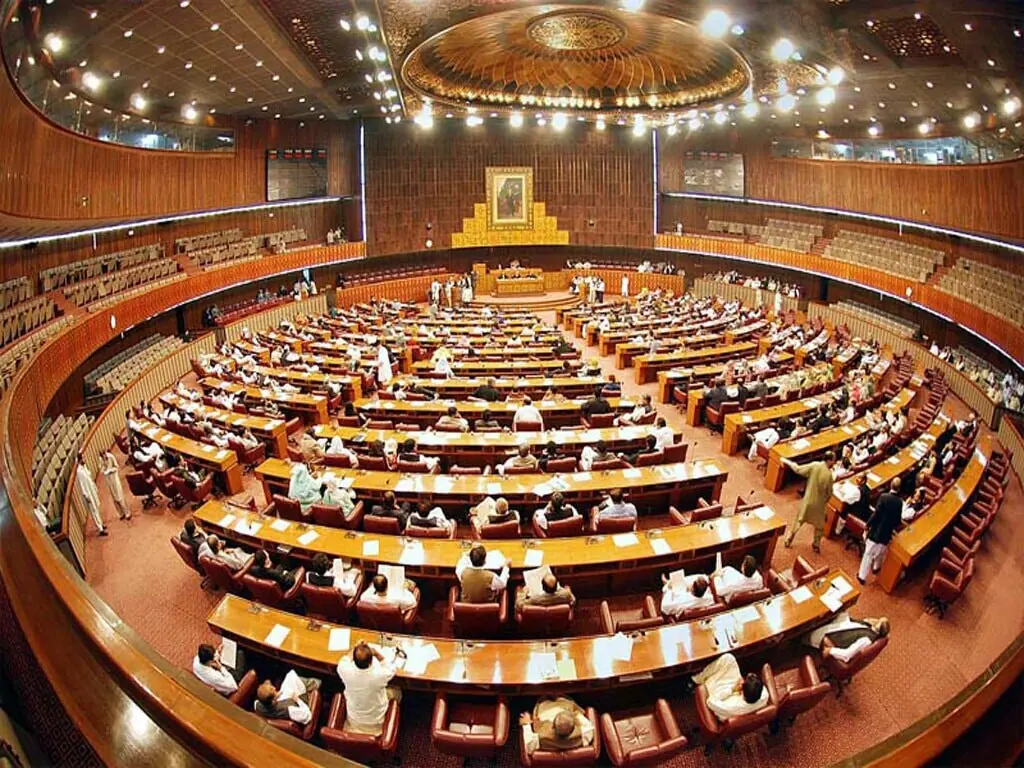

ISLAMABAD: The National Assembly on Tuesday passed seven bills, including one government bill and six private members’ bills, while rejecting all amendments moved by opposition members belonging to the Jamiat Ulema-i-Islam–Fazl (JUI-F).
The government’s bill was taken up after the House suspended the business of the private members’ day through a motion. Federal Minister for Parliamentary Affairs Dr Tariq Fazal Chaudhary presented the Daanish University Islamabad Bill, 2026, for approval.
Speaking on the bill, Alia Kamran of JUI-F suggested that it should be referred to the relevant standing committee for further discussion. However, the minister informed the House that the bill had already been passed by the Senate and therefore there was no need to send it to the committee again. After a brief debate, the House passed the bill with a majority vote, rejecting the opposition’s amendments.
According to the statement of objects and reasons of the Daanish University Islamabad Bill, 2026, the Federal Cabinet approved the draft charter of Daanish University as proposed by the Cabinet Committee for Disposal of Legislative Cases (CCLC) on January 2, 2026. To implement the Cabinet’s decision, the bill was presented before Parliament so that it could be enacted as the Daanish University Islamabad Act, 2026. The legislation aims to formally establish the university under a legal framework.
Later, the House took up the agenda of the private members’ day. During the session, the National Assembly passed six private members’ bills after rejecting all amendments moved by MNAs Alia Kamran and Naeema Kishwer Khan.
The bills passed by the House included the Islamabad Capital Territory Charities Registration and Facilitation (Amendment) Bill, 2025; the Provincial Motor Vehicles (Amendment) Bill, 2025; the Code of Criminal Procedure (Amendment) Bill, 2025; the Pakistan Names and Emblems (Prevention of Unauthorized Use) (Amendment) Bill, 2025; the Islamabad Capital Territory Compulsory Thalassemia Screening Bill, 2025; and the Federal Supervision of Curricula, Textbooks and Maintenance of Standards of Education (Amendment) Bill, 2026.
Deputy Speaker Ghulam Mustafa Shah, who was presiding over the session, referred the Civil Servants (Amendment) Bill, 2026, to the concerned standing committee after strong opposition from members. He also sent the Higher Education Commission (Amendment) Bill, 2025, to the relevant standing committee for further review.
During the proceedings, Pakistan People’s Party (PPP) senior leader Syed Naveed Qamar strongly opposed the Criminal Law (Amendment) Bill, 2025, tabled by Khawaja Izharul Hassan of the Muttahida Qaumi Movement-Pakistan (MQM-P). However, when Khawaja Izharul Hassan presented the bill for passage, Federal Minister Dr. Tariq Fazal Chaudhary did not oppose it.
Presenting the bill, Khawaja Izharul Hassan said that murder cases occurring during incidents of snatching mobile phones, gold, purses, and other valuables should be registered under anti-terrorism laws. He added that the relevant parliamentary committee had unanimously approved the bill.
However, Naveed Qamar argued that such incidents should be treated as murder cases under existing criminal laws and their trials should be conducted in sessions courts rather than anti-terrorism courts.
“If we start registering such cases under anti-terrorism laws, the anti-terrorism courts will become overburdened. This may also lead to renewed demands for military courts. Therefore, this legislation should be deferred for a week,” he said.
Khawaja Izharul Hassan responded that the provinces of Punjab, Balochistan, and Khyber Pakhtunkhwa had supported the proposed legislation, while Sindh had also not raised any objection to it.
Copyright Business Recorder, 2026





















Comments