


Govt–industry dialogue key to sustainable growth: minister
- Exports, growth, and job creation must be driven by private sector, says Bilal Azhar Kayani
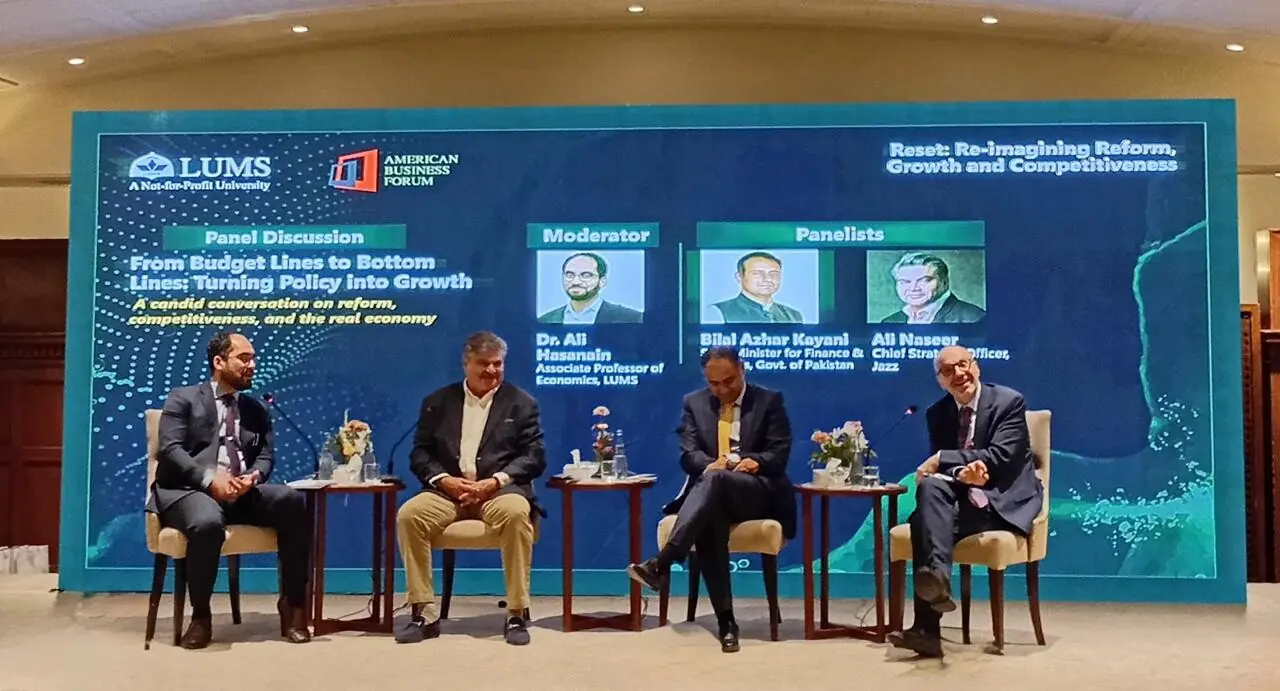

State Minister for Finance and Railways Bilal Azhar Kayani underscored the importance of dialogue between the government and industry, saying economic decision-making could not take place in isolation and that sustainable growth depends on consistent engagement.
He passed these remarks speaking to a policy dialogue titled ‘From budget lines to bottom lines: turning policy into growth.’ The session, part of ‘Reset: reimagining reform, growth, and competitiveness,” organised by the Lahore University of Management Sciences (LUMS) and the American Business Forum, brought together policymakers, economists, and industry leaders.
“Decision-making cannot occur in isolation…exports, growth, and job creation must be driven by the private sector, with government focused on creating an enabling environment through consistent engagement and predictable policies,” the minister was quoted as saying in a press release.
Also present at the event, Ali Naseer, Chief Strategy Officer at JazzWorld, said Pakistan’s core challenge was not the absence of policy, but the frequent reversal of it.
“One of the worst things that has happened to Pakistan is policy inconsistency,” he said, noting that even well-designed frameworks were often shelved within a few years, undermining investor confidence and long-term competitiveness.
Naseer stressed that durable growth required rules-based frameworks, regulatory predictability, and continuity beyond political cycles.
Also read: Regulatory reforms: Public-private dialogue in key agricultural markets held
He described digital infrastructure as economic infrastructure, underpinning financial services, healthtech, education technology, e-commerce, and emerging artificial intelligence (AI) applications.
Naseer welcomed the government’s approach to spectrum policy, observing that the upcoming auction reflects improved design and greater sensitivity to sector realities, including more competitive reserve pricing.
Meanwhile, Dr Stefan Dercon, Professor of Economic Policy at the University of Oxford, cautioned that while headline indicators such as inflation and near-term growth projections showed relative stability, structural constraints continued to cap Pakistan’s long-term trajectory.
He noted that low investment, modest export performance, and regulatory inefficiencies limit sustainable expansion, arguing that productivity gains and export competitiveness were essential for durable growth.
Businesses, he observed, seek policy certainty rather than short-term stimulus, and reforms must be sustained rather than episodic.




















Comments
Comments are closed for this article.