


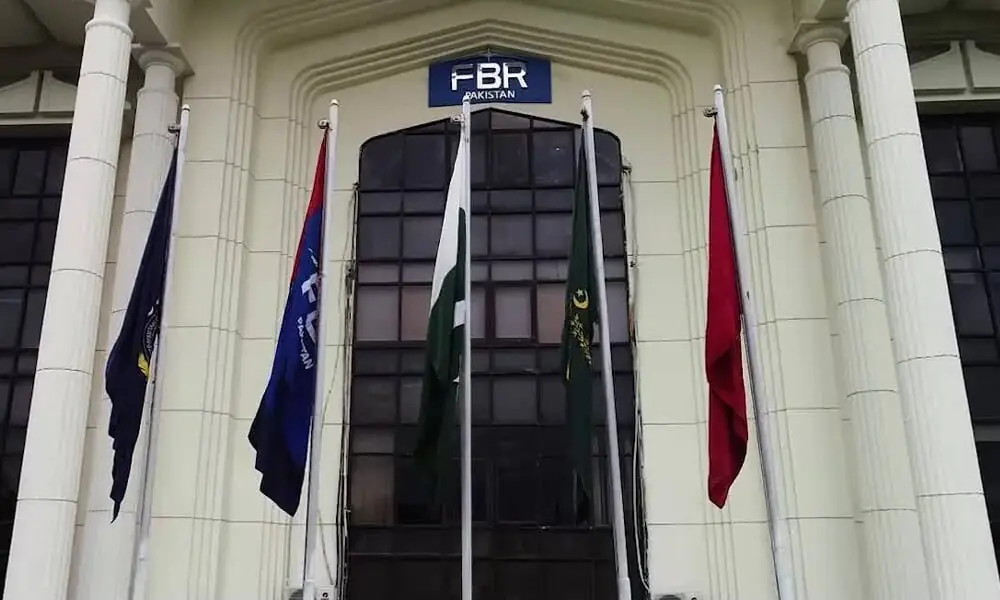

ISLAMABAD: The Federal Board of Revenue (FBR) is considering two options to amend the Second Schedule to the Income Tax Ordinance, 2001, aimed at resolving payment issues of Pak-Matiari Lahore Transmission Company (Private) Limited (PMLTC), well-informed sources told Business Recorder.
Recently, during a meeting presided over by the Minister for Planning, Development and Special Initiatives Ahsan Iqbal, it was shared that PMLTC had submitted invoices for pending payments, which are currently under process.
PMLTC has now requested that the Punjab Revenue Authority (PRA) and Sindh Revenue Board (SRB) provide formal assurances exempting the company from all default surcharges and penalties associated with payment delays.
READ MORE: Rs23bn NGC-PMLTC dispute lands in CPEC panel’s camp
Furthermore, due to the non-submission of Provincial Sales Tax returns, PMLTC’s status has been declared “inactive,” which the company requested be restored to “active.”
It was reiterated in the meeting that the necessary amendment—replacing the word “to” with “by” in Clause (12A) of Part IV of the Second Schedule to the Income Tax Ordinance, 2001—should be expedited.
In another meeting held at the Ministry of Planning, Development and Special Initiatives on February 10, 2026, participants deliberated on the required correction in Clause (12A) of Part IV of the Second Schedule. A FBR representative informed the meeting that two options are under consideration: (i) processing an immediate amendment through Parliament, or (ii) incorporating the required change in the upcoming Finance Bill.
It was further apprised that the Chairman FBR will decide between the two options, and the decision will be communicated to the company and the CPEC Secretariat.
According to sources, the issue of pending payments and related invoices was also reviewed. The Central Power Purchasing Agency-Guarantee (CPPA-G) informed the meeting that Rs 19 billion has been paid to the company for onward payment to provincial tax collection authorities. However, PMLTC stated that it had not received invoices from the National Grid Company (NGC), formerly NTDC, against the payments made by CPPA-G.
It was decided that NGC would forward revised emails regarding invoice categorisation to PMLTC. Subsequently, PMLTC would be responsible for clearing all outstanding payments, including sales tax liabilities, with the concerned provincial revenue boards.
CPPA-G will also provide detailed invoices specifying the relevant heads or portions against which payments have been made, as PMLTC is currently unclear about the nature of the payments received. Additionally, CPPA-G will present a plan for clearing pending payments. PMLTC will follow proper procedures for issuing invoices in the future.
On December 30, 2025, PMLTC wrote to the Power Minister stating that the Deputy Commissioner, Unit-25, Sindh Revenue Board, Karachi, had adjudicated an assessment order on December 26, 2025, for the tax period July 2023 to September 2023. The order assessed a total liability of Rs 1,487,769,192, including penalty but excluding default surcharge.
PMLTC maintained that the Implementation Agreement (IA) was signed between the President of Pakistan and the company on May 14, 2018.
Under Schedule 3 (“Form of Guarantee”) on page 112 of the IA, the Government of Pakistan provided the following guarantee:
“In consideration of the Chinese entering into the Transmission Services Agreement with the purchaser, the guarantor hereby irrevocably and unconditionally guarantees and promises to pay the company every sum of money the purchaser is obliged to pay under or pursuant to the Transmission Services Agreement which the purchaser has failed to pay when due, in accordance with the terms of that agreement.
This obligation of the Government of Pakistan shall include monetary damages arising out of any failure by the purchaser to perform its obligations under the TSA, to the extent that such failure gives rise to monetary damages.”
Regarding taxes, the guarantee further provides that the guarantor shall be liable for any duty, impost, levy, charge, fee, or tax of whatever nature imposed by any federal entity or political subdivision on any payment made under the guarantee, unless such payment—if made by the purchaser—would itself have rendered the company liable for the tax. If, under applicable law, the guarantor is unable to pay the tax and the company is required to do so, the amount payable to the company shall be increased to ensure that the net payment received equals the amount the company would have received from the purchaser after applicable taxes.
Copyright Business Recorder, 2026





















Comments