


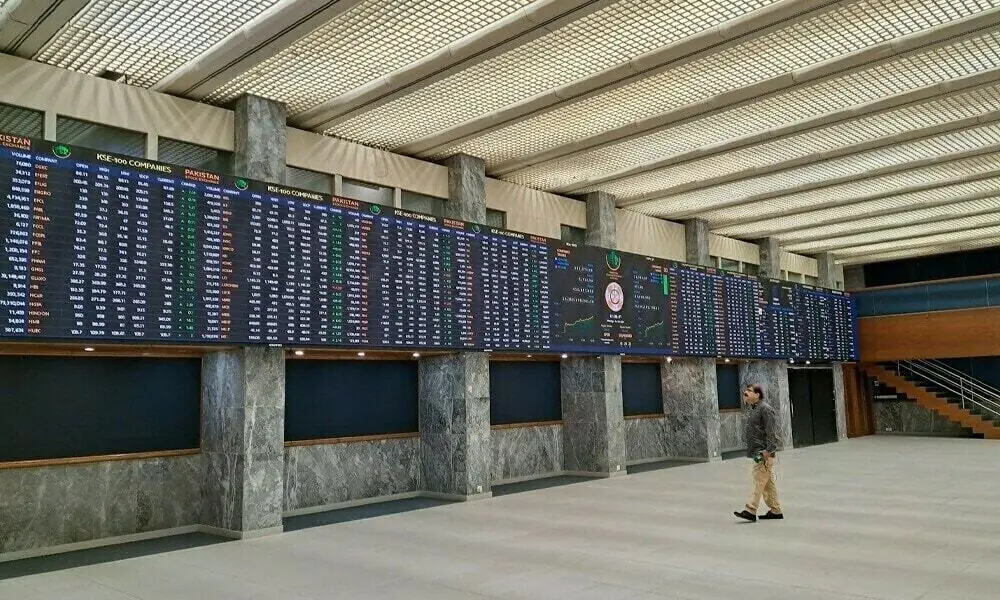
KARACHI: The Pakistan Stock Exchange (PSX) came under sustained selling pressure during the week ended February 13, 2026, as heightened political uncertainty and deteriorating security conditions particularly in Balochistan undermined investor confidence, overshadowing otherwise supportive macroeconomic developments and strong external inflows.
The benchmark KSE-100 Index closed the week at 179,603.73 points, registering a decline of 4,525.85 points or 2.5 percent week-on-week, after opening at 184,129.58 points. The index remained under pressure throughout the week, with limited buying interest emerging even at lower levels, as market participants adopted a cautious stance amid rising political noise and concerns surrounding the future trajectory of the Reko Diq mining project.
The BRIndex100 slipped to close at 20,325.04 points, marking a decline of 706.64 points over the period. Total turnover on the BRIndex100 stood at 3.56 billion shares, highlighting active selling despite declining prices. Similarly, the BRIndex30 closed at 74,036.48 points, reflecting a sharp contraction of 5,205.86 points. Trading activity in the BRIndex30 remained elevated, with total turnover recorded at 2.67 billion shares, during the week.
The decline in the benchmark index was mirrored by a contraction in overall market value. PSX market capitalisation fell 2.5 percent WoW to Rs20.36 trillion, while market capitalization in US dollar terms also declined by 2.5 percent to USD72.81 billion, reflecting the combined impact of falling equity prices and subdued investor participation.
Despite the weak market performance, macroeconomic indicators during the week remained broadly supportive. The International Monetary Fund (IMF) review mission is expected later in February, with Pakistan set to engage in discussions for the third review under the US$7 billion Extended Fund Facility (EFF). According to the reports Pakistan has met three out of five key conditions ahead of the review, providing some reassurance on programme continuity, even as political and security challenges persist.
External sector indicators continued to strengthen. Workers’ remittances surged to USD3.46 billion in January 2026, marking a 15.4 percent year-on-year increase. On a cumulative basis, remittances during 7MFY26 reached USD23.2 billion, up 11 percent YoY, helping to support the balance of payments, stabilize the currency market and sustain domestic consumption.
In terms of index composition, Pakistan witnessed two additions and two deletions in the latest MSCI review, affecting both the MSCI Frontier Market Index and MSCI Small Cap Index, with changes scheduled to take effect from February 27. The rebalancing is expected to result in stock-specific flows toward the end of the month, potentially increasing volatility in selected names.
Fiscal indicators also pointed toward consolidation. Public Sector Development Programme (PSDP) spending amounted to around Rs273 billion during 7MFY26, reflecting only 27 percent utilization of the Rs1 trillion allocation for FY26, highlighting a slow pace of development spending in the first half of the fiscal year. At the same time, the Finance Division reported a primary surplus of Rs4.1 trillion in 1HFY26, equivalent to 3.2 percent of GDP, underscoring strong fiscal discipline driven by revenue measures and expenditure control.
Sector-specific macro developments were mixed. Moody’s revised Pakistan’s banking sector outlook to “stable” from “positive”, citing signs of gradual recovery and improved macroeconomic stability. Meanwhile, the automobile sector posted strong growth, with four-wheeler sales jumping 38 percent YoY to around 23,000 units in January 2026, marking the highest monthly sales level in 43 months. As a result, 7MFY26 auto sales rose 43 percent YoY, reflecting a recovery in consumer demand amid easing financing constraints.
On the external liquidity front, State Bank of Pakistan-held foreign exchange reserves remained stable at US$16.2 billion on a week-on-week basis, offering short-term stability to the currency market and supporting investor confidence on the external account.
Market activity, however, slowed notably during the week. Average daily traded volume on the Ready Board declined 15.0 percent WoW to 862.26 million shares, while average daily traded value fell 13.4 percent to Rs42.56 billion, equivalent to USD152.19 million, reflecting reduced participation as investors stayed on the sidelines amid uncertainty.
Sector-wise performance remained broadly negative, underscoring risk-averse sentiment. Pharmaceuticals and chemicals were among the few gainers, each rising 1.0 percent, while autos edged up 0.3 percent. Losses were led by exploration and production stocks, which fell 6.4 percent, followed by technology and communication (-4.2 percent), power (-3.8 percent), oil and gas marketing companies (-3.5 percent), textile composite (-3.1 percent), banks (-2.8 percent), fertilizer (-2.5 percent), engineering (-2.5 percent), cement (-2.1 percent), refinery (-1.6 percent) and food (-0.5 percent). The kse-100 index itself declined 2.5 percent during the week.
In terms of trading activity by sector, Power sector stocks dominated volumes, accounting for 27 percent of total turnover, followed by technology and Communication at 12 percent, refinery at 9 percent, investment banks at 8 percent, and banks at 7 percent, while the remaining sectors collectively contributed 38 percent of overall market activity.
At the stock level, AGP Limited emerged as the top gainer, rising 12.0 percent to Rs239.38, followed by SSOM (+9.8 percent), Engro Holdings (+7.1 percent), Standard Chartered Bank Pakistan (+5.1 percent), CPHL (+4.4 percent), Cnergyico (+4.0 percent) and Indus Motor (+3.0 percent). On the downside, AKBL recorded the steepest decline, falling 15.7 percent, followed by UNITY (-11.2 percent), PPL (-9.6 percent), PKGP (-9.4 percent), BOP (-9.3 percent), TRG (-9.2 percent) and OGDC (-8.2 percent).
Overall, the week highlighted the market’s heightened sensitivity to political and security developments, with domestic uncertainty exerting strong downward pressure on equities, even as solid remittance inflows, improving fiscal metrics, resilient foreign exchange reserves and robust auto sector performance provided underlying macroeconomic support.
Copyright Business Recorder, 2026
















Comments
Comments are closed for this article.