


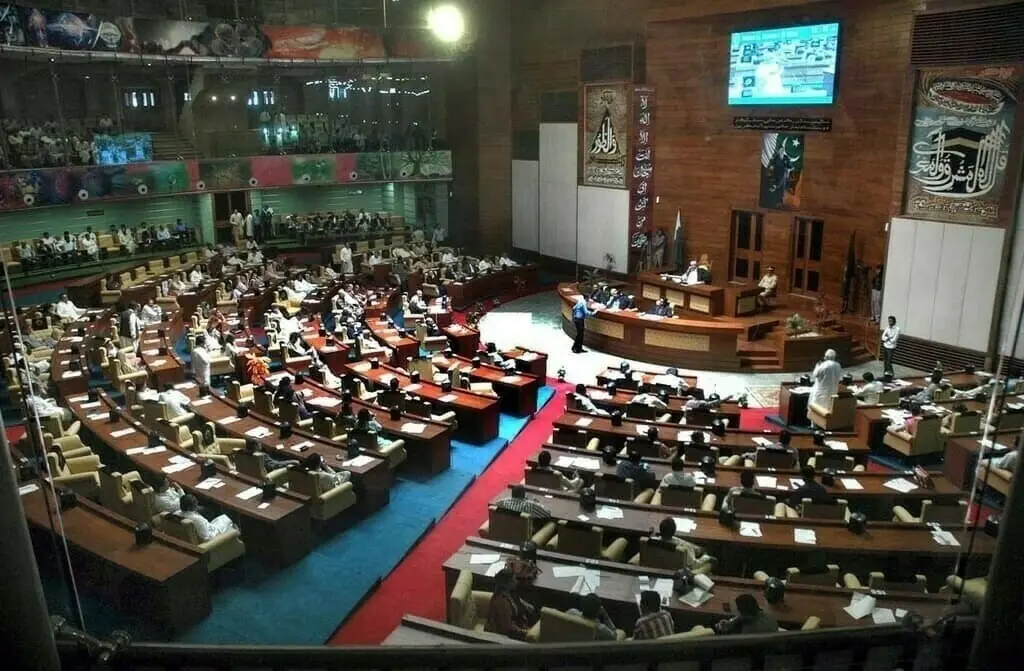

KARACHI: In a bid to facilitate traders and spare the export sector from the levy, the Sindh Assembly on Friday approved the Sindh Development and Maintenance of Infrastructure Cess (Amendment) Bill, restructuring the regime amid mounting pressure from the business community and prolonged litigation.
The amendment reduces the infrastructure cess to below one percent, abolishes it entirely on exports, and aims to address long-standing concerns that the levy had failed to deliver tangible financial benefits for Sindh while increasing the cost of business and encouraging the relocation of industries to other provinces.
Law and Parliamentary Affairs Minister Zia Ul Hassan Lanjar, while presenting the bill, told the House that the provincial government had decided to amend the infrastructure cess law as Sindh was not deriving any meaningful benefit from it. He said no cess would be charged on exports in future and that the rate for traders had been reduced to below one percent, making it lower than the levy imposed in Punjab.
He informed the House that more than 500 cases relating to the cess were pending in courts, adding that traders had been taken into confidence on the matter. According to him, the business community had been requested to withdraw the litigation in view of the revised framework.
Provincial Excise Minister Kishore Kumar Chawla welcomed the passage of the bill, calling it a longstanding demand of the business community. He said the higher cess had previously prompted factories to shift to Punjab, noting that the rate had earlier stood at 1.8 percent.
During the same sitting, the assembly also passed the Sindh Registration (Amendment) Bill, 2026. The session was presided over by Rehana Laghari, a member of the Panel of Chairpersons. Law Minister Zia-ul-Hassan Lanjar presented the bill clause by clause, which was approved by the House.
The Assembly further adopted the Provincial Motor Vehicles Tax (Amendment) Bill, 2026 after the Parliamentary Affairs Minister presented the committee report.
Earlier, the House rejected as inadmissible an adjournment motion moved by MQM member Aamir Siddiqui seeking restoration of traffic on University Road. Opposing the motion, the law minister said development work was under way on the artery and questioned whether construction activity should be halted.
Siddiqui argued that he was raising a public issue and referred specifically to service roads. Ruling on the matter, Chairperson Rehana Laghari declared the motion against the rules and dismissed it.
On a point of order, MQM member Abdul Waseem highlighted excessive delays in development work on major under-construction roads in Karachi, saying the situation was causing severe inconvenience to the public.
However, several calling attention notices were also taken up.
MQM member Nisar Ahmed said that, despite government announcements, salaries of employees in various Karachi towns had not been increased amid rising inflation. He demanded implementation of the notified pay raises.
Responding, Local Government Minister Syed Nasir Hussain Shah said salaries increased whenever budgets expanded and maintained that Sindh raised pay more regularly than the federation or other provinces.
He acknowledged receiving complaints from some towns and said the matter had been taken up with the chief minister and the finance department, assuring the House that the issue would be resolved soon.
Minority member Mahesh Haseja drew attention to recruitment in Sindh Police, stating that while 16,000 constable posts were advertised and two Lakh candidates applied— including about 2,000 minority candidates— the minority quota was not implemented. He said the chief minister had acknowledged injustice to minorities and urged the interior minister to address the issue.
Home Minister Lanjar urged members not to politicise the matter, saying it had also come under the notice of PPP Chairman Bilawal Bhutto, who had directed that minorities should not face discrimination. He added that instructions had been issued to the Sindh IGP to ensure no injustice to minority candidates on open merit.
MQM member Musarrat Jabeen raised the issue of acute water shortages in Jamshed Town and Chanesar Town, saying her area had gone without water for six days and that a scheme approved in 2023 had yet to be implemented.
Local Government Minister Nasir Shah attributed the problem partly to unannounced shutdowns by K-Electric and said Jinnah Town and Chanesar Town were receiving water five days a week, adding that remaining issues would be addressed shortly. The session was later adjourned until Monday at 2:30 pm.
Meanwhile, during question hour related to the Irrigation Department, Provincial Minister Jam Khan Shoro responded to written and supplementary queries. He told the House that new water reservoirs were not feasible due to water scarcity, despite the benefits of dams.
He said provinces were not receiving their full share of water under the 1991 Water Accord, and even the sea was not getting adequate flows, raising questions about the source of water for new reservoirs.
He noted persistent shortages at Kotri Barrage and said water for the K-IV project would also have to be arranged from elsewhere.
He acknowledged that sewage from various parts of Sindh flowed into the sea and said the Public Health Engineering Department was working to ensure only treated water was discharged.
Shoro said the Sindh government had constructed Darawat Dam and several small dams, but floods affected the entire province. He stressed that one million cusecs of water should flow downstream of Kotri.
Referring to Hyderabad, he said three canals originated there but dams could not be built on them, adding that the capacity of the Panjari Canal was being increased and that much of Hyderabad’s sewage was currently discharged into it.
Summing up, the irrigation minister reiterated that acute water shortages made new reservoirs impractical, that Kotri Barrage continued to face deficits, and that provinces and the sea alike were receiving less water than envisaged under the 1991 accord.
Copyright Business Recorder, 2026




















Comments
Comments are closed for this article.