


Alexander in South Asia: Robin Lane Fox reframes the conqueror’s legacy
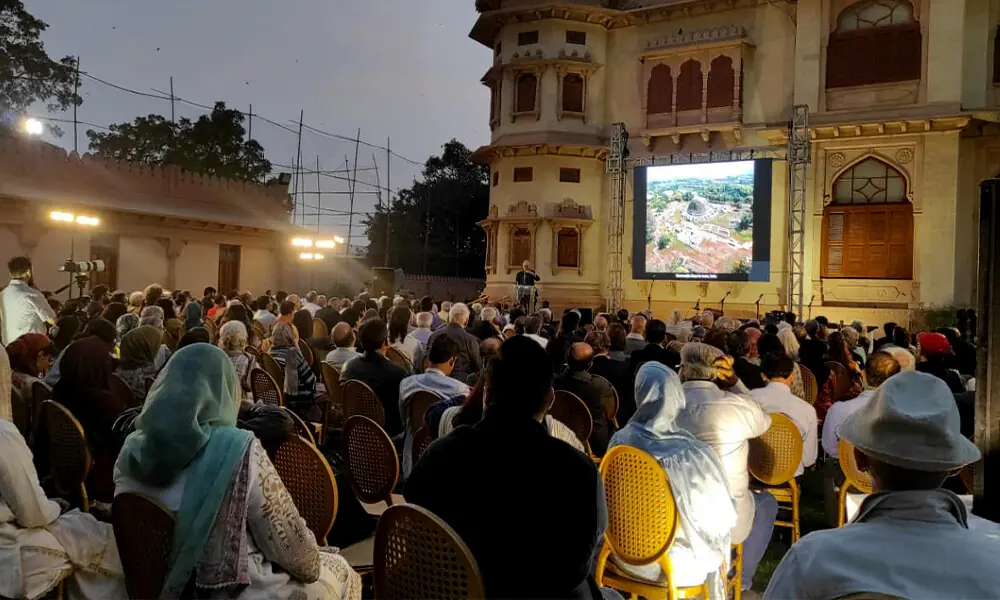

KARACHI: Famous King of Macedonia Alexander the Great was a “pragmatic, wise, and strong fighter” as he flattened those who opposed him during his reign from 336–323 BC.
This was stated by Robin Lane Fox, one of the world’s leading classicists, during a lecture ‘Alexander in South Asia’ at Mohatta Palace Museum in Karachi.
Fox is one of the most celebrated English classicists, renowned for his masterful scholarship on Alexander the Great and the wider world of classical antiquity. His landmark biography Alexander the Great (1973) established him as a leading authority, with subsequent works such as Pagans and Christians (1986), The Classical World (2005) and Travelling Heroes (2008). His most recent book, Homer and His Iliad (2023), affirmed his lifelong dedication to bringing the ancient epic tradition vividly to life.
Reflecting on journey of the king of the ancient Greek kingdom of Macedon (Macedonia) into the Indian subcontinent, Fox suggested that beyond battlefield glory, Alexander’s most enduring legacy might lie in his intellectual vision.
The lecture focused Indian philosophy and shared humanity in the context of Alexander. Fox stated that the king was a ruler who learned from wise men and whose encounters reshaped Western thoughts.
Addressing popular narratives in Pakistan, he discussed Kailashi and Afridi tribes that are considered to be descendants of Alexander.
“No, they’re not Greek,” Fox claimed.
Regarding Afridis, he added a historical twist, explaining that their ancestors were recorded in the Persian army of Xerxes in 480BC – meaning they fought against the Greeks.
The classicist said while Alexander’s invasion of the subcontinent in 327 BC provided one of the earliest firmly dated events in South Asian antiquity, physical evidence remained elusive.
“So very briefly, in 327 BC, the governor, he invaded down from Afghanistan, over the Hindu Kush, down the valley, with the encouragement of Indians who had left the courts of India and were encouraging to come in and either overthrow the monarchies or befriend their kings. So he had invitations. Now first thing is summer 327 BC. That is the first date, serious date, we can give in the entire history of the Indian subcontinent because it relates to Greek calculations which relate to Egyptian calculations. So there is a change in our understanding of time. As yet it will change.”
“There is no archaeological evidence in the ground that Alexander actually came,” he maintained.
Alexander, Fox explained, entered the region with geographical misconceptions inherited from Greek philosopher Aristotle.
The king believed the Indus connected to the Nile and thought he was nearing the edge of the world. Instead, he encountered civilisations far more complex and populous than Greeks had imagined, according to Fox.
“He had no idea where he was and there were two problems. First, he thought that the river Indus comes down and connects with the river Nile in Egypt. And so he could boat down it, and as we would say, he’d be home by the new year. Why did he think this? Well, he had reasons. He saw lotus flowers, he’d only seen them in India. He saw crocodiles and other similarities. So it was quite easy to get home, he thought. And secondly, he thought he was very near, he’s coming down across the Hindukush Mountains, the top left, the Khyber Pass, not quite over there, he thought he was very near the edge of the world.”
Fox organised his lecture around five ‘W’s
1- War
On warfare, he was candid. “Yes, these are months of war. And yes, Alexander fought.” Yet he emphasised nuance.
According to Fox, those who resisted were crushed, but rulers who submitted were often reinstated. The subcontinent, he argued, was not a peaceful paradise disrupted by foreign invasion; local rulers already commanded armies and rivalries. Alexander inserted himself into an existing political landscape.
2- Women
The next theme shifted dramatically. “Now, my next W is women, of course.” Greek observers, he explained, described Indian women as beautiful and modest, though they often misunderstood local customs. Stories such as Queen Cleophis – who surrendered to Alexander and reportedly named a son after him – reflected complex responses to conquest rather than uniform hostility.
3- War elephants
Military astonishment reached its peak with elephants at that time.
“Now, we come to the next W. war elephants.” For the Greeks, these animals were unlike anything they had faced before. The historian described how elephants’ loyalty to handlers and battlefield power transformed Greek military understanding. Drawing on his own experience advising a major Hollywood film on Alexander, he shared insights into how horses react when confronting charging elephants – observations that illuminated ancient battle accounts.
4- Weather
Climate and science formed another turning point. “Right. Next W, weather.” Greek soldiers, unfamiliar with monsoons and tropical patterns, were stunned. Even more transformative was their encounter with tides near the Indus delta. “They had never known this in the world,” he said of tidal phenomena. Observing waters that receded and returned, Greek thinkers began reconsidering cosmic forces and the moon’s influence, laying groundwork for scientific speculation.
5- Wealth
The historian then turned to prosperity. “Well, last W, you’re pleased to hear. It could be wealth.” Greek writers marveled at jewels, pearls, gold garments and earrings worn by Indian elites –adornments unimaginable for Greek men at the time. Far from depicting a backward land, their accounts describe flourishing cities and rich courts.
The lecture series held at Mohatta Palace featured talks by Dr Salima Ikram – an Egyptologist, Dr Eduardo Manzano Moreno – an Al-Andalus expert, and Dr Robin Lane Fox - a historian, each offering unique perspectives rooted in decades of scholarship and research. The lectures explored themes of civilisation, empire, memory and the interpretation of the past, subjects that resonate strongly within the cultural and historical landscape of Sindh and South Asia.
Copyright Business Recorder, 2026






















Comments
Comments are closed for this article.