


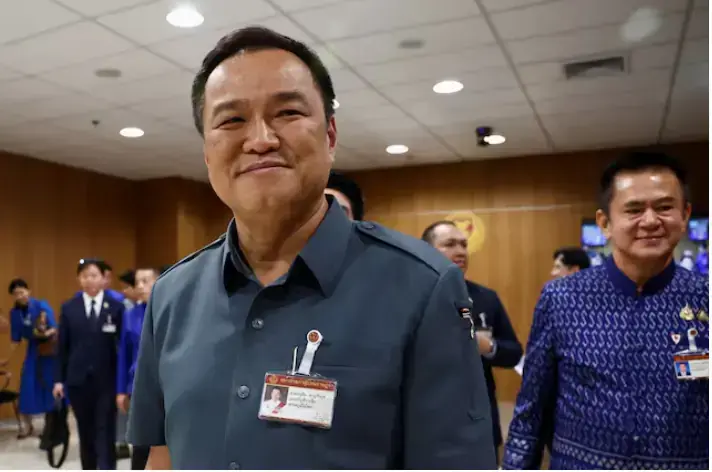

BANGKOK: Thailand’s conservative prime minister claimed victory in the country’s general election Sunday, after television stations projected his party would be by far the largest in parliament after riding a wave of nationalism.
“We are likely to take first place in the election,” Anutin Charnvirakul told reporters at his party headquarters in Bangkok.
“The victory today belongs to all Thais, no matter whether you voted for us or not.”
His Bhumjaithai party was forecast to win nearly 200 seats by Channel 3 on the basis of results from the parties. The progressive People’s Party trailed far behind, just above 100 seats, ahead of jailed former prime minister Thaksin Shinawatra’s Pheu Thai party in third.
It would be a stunning turnaround for Anutin, whose party came third at the last election and who was only installed as prime minister by parliament in September, after two predecessors from Pheu Thai were ousted by the courts. Conceding defeat, People’s Party leader Natthaphong Ruengpanyawut told reporters in Bangkok that “we stand by our principle of respecting the party that finishes first and its right to form the government”.
Foremost on many voters’ minds was a longstanding border dispute with Cambodia that erupted into deadly fighting twice last year.
“We need a strong leader who can protect our sovereignty,” said Yuernyong Loonboot, 64, the first voter to cast his ballot at a polling station in Buriram, Anutin’s hometown.
“Living here, the border conflict has made me anxious. War was never something we used to think about.”
Soon after taking office, Anutin authorised the armed forces to take whatever action they saw fit on the border, without referring to the government first.
Thailand’s military took control of some disputed areas in the latest fighting in December, and a ceasefire is now in place.
“Nationalism is in the heart of everybody in the Bhumjaithai party,” said Anutin, heir to a construction fortune and an amateur jet pilot who championed the legalisation of cannabis.
“You can look at the colour,” he added, referring to the blue of his party and the Thai national flag. Political analyst Titipol Phakdeew-anich of Ubon Ratchathani University told AFP that Bhumjaithai had exceeded expectations in the election by embracing nationalism.
“They presented themselves as supportive of the military and the royalty,” he said. “They represented a notion of ‘Thainess’ that had a significant impact on voters.”
The Southeast Asian nation’s next government will also need to contend with anaemic economic growth — the tourism sector is vital but arrivals are yet to return to their pre-Covid highs — and the multibillion-dollar transnational cyberscam networks operating from several neighbouring countries.
While Bhumjaithai looked unlikely to secure an overall majority in the 500-seat lower house, its seat share would give it the upper hand in coalition negotiations.
Thailand uses a mixed representation system, where 400 MPs are elected by individual constituencies, and 100 are allocated according to a separate ballot for party lists.




















Comments
Comments are closed for this article.