


Gul Plaza, we will remember you
- Karachi’s commercial buildings reflect a wider malaise: unauthorised expansion and encroachment masquerading as entrepreneurial zeal
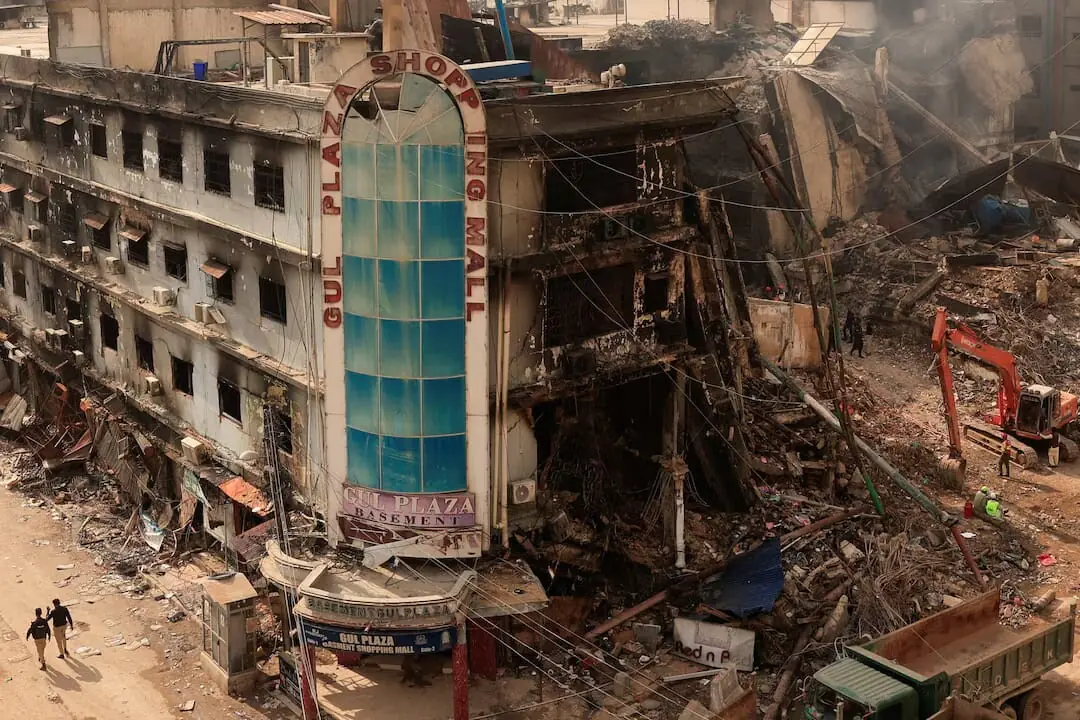

Karachi is still reeling from the catastrophic loss of life in the Gul Plaza incident. The city has seen tragedy before, but there was something horrific about this. There was something about what unfolded after the event that touched all of our hearts. It wasn’t just that the plaza was an institution or that it had hosted almost all of us. There was more. And we were at a loss to explain.
Karachi has always been strong, its residents have even more resilience than sometimes needed. But the Gul Plaza incident broke us, stopped us in our tracks, and forced us to reflect. Perhaps, the smoke ironically gave us clarity.
As the fire spread, tragedy unfolded and we all got angry. It is here where voices started to unite. They expressed sadness. It was in response to the collective failure of this city’s administration that put a diverse and divided Karachi together.
This was an inferno that took over 40 hours to bring under control, collapsing the structure like it was made of matchsticks and claimed countless lives, affecting thousands others.
So why was this event so different?
Roam around the streets of Karachi and you will find why this city is described as among the most unlivable in the world. Add the city’s structural and administrative issues, failures that are rooted in regulation, enforcement, civic will, and human dignity. The remaining comes from our exuberance and flirtations with danger and the very touting of how we overlook basis SOPs, the apathy of enforcing departments, and the dictatorship of small associations in controlling the flow of movement.
According to Chief Fire Officer, Humayun Khan, Karachi’s population of over 22 million is served by only 28 fire stations. That is one fire station serving just around 800,000 people
But the worst, perhaps, was the manner in which the government responded. In a short video, which obviously went viral, Karachi’s mayor – if he can be termed that – said that the city’s functioning rests on a lot of departments whose names the residents have never heard of. He was mentioning federal institutions that are responsible for development work in the city. This came after he had said in another incident that those voicing concerns after the Gul Plaza incident are playing politics. What are you doing, Mr Mayor, as you bring in federal institutions? Let’s keep that aside.
Let’s instead dive into the world that Sindh is and where Karachi sits. The primary onus of buildings and their controls rests with the Sindh Building Control Authority (SBCA) as the name suggests; it is responsible for ensuring regulatory requirements were met for safety and construction quality. Records obtained by the media reveal that the number of shops constructed in Gul Plaza exceeded those approved in the original building plan. Some shops were built on corridors and designated exit routes, potentially obstructing emergency evacuation. The real question is how this escaped their notice for so long. Obviously, it didn’t. They just didn’t care.
Not more than 6 months ago, a fire at Millennium Mall in Gulistan-e-Johar became a near-disaster in its own right
More disturbing was the structural integrity of the building. The SBCA is responsible for auditing the building during the construction phase to ensure that pillar strength and the rebar used is aligned with the specifications laid out by their engineer at the time of the building plan’s approval; steps which if followed would not have resulted in the loss of life being faced. They just didn’t care.
The SBCA’s recent ultimatum on fire-safety systems comes only after bodies were still being pulled from the rubble. Where were the mandatory fire suppression systems? The certified evacuation routes? Regular inspections? Legal codes that exist on paper – but enforcement has been sporadic, corruptible, and reactive at best. Architectural safety is only as strong as regulatory teeth – and Karachi’s have long been rusted. They just didn’t care.
Equally responsible are the trade association union members elected for this market. Annual maintenance fees was collected, yet no visible investment into life-safety infrastructure occurred. We see them voicing the loss of outrage – where was this voice when it came to implementing the protocols to prevent this? There were no exit signs, no fire safety equipment, and the exits themselves were narrower than the specified conditions. Conditions which would fail any basic fire-safety audit in modern building codes. They just didn’t care.
The travesty is further impounded as it was a failure to learn from lessons. Not more than 6 months ago, a fire at Millennium Mall in Gulistan-e-Johar became a near-disaster in its own right. Flames consumed hundreds of shops, properties worth millions were lost. Miraculously there were no reported casualties. Miraculous, because it was luck over design that led to no casualties. No robust fire control system saved Millennium Mall — it was absence of occupants, not compliance, that prevented deaths. Moreover, in the statement shared by Rescue 1122 at that time said, “The rescue operation faced challenges due to the intensity of the smoke and the lack of an uninterrupted water supply.” They just didn’t care.
Then comes Sindh’s energy department, which proudly states on its website that the main functions of Electric Inspectorates are to implement the Electricity Act 1910 and Electricity Rules 1937. The major responsibilities of the Electric Inspectorate are: to conduct initial and periodical Inspections of Electrical Installations under Rule-5 (I) of Electricity Rules 1937, framed under Section 37 of Electricity Act 1910; to conduct the examination for competency certificates of wireman and Electrical Supervisor.
Please pray tell how many buildings would fail this inspection. Please pray tell if anyone has even heard of Sindh’s energy department and the electrical inspection done by it. Those who know know. Mr Mayor, if you want to ask the question of how many know which federal institute is responsible for delayed projects in Karachi and that no one knows these departments exist, perhaps, it is a good idea to divulge Sindh’s functions as well.
The system is woefully under-equipped and not because of budgetary constraints. VIP protocols are the single largest feature of how rich Pakistan is.
According to Chief Fire Officer, Humayun Khan, Karachi’s population of over 22 million is served by only 28 fire stations. That is one fire station serving just around 800,000 people. In contrast, Delhi has close to 150 stations for a population of 33 million, Mumbai: 85 stations for a population of close to 21 million, Dhaka: 41 stations for a population of 22 million while Beijing has over 100 fire stations for a similarly sized population. The divide is self-explanatory.
Karachi’s commercial buildings reflect a wider malaise: unauthorised expansion and encroachment masquerading as entrepreneurial zeal. Shop owners, driven by profit and lax enforcement, have turned corridors into storerooms, blocked stairways with inventory, and obliterated safety zones. Encroachment isn’t just frictional encroachment onto pavement – it’s structural theft of escape routes. A building is defined as much by its empty space as its built form. Corridors, stairwells, fire exits, lobby spaces – these are safety infrastructure just as essential as beams and walls. Gul Plaza’s interior was a death trap precisely because that regulation was abandoned.
Perhaps, Karachi will remain abandoned. The long-lost son that needs to fulfil all responsibility and makes sacrifices for the entire family.
The writer is an economist with nearly 20 years of experience, and has an interest in Pakistan’s stock market, energy and auto sectors




















Comments
Comments are closed for this article.