



One of Pakistan’s many standing commitmentsto the IMF is to “refrain from signing additional external RLNG contracts”.
Pakistan’s RLNG journey has come a full circle in four years. From prime time shows to hard-hitting opinion pieces on the then government’s “callous” approach in setting up another LNG terminal to now the government subtly terming what it calls “improved RLNG surplus coordination” a “foundational reform”.
How RLNG in Pakistan became almost a national embarrassment in such a short span is for another day. For now, let us simplify to say it all happened due to a complete breakdown of corordination between planners in power and petroleum divisions. Everything else is noise.
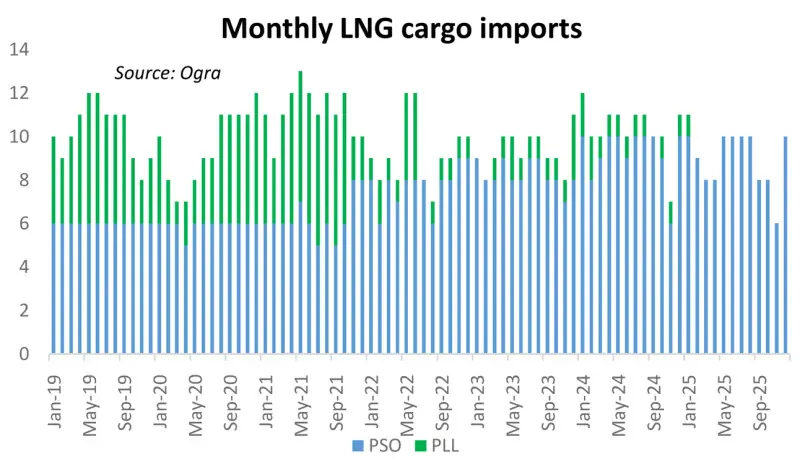
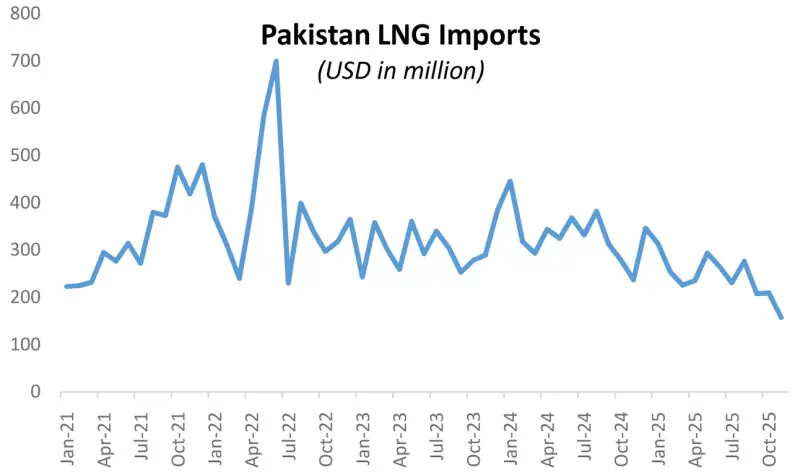
Pakistan’s November 2025 LNG imports at $157 million are the lowest for any month – either side of the Covid quarters in 2020. With the focus now shifting to the newly-coined “foundational reform” –November numbers may now become more of a norm, at prevailing prices.What the numbers also reveal is that this is not merely a price story; it is fundamentally a volume story. LNG import values have been grinding lower for well over a year, not because delivered prices collapsed overnight, but because Pakistan is simply lifting less cargo.
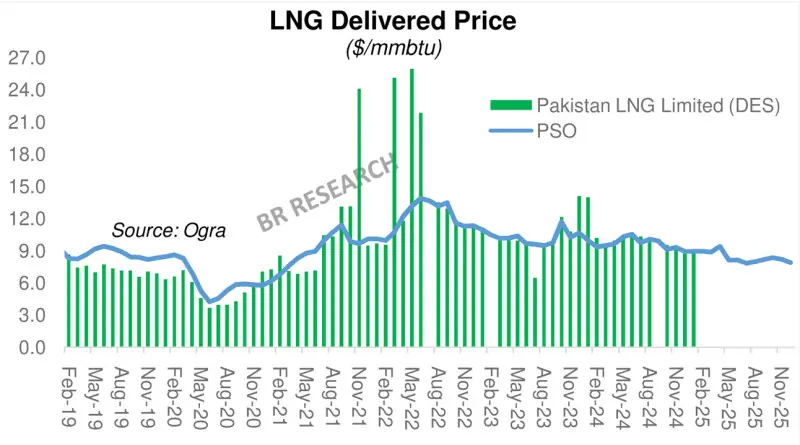
Even when delivered LNG prices briefly firmed up in early 2024, imports failed to respond in any meaningful way.
The system no longer has the elasticity it once did. Power demand remains depressed, industrial offtake is shifting back to grid, and RLNG dispatch keeps getting squeezed out by a combination of surplus capacity, cheaper alternatives, and chronic planning inertia.
Equally telling is the absence of panic in pricing. The delivered price curve shows volatility has compressed sharply compared to the 2022 blowout, when prices spiked into the mid-$20s per mmbtu and forced emergency decisions across the energy chain.
Today, even geopolitical noise and supply-side posturing struggle to generate sustained price premiums. Global LNG markets are softer, supply is more forgiving, and buyers are more disciplined. Pakistan, for once, is a price taker in a benign market rather than a desperate bidder in a tight one.
For Pakistan, this relative calm could not have arrived at a better time. Softer LNG prices are reinforcing a broader downtrend in imported fuel costs, keeping RLNG, coal, and oil-linked generation benchmarks under pressure. That offers temporary fiscal and tariff relief to a power system buckling under circular debt and idle capacity. But it also sharpens the policy test.
Cheaper fuel should not be confused with reform. Without fixing demand forecasting, fuel prioritization, and cross-sector coordination, today’s “foundational reform” risks becoming tomorrow’s footnote in yet another avoidable energy misadventure.


























Comments
Comments are closed for this article.