


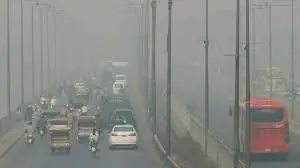
EDITORIAL: If the Pakistan Air Quality Initiative (PAQI) emissions data mapping pollution across Karachi, Lahore, Islamabad-Rawalpindi and Peshawar is accurate, it demands an urgent rethink of how Pakistan manages its air. If it is not, it deserves to be challenged with stronger evidence rather than politically convenient dismissal. The Punjab government’s decision to cast doubts on the findings immediately after publication makes a clear opening question unavoidable: is the data wrong, or is the state simply unwilling to confront what it reveals?
The report’s central claim is straightforward. Pakistan’s air pollution is not a single national haze, it is a cluster of local emergencies driven by local economies. Lahore’s smog is attributed to a mix of transport, heavy industry and a dense ring of brick kilns. Karachi’s burden is described as overwhelmingly industrial, with almost half of its fine particulate matter traced to factories and port activity. In Islamabad and Rawalpindi, the problem is framed as one of urban design and congestion, with transport the dominant source. Peshawar’s valley geography, layered with transit trade and traditional industry, is said to create the highest per capita pollution burden in the country. The message is that each city’s “economic DNA” produces a different emissions fingerprint, and that policy must respond accordingly.
Methodologically, the study relies on satellite-derived aerosol data, chemical transport modelling and PAQI’s own monitoring network. Its authors use this to argue that smog is overwhelmingly generated within Pakistan’s own airsheds. They also highlight household air pollution from biomass fuels in rural kitchens and the open burning of waste and crop residue as severe but under-measured contributors. The conclusion is blunt. The crisis is local and structural, and the barrier is no longer a lack of evidence but a lack of will.
This is where the governance gap becomes impossible to ignore. One of the authors describes “uniform bans and seasonal theatrics” as the dominant national response. That phrase captures years of ad hoc decisions, from sporadic school closures to short-lived clampdowns, that treat smog as a temporary nuisance rather than a permanent public health emergency. If the emissions profile really does vary so sharply by city, then blanket measures will always be inadequate. Karachi’s industrial belt, Lahore’s kilns and transport, Islamabad’s congestion and Peshawar’s geography cannot be managed with identical, time-bound orders issued each winter.
The Punjab EPA’s reaction points to a deeper institutional discomfort with this kind of analysis. The agency has rejected the findings, questioned PAQI’s data on vehicles and kilns, and once again pointed across the border, blaming India for Lahore’s pollution. At the same time, it insists that billions are being spent on emission control and that most industry has installed equipment. Yet it’s also reported that a separate Urban Unit study last year identified transport as a key polluter. When independent datasets and models are dismissed out of hand, and when responsibility is shifted outward rather than inward, it becomes harder to build any kind of coherent policy response.
None of this is an argument for accepting PAQI’s inventory uncritically. Emissions mapping is technically complex; and any model can and should be interrogated. If the government believes the data is flawed, it should commission its own transparent, peer-reviewed work using clear methodologies and make the results public. What it cannot afford to do is treat serious, quantified analysis as an irritant. Pakistan’s cities and many rural districts are living with particle and gas concentrations described in the report as high enough to breed disease, shorten lives and sap productivity. That ought to be the starting point for policy, not an afterthought.
The report itself suggests practical interventions that align with global experience: empowering the public with timely air quality information, closing governance gaps in enforcement, targeting super-emitters, transitioning to cleaner fuels and gradually electrifying the two and three wheelers that dominate urban mobility. None of these ideas is radical. All of them require the state to move from seasonal shows of concern to sustained, sector-specific regulation.
At this stage, the real test is not whether every percentage in the PAQI inventory survives scrutiny. It is whether the state is prepared to treat air pollution as a structural governance challenge rather than a passing weather event. That begins with answering a simple question at the highest level: are we willing to let rigorous data, even when uncomfortable, shape policy, or will we continue to rely on uniform bans and theatrics while the air gets harder to breathe?
Copyright Business Recorder, 2025

























Comments
Comments are closed for this article.