


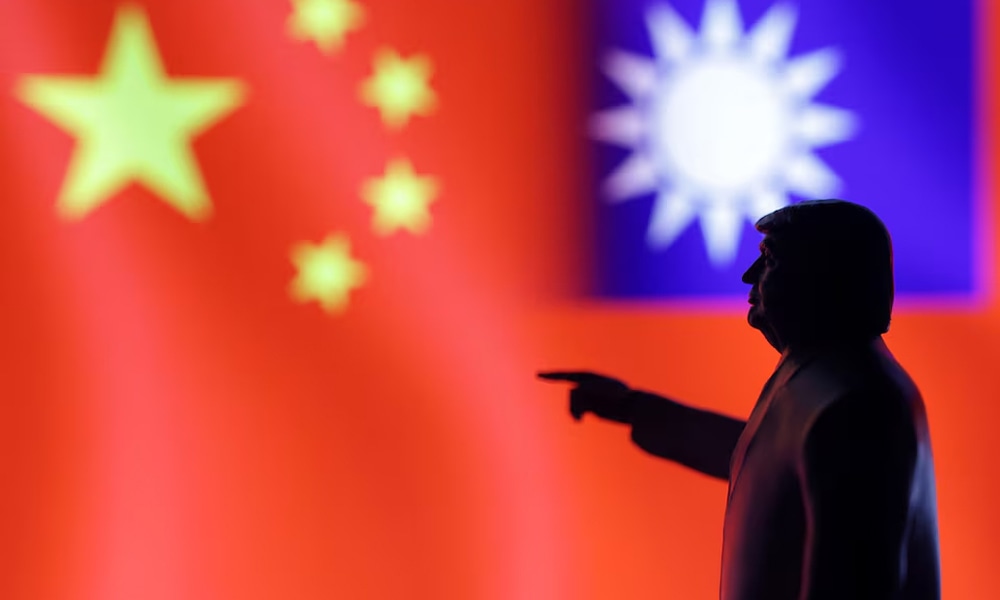

WASHINGTON: President Donald Trump aims to prevent conflict with China over Taiwan and the South China Sea by building up U.S. and allies' military power, according to a new U.S. strategy document.
The Trump administration laid out its approach to one of the world's most sensitive diplomatic issues in an official National Security Strategy document, released on Friday. It comes as Beijing ratchets up pressure on democratically governed Taiwan and Japan, deploying vessels across East Asian waters this week in its largest maritime show of force to date.
"Deterring a conflict over Taiwan, ideally by preserving military overmatch, is a priority," said the document, a periodically updated vision statement from the administration to Congress and the first since Trump took office in January.
China views Taiwan as its own, and Beijing has never renounced the use of force to bring Taiwan under its control. China also has vast regional claims, including almost the entire South China Sea, which are disputed by many of its smaller neighbors.
US confirms sale of $700mn air defence missile system to Taiwan
The United States has no formal diplomatic ties with Taiwan but Washington is the island's most important international backer and is required by law to provide Taiwan with the means to defend itself. The issue has been an irritant in U.S.-China relations for years.
The document's language on Taiwan is stronger than the national security strategy produced during Trump's first term in office. The document in 2017 mentioned Taiwan three times in a single sentence, echoing longstanding diplomatic language.
The updated strategy, however, mentions Taiwan eight times across three paragraphs and concludes that "there is, rightly, much focus on Taiwan" because of its strategic location in trade-rich waters and dominance in semiconductor manufacturing.
"We will build a military capable of denying aggression anywhere," in the chain of islands stretching from Japan to Southeast Asia, said the latest document. "But the American military cannot, and should not have to, do this alone. Our allies must step up and spend - and more importantly do - much more for collective defense."
That will reinforce "U.S. and allies' capacity to deny any attempt to seize Taiwan" or any other steps that would "make defending that island impossible," the report said. Closer ties with China
Trump, a Republican, has largely avoided directly saying how he would respond to a rise in tensions over the island. His Democratic predecessor, Joe Biden, said repeatedly during his 2021-2025 term in office that the U.S. would defend Taiwan if China invaded.
Trump's penchant for dealmaking and effort to seek closer ties with Chinese President Xi Jinping have kindled fears in the region of weakening U.S. support for Taiwan and regional allies from Tokyo to Manila. Trump plans to travel to Beijing in April, where the leaders will discuss extending the truce in their trade war.
Last month, Japanese Prime Minister Sanae Takaichi drew Beijing's wrath when she told parliament that a hypothetical Chinese attack on Taiwan that threatened Japan could justify a military response. Trump privately asked Takaichi not to escalate the dispute with China, Reuters previously reported.
But Trump also signed a new law requiring his administration to regularly review how it interacts with Taipei. It also approved the sale of fighter jet and other aircraft parts to Taiwan for $330 million. Both were seen as signs of support by Taiwan. Trump has also pressed Japan and South Korea, two key regional allies, to hike defense spending.


























Comments
Comments are closed for this article.