


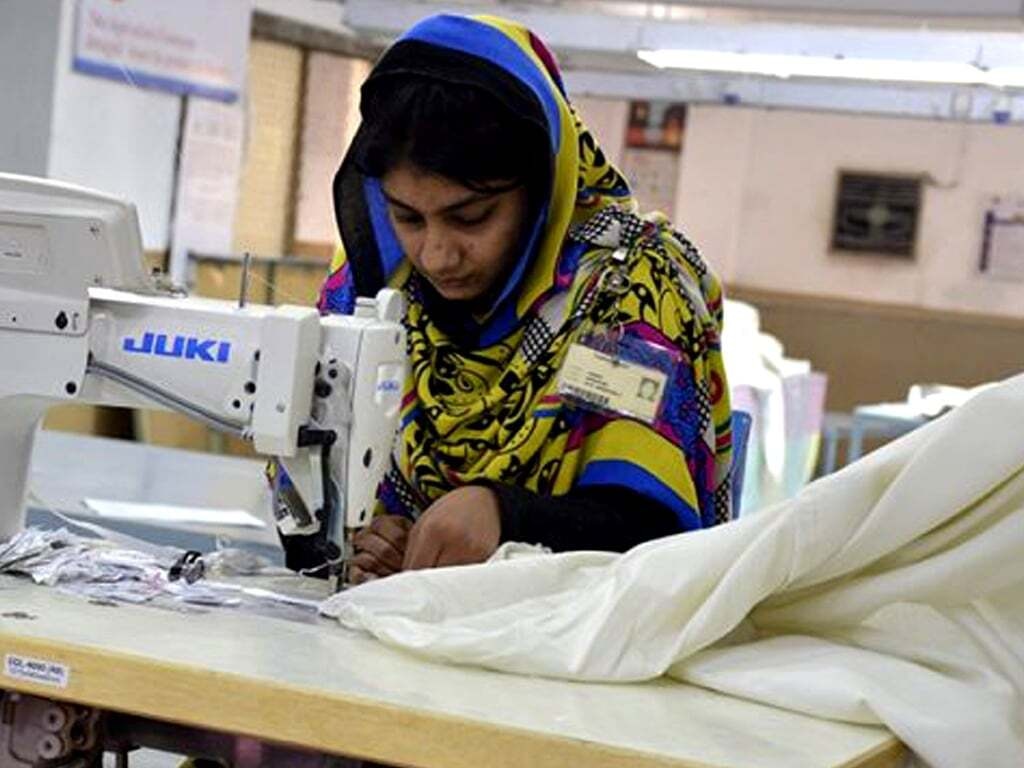

ISLAMABAD: In a decisive stride toward redefining Pakistan’s economic future, the government has announced the country’s first-ever National Women Entrepreneurship Policy (NWEP), positioning women at the centre of industrial growth and economic transformation.
The announcement came during a ceremony marking Women’s Entrepreneurship Day, jointly organised by Small and Medium Enterprise Development Authority (SMEDA) and The Federation of Pakistan Chambers of Commerce and Industry (FPCCI) here on Wednesday. The event brought together more than 21 Women Chambers of Commerce and Industry from across Pakistan, which was described as one of the largest congregations of women business leaders.
Addressing the ceremony and later speaking to the media at FPCCI headquarters, Special Assistant to the Prime Minister on Industries (SAMP) on Industries Production, Haroon Akhtar Khan, said the story of women’s entrepreneurship in Pakistan is not one of struggle alone, but of reinvention and silent revolution. “Opportunities were not awaited—they were created,” he remarked, adding that women are no longer seeking assistance but demanding fairness, not waiting to be included but actively reshaping the country’s economic narrative. He noted that Pakistani women, from home-based innovators to global exporters, are steadily shifting from facilitation beneficiaries to decision-makers, proving that constraints can be recast as catalysts.
Khan revealed that economic facilitation measures are projected to exceed USD 40 billion in 2025, and the outcome could be much higher if Pakistan secures additional trade access in at least 25 more markets. He credited the inclusion-oriented economic agenda of Prime Minister Shehbaz Sharif for accelerating this transition and shared that the policy was developed through the Economic Implementation Cell, underscoring the government’s openness to innovative planning.
He said that many of Pakistan’s successful industries began as small, informal ventures without formal financial assistance, establishing that entrepreneurial resolve has of ten outpaced structured support mechanisms. “The time has come to move beyond assistance—to entrust women with leadership,” he said. “No nation can realise its full potential unless its women progress with it. Pakistan is now becoming a place where every woman will have the opportunity to turn an idea into an enterprise. “The National Women Entrepreneurship Policy is designed to strengthen economic participation by improving access to finance, reducing regulatory hurdles, expanding digital connectivity and market linkages, and promoting social inclusion. It envisions a business environment where women-owned enterprises can evolve from survival concepts to strategic industry players.
The policy also aims to address disparities in technology use, provide dedicated financing through both federal and provincial channels, encourage banks to design gender-responsive financial products, and push for the implementation of equality-led policies by financial regulators. Greater participation in export markets is encouraged through simplified access to exhibition platforms, digital trade gateways, and integration of women-led businesses into international trade delegations. Institutional coordination, a long-standing challenge due to overlapping mandates, will be centralised with SMEDA nominated as the nodal body to ensure cohesive implementation over a period of five years.
Among the initiatives already under way is an AI-enabled Women Entrepreneurship Portal developed with FCDO support, serving as a central ecosystem for mentorship, regulatory access and business facilitation. A USD2.2 million Women Inclusive Finance Program, backed by the Asian Development Bank, is providing innovative solutions, including digital training for women using non-smart phone technologies, reintegration support for homemakers, and entrepreneurship development in rural communities.
There are also plans to build design support cells in collaboration with top textile and fashion institutions, launch dedicated incubation spaces in technology parks, and introduce green financing and circular economy models to strengthen eco-conscious business practices.
JICA-supported booster packages will further assist women through business pre-incubation, scaling support and supply chain integration.
Acting CEO of SMED, Nadia J Seth reiterated the government’s commitment to enabling women through skills development, SME financing and institutional partnerships, stating that the real shift comes from building supportive frameworks rather than occasional facilitation.
The event gathered prominent business leaders, including FPCCI Vice President Qurat-ul-Ain, Tariq Jadoon, Chairman Capital Office, Karim Aziz Malik and Hafizabad Chamber President Malik Sohail Hussain, signalling determined support from both public and private sectors.
Copyright Business Recorder, 2025

























Comments
Comments are closed for this article.