


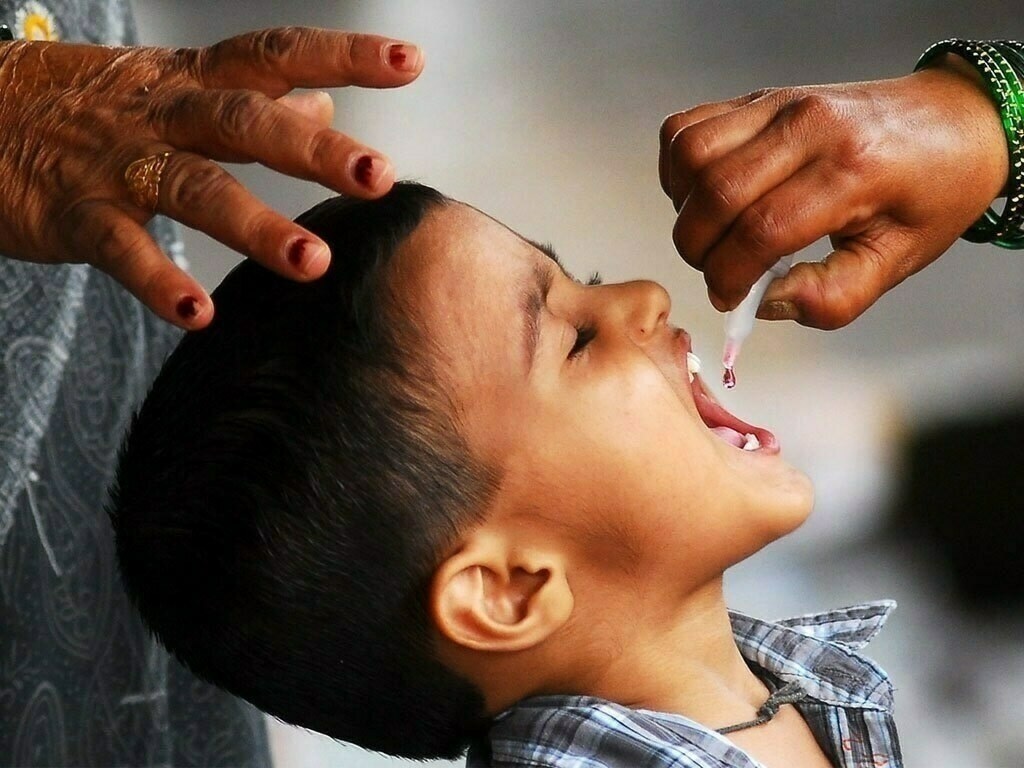

October 24 (today) is observed every year as the World Polio Day which assumes greater significance for Pakistan because it is one of the only two countries left in the world where the devastating of poliomyelitis still exists. The other country is Afghanistan.
Poliomyelitis, or Polio in short, is an infectious disease caused by the poliovirus. It primarily affects children under the age of five. But it can also infect an unvaccinated person of any age. The poliovirus attacks the nervous system and can cause total paralysis in a matter of a few hours. Irreversible paralysis, usually of the leg, occurs in about one in 200 cases. And among those paralyzed, 5 to 10 percent die when breathing muscles become immobilized.
No cure for polio has been discovered yet. But fortunately, it can be prevented through vaccination, which needs to be during Routine Immunization, which is at birth, then six weeks, 10 week and 14 weeks. Due to low Routine Immunization in most parts of the country, we need to administer polio vaccine drops multiple times, which offers protection and builds immunity against the polio virus.
Polio has perhaps existed for thousands of years, although it was recognized as a virus-caused contagious disease only in the past 100 years or so. Until about the mid-1980s, polio was prevalent throughout the world, even though the first polio vaccine was developed in 1955.
As global vaccination vastly increased, the incidence of wild poliovirus decreased by over 99 percent since 1988, from an estimated 350,000 cases in more than 125 countries, to two endemic countries at the moment-Afghanistan and Pakistan. The global war against polio has been led from the start by Rotary International, a global, not-for-profit humanitarian organization, which is 120 years old this year.
The virus is spread mainly through the oral-faecal route or, through contaminated water or food, multiplying rapidly in the intestine.
In 1985, Rotary had launched a global effort for immunization of the world’s children. World Polio Day was first observed by Rotary International on October 24, 1985, to commemorate the birthday of Dr. Jonas Salk, the scientist who developed the first effective polio vaccine in 1955. And that is how World Polio Day came about.
After this, the Global Polio Eradication Initiative (GPEI) was established in 1988 with Rotary as a founding partner, alongside WHO, UNICEF, the US CDC, and later the Bill & Melinda Gates Foundation.
Since then, Rotary has contributed more than USD3 billion towards polio eradication worldwide and over USD 500 million in Pakistan alone. Today, 2.5 billion children have been immunized against polio thanks to the cooperation of more than 200 countries and 20 million volunteers.
The Pakistan National PolioPlus Committee has established Resource centers to bond with the community, water filtration plants to provide clean drinking water in backward communities, team support centers to provide space for front line workers and Permanent Transit Posts at all cross border check-posts, airports, bus stops and railway stations, across the country. These projects provide coverage for missed children, refusals and nomadic transit populations who are missed during polio campaigns. Rotary has provided funds to make 200,000 vaccine carriers for Pakistan.
And today we are very close to eradicating a disease globally from our planet. When this happens, it will be only the second time in human history that a disease has been forever eliminated. The first time was when smallpox was eradicated in 1980.
Pakistan continues to report wild poliovirus cases, with 74 cases recorded in 2024 but the figure has gone down to one third this year, reflecting progress in containing the spread of disease. These are primarily in high-risk districts of Sindh and Khyber Pakhtunkhwa. Karachi remains a critical battleground also. Conflict, illiteracy, migration patterns and disinformation have been persistent challenges. The solution lies in unyielding political will, community engagement, and the unwavering efforts of organizations like Rotary.
The Pakistan Polio Eradication Programme, supported by Rotary and GPEI partners, is one of the most extensive public health campaigns in the world. More than 339,000 health workers, many of them women, go door-to-door across Pakistan to ensure that every child under five is immunized.
World Polio Day is also a call to honour the tireless vaccinators working in some of the most difficult conditions. Several have laid down their lives for the cause, as have many law enforcement personnel, protecting them on duty.
The final steps are always the hardest, but history will remember those who refused to give up. Eradication will be a victory for humanity; proof that collective action, global solidarity, and the simple act of caring for children can change the course of history. And as Rotarians, we take pride in knowing that polio eradication is Rotary’s gift to the world, and it is within our grasp to make it permanent.
Copyright Business Recorder, 2025
The writer is National Chair of Pakistan PolioPlus Committee and Member, International PolioPlus Committee

























Comments
Comments are closed for this article.