




Pakistan is in the process of formulating a National Health and Population Policy (2025–2034) with an emphasis on integrating health and population services, addressing emerging challenges such as climate change and non-communicable diseases, and strengthening primary healthcare delivery.
The policy also seeks to increase health financing, promote resilience and equity in the health system, and, above all, confront the challenge of rapid population growth. A key proposal under consideration is the establishment of a Family Planning Commission as the apex body, to be chaired by the Prime Minister of Pakistan and to include the chief ministers of all the four provinces.
Meanwhile, the Prime Minister has established a committee, headed by the Federal Minister for Planning, Development, and Special Initiatives, to recommend measures to check the uncontrolled increase in population.
Although a draft of the policy has not yet been released, the approach appears to include a review of the National Action Plan on Population (2025–30), which defines specific targets for contraceptive prevalence, fertility, and population growth rates.
The National Action Plan, prepared by the Ministry of National Health Services, Regulation and Coordination, sets ambitious but essential goals: raising the contraceptive prevalence rate to 60 percent, reducing the total fertility rate to 2.2, and bringing down the population growth rate to 1.1 percent by 2030.
To achieve this, the strategy envisions federal and provincial task forces, an expansion of family planning services, and significantly higher budgetary allocations. Declared a matter of national emergency, these measures are also aligned with Pakistan’s international commitments under “FP2030” (Family Planning 2030).
A rapid demographic surge
Pakistan today ranks among the most populous nations in the world. According to the U.S. Census Bureau’s 2025 report, India leads with 1,419 million people, followed by China with 1,407 million, the United States with 342 million, Indonesia with 283 million, and Pakistan with 257 million—placing it fifth globally, ahead of many wealthier nations with far greater resources.
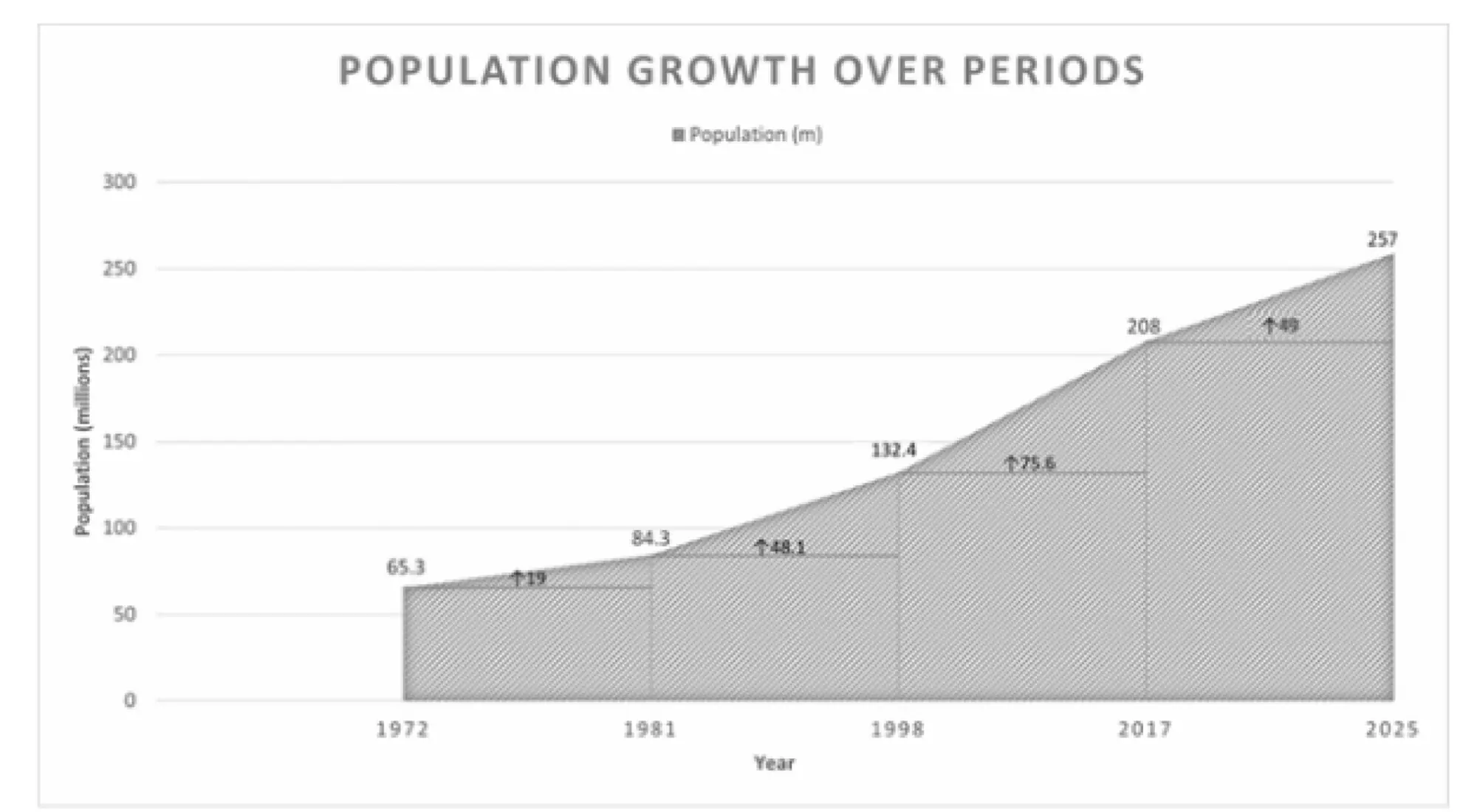
The pace of population growth has been staggering. In 1972, Pakistan’s population was 65 million; it rose to 84 million by 1981, 132 million in 1998, 208 million in 2017, and is projected to reach 257 million in 2025. This means that in just 53 years, nearly 192 million people have been added, almost quadrupling the population. Looking ahead, the United Nations (UN) projects that by 2050, Pakistan could reach 450 million people—significantly higher than the government’s own estimate of 386 million.
Notes:
Population figures for Pakistan from the 1972, 1981, 1998, and 2017 censuses, along with the U.S. Census Bureau estimate for 2025.
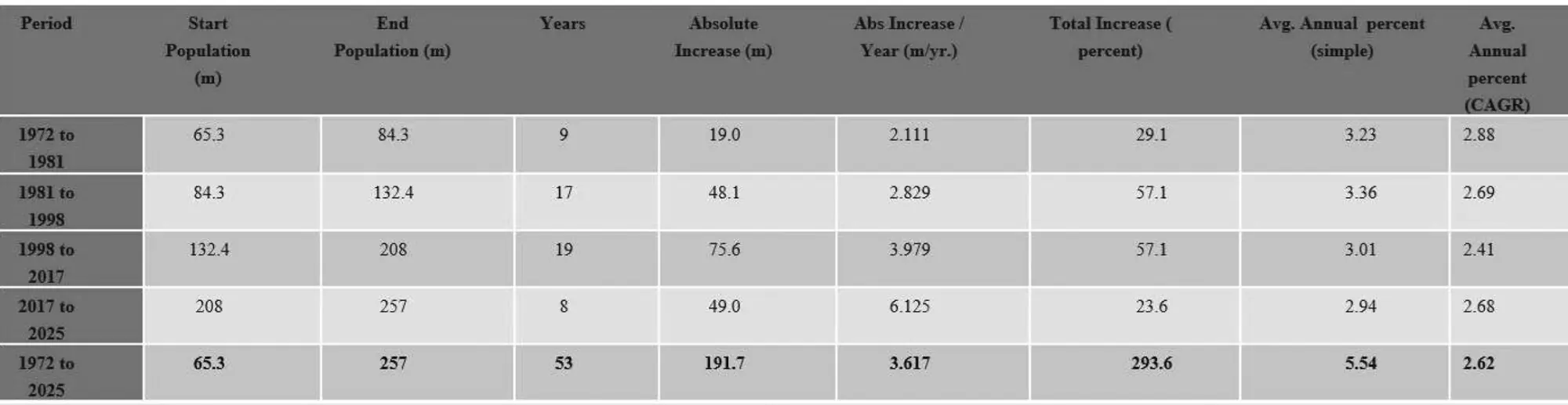
Average Annual percent (CAGR) = the standard “annual growth rate” used in demography.
These figures acquire added gravity when viewed against Pakistan’s fragile socio-economic backdrop. With persistent poverty, limited job creation, and sluggish economic growth, a rapidly expanding population depresses GDP per capita and entrenches poverty. Already, resources such as food, water, energy, housing, health, and education are stretched thin, and growing demographic burden only deepens the crisis.
Missed demographic dividend
Unlike China, which harnessed its population boom into building a productive workforce that fueled industrial growth and innovation, Pakistan has failed to turn its demographic surge into economic strength. Weak governance, inadequate family planning, and lack of political commitment have squandered what could have been a powerful demographic dividend.
Pakistan’s population planning efforts are directly tied to the Sustainable Development Goals (SDGs), which focus on ensuring universal access to sexual and reproductive health-care services, information, education, and reproductive rights by 2030. Sadly, Pakistan’s progress on population planning SDGs is currently insufficient, to say the least.
The contrast with other Muslim-majority countries is striking. Indonesia and Bangladesh, despite their own challenges, have achieved substantial control over population growth through consistent and community-based family planning. Bangladesh, the eighth most populous country, has reduced its annual growth rate to 1.2 percent compared to Pakistan’s 2.6 percent.
Indonesia has lowered its growth to 0.8 percent. Their economic outcomes reflect this success: GDP per capita in Indonesia is USD 4,925 and in Bangladesh USD 2,593, compared to only USD 1,581 in Pakistan. In terms of per capita incomes, Indonesia stands at USD 3,189, Bangladesh at USD 2,159, while Pakistan lags at USD 1,470.
This divergence highlights how effective population management translates into stronger economies and higher living standards. Both Indonesia and Bangladesh relied on widespread public education, community involvement, free contraceptive distribution, and religious endorsement to shift social attitudes toward smaller families. Bangladesh, in particular, is often cited by the World Bank (WB) as a model Pakistan could emulate.
The crisis is not just about numbers. Pakistan’s human capital index measuring health, education, and productivity remains among the lowest in the world, comparable to Sub-Sahara African countries. Despite having a young population, Pakistan invests too little in education, healthcare, and skills development. Recent climate disasters, such as the 2022 and 2025 floods, further revealed the fragility of this foundation, showing how millions remain vulnerable to poverty and displacement.
A clear choice for Pakistan’s future
Pakistan now stands at a critical tipping point. If current trends persist, the country will be home to nearly half a billion people by mid-century, straining already weak institutions and scarce resources.
High population growth is not merely a demographic concern; it is the underlying cause of poverty, unemployment, food insecurity, and economic stagnation. Family planning must therefore be treated as the highest national priority, backed by political resolve, sustainable funding, and effective execution. Without such action, Pakistan risks locking future generations into poverty and instability.
The lessons from Indonesia and Bangladesh are unambiguous: population growth can be brought under control, and economic progress can follow. Pakistan cannot afford to waste any more time. The choice before the country is stark and urgent: act decisively to harness its human potential or face an unsustainable demographic explosion that will cripple the economy and society for decades to come.
Copyright Business Recorder, 2025
The writer is retired Chairman of the State Engineering Corporation and former Chairman of the Institution of Engineers, Pakistan




















Comments
Comments are closed for this article.